Book summary
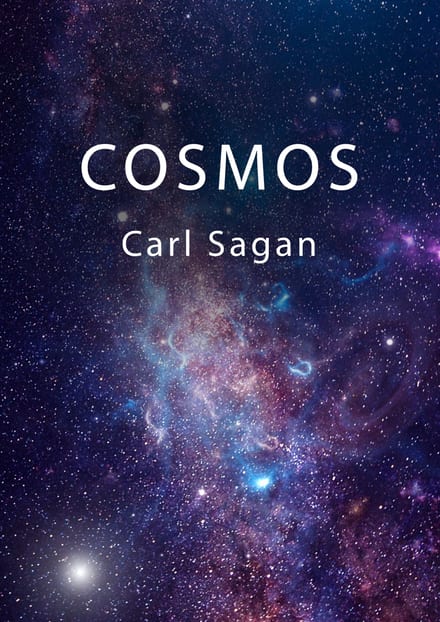
Cosmos
The full book runs ~354 pages — roughly 6 hours of reading. You get the key ideas here in 5 minutes.
The key ideas
- Forged in stars, every atom in you came from stellar death
- Shared DNA unites all Earth life from one origin
- Science replaced myth from Ionia through Copernicus to Einstein
- Venus and Mars warn us about planetary fate
- Light speed makes interstellar travel and contact extraordinarily hard
- Cooperation, not aggression, decides whether humanity survives itself
The summary
Every atom in your body was forged inside a dying star. The carbon in your cells, the oxygen in your blood, the iron, the gold—every element heavier than hydrogen was cooked up by nuclear fusion in a stellar core and flung across space when that star died. As Carl Sagan liked to say, “If you wish to make an apple pie from scratch, you must first invent the universe.” This is not poetry dressed up as science; it’s the literal chain of custody of your atoms. And once you feel the weight of it, Sagan’s central point follows: on a speck this small, in a cosmos this vast, we are the only known place where the universe has woken up and begun to look at itself. That makes us worth protecting.
The scale is almost impossible to hold in mind. Earth is one planet circling one star among a hundred billion in our galaxy, which is one of a hundred billion galaxies. We are, Sagan wrote, “like butterflies who flutter for a day and think it is forever.” His answer to that smallness is not despair but care.
One family of life, maybe on countless worlds
All life on Earth traces back to a single microscopic ancestor, shaped over billions of years by natural selection—mutations that helped an organism survive got passed on, and complexity accumulated. Under the staggering diversity there’s a hidden unity: every living thing runs on the same molecular machinery, the same DNA and proteins, which points to that common origin.
What makes this cosmic rather than merely biological is that the raw ingredients are cheap. Recreate the conditions of early Earth in a lab and the building blocks of life assemble on their own. Since those conditions are ordinary across the universe, life may have sparked on countless other worlds. But don’t expect it to look like us. Evolution is a game of chance played across an unimaginable number of genetic possibilities, so alien life could be something as strange as a gas-based entity. The Drake equation tries to estimate how many advanced civilizations share our galaxy; the answer could be millions—or nearly none—depending almost entirely on one unknown: whether civilizations survive their own technological adolescence.
From myth to method
For most of history, people read the sky through stories. Early humans tracked the stars to time the seasons and coordinate gatherings; two thousand years ago in Alexandria, the belief that planets steered earthly events gave us astrology, which still sells despite having no scientific basis. But another tradition was taking root. Around the same era, Eratosthenes worked out that Earth is a sphere and measured its circumference just by comparing how shadows fell in Alexandria and Syene.
The real break came in ancient Ionia, where thinkers insisted the universe was knowable through observation and experiment. Progress was uneven. Ptolemy’s Earth-centered model held for over a thousand years until Copernicus put the Sun at the center in 1543. Working from Tycho Brahe’s meticulous measurements, Johannes Kepler then found that orbits are ellipses, not circles, and that planets speed up near the Sun and slow down far from it—an insight that pointed straight toward Newton’s gravity.
What Venus and Mars are warning us
Our own solar system is a set of cautionary tales. Venus was once imagined as Earth’s twin; it turned out to be a 900-degree hell of sulfuric-acid clouds under an atmosphere that’s 96 percent carbon dioxide, cooked by a runaway greenhouse effect. Mars went the other way—thin air, scarce water—though its polar ice caps might one day make human settlement possible. (Percival Lowell once swore he saw canals there, evidence of Martians; they were optical illusions.) Earth looks stable by comparison, but in 1908 a comet flattened a swath of Siberia in the Tunguska Event, a blast like a nuclear detonation without the fallout. We rarely notice such scars because erosion erases them, unlike the pristine craters on the Moon. Now we are the ones altering our atmosphere, and Venus is a reminder of how a planet’s climate can run away from its inhabitants.
Alone, unless we grow up
Relativity makes the isolation worse. Einstein showed that the speed of light is a hard cosmic limit and stays constant no matter how you move—drive alongside a train and it appears slower, but light never does. Because light takes time to cross space, we see distant objects as they were in the past, and nothing can outrun it. That puts physical interstellar travel almost out of reach; Project Orion dreamed of nuclear-powered starships until the 1963 treaty banning nuclear blasts in space grounded it. Our first contact, if it comes, will likely be a radio signal—cheap to send across light-years and obvious to anyone advanced enough to listen. And any civilization we hear from will be older and wiser than us, because a species that never learned to stop killing itself wouldn’t last long enough to broadcast.
The bottom line
The same technology that lets us read the cosmos, above all nuclear weapons, can end us, and our own aggression is the real threat to our future. There will be no humans elsewhere—only here, on this small planet, a species both rare and endangered. In a hundred billion galaxies you will not find another version of any single person, which is why every one of us is, in the cosmic perspective, precious. Read this if you want a reason, grounded in physics rather than sentiment, to take our survival seriously.
Fact check
Popular books repeat findings that later research has complicated. Where Cosmos makes a testable claim, here's what the evidence actually shows.
The 1908 Tunguska explosion over Siberia was caused by a comet.
The weight of modern evidence points to a stony asteroid rather than a comet. Chyba, Thomas and Zahnle modelled the airburst in Nature and concluded the event is best explained by the atmospheric disruption of a stony asteroid, and a 2013 study of microscopic remains recovered near the site reported meteoritic material consistent with an impacting body. The cometary reading was a mainstream option when Sagan wrote, and since no fragment has ever been recovered the question is not fully closed.
Recreate the conditions of early Earth in a lab and the building blocks of life assemble on their own.
Spark-discharge chemistry does produce amino acids, and a 2008 reanalysis of Miller's archived samples from a volcanic-style apparatus found a wider variety of them than his classic 1953 setup. The complication is the starting mixture: Miller used a strongly reducing methane-ammonia atmosphere, while geochemists now favour a more neutral early atmosphere dominated by nitrogen and carbon dioxide. Yields from neutral mixtures were long thought negligible, though a companion 2008 paper showed those low numbers were largely an artefact of oxidation during sample workup and that adding inhibitors such as ferrous iron restores substantial amino acid production. Amino acids are still a long way from a self-replicating cell.
- Johnson AP, Cleaves HJ, Dworkin JP, Glavin DP, Lazcano A, Bada JL. The Miller volcanic spark discharge experiment. Science. 2008;322(5900):404. PubMed
- Cleaves HJ, Chalmers JH, Lazcano A, Miller SL, Bada JL. A reassessment of prebiotic organic synthesis in neutral planetary atmospheres. Orig Life Evol Biosph. 2008;38(2):105-115. PubMed
Venus's surface sits at roughly 900 degrees, cooked by a runaway greenhouse effect.
NASA gives Venus a surface temperature of about 872 degrees Fahrenheit (467 Celsius), hot enough to melt lead, so the figure is Fahrenheit and close to the measured value. Venus is the hottest planet in the solar system even though Mercury orbits nearer the Sun, which is exactly the contrast Sagan built his climate warning on.
- NASA Science. Venus Facts. National Aeronautics and Space Administration. Accessed July 30, 2026. Source
Frequently asked questions
What is Cosmos about?
Every atom in your body was forged inside a dying star, which makes us, on a speck this small in a cosmos this vast, the only known place where the universe has woken up to look at itself. Carl Sagan's book journeys through astronomy, evolution, and the history of science to argue that our rarity is exactly why our survival is worth taking seriously.
What are the key takeaways from Cosmos?
All life on Earth shares one microscopic ancestor and the same molecular machinery, and because life's building blocks assemble easily under ordinary conditions, life may have sparked on countless worlds — though it needn't look like us. Science advanced by moving from myth to method, from Eratosthenes measuring Earth with shadows to Copernicus and Kepler's elliptical orbits. Venus's runaway greenhouse and thin-aired Mars are cautionary tales about a planet's climate. Relativity makes the speed of light a hard limit, so first contact would likely be a radio signal — and the real threat to our future is our own aggression, above all nuclear weapons.
Who should read Cosmos?
Read this if you want a reason, grounded in physics rather than sentiment, to take our survival seriously. It's for anyone drawn to the big picture of science and our place in the universe.
Is Cosmos worth reading?
It's worth it for the way it fuses hard science with genuine wonder, tracing everything from stellar fusion to the Drake equation while making the case that we're both rare and endangered. Sagan's perspective is expansive and humane, and the science is real rather than decorative. Readers wanting the very latest astronomy should remember its framing predates recent discoveries, but its core reflections on scale and survival hold up.