Book summary
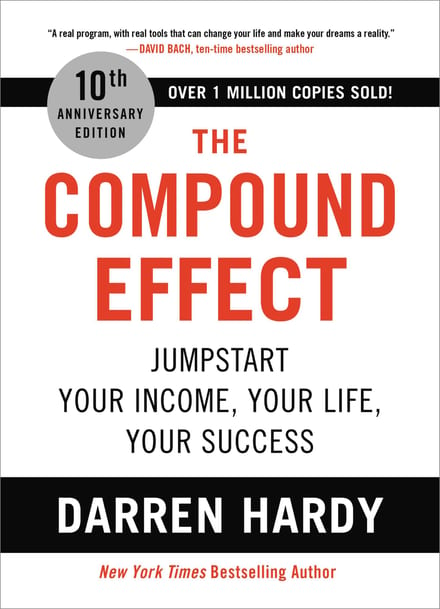
The Compound Effect
Jumpstart Your Income, Your Life, Your Success
The full book runs ~172 pages — roughly 3 hours of reading. You get the key ideas here in 4 minutes.
The key ideas
- Compound tiny consistent choices into life-changing results
- Expect no visible payoff until far down the line
- Own 100 percent responsibility for every choice you make
- Track behaviors to make the unconscious conscious
- Build better habits instead of chasing instant gratification
- Guard your inputs, associations, and environment
The summary
There’s no secret, no shortcut, no hack. The people who end up with remarkable health, money, and relationships got there the same unglamorous way: small, smart choices, made consistently, repeated long enough for the math to turn massive. Darren Hardy calls this the compound effect, and the frustrating part is that while it’s working, none of it feels like it’s working.
The magic penny
The compound effect is reaping huge rewards from a series of small, smart choices. What makes it so easy to quit on is that the steps feel insignificant while you’re taking them. The changes are so subtle they’re almost imperceptible — no big win, no obvious payoff — so most people bail. They quit running on day eight because they’re still overweight.
Hardy makes the point with a penny. Would you take $3 million in cash right now, or a single penny that doubles every day for 31 days? Take the cash and you feel brilliant for weeks. After twenty days your friend with the penny has about $5,243 while you’re spending millions. It isn’t until day thirty that she pulls ahead — and on day thirty-one that penny is worth $10,737,418.24, more than three times your money. Same tiny growth every single day; the result only becomes visible at the very end.
Then he runs it with people. Three friends, same neighborhood, same income, same “marriage flab.” Larry changes nothing. Scott makes a few quiet improvements — reads ten pages a day, listens to something instructional on his commute, trims 125 calories, walks a bit more. Brad drifts the other way — bigger TV, richer food, a weekly drink. At five months you can’t tell them apart. At eighteen, barely. But around month thirty-one the gap is startling: Scott has dropped 33 pounds, earned a promotion, and has a thriving marriage; Brad has gained 33.5 and his marriage is on the rocks. The “overnight success” was just small choices, stacked.
You reap what you sow
Here’s the sobering half: the compound effect is always running, and it doesn’t care which direction. One of Brad’s small habits — cooking and eating richer food — makes him sluggish, which dents his work, which sours his mood, which pulls him away from his wife, which unravels the marriage. A single choice ripples across his entire life. You reap what you sow, whether you’re paying attention or not.
And mostly you’re not. Everything in your life exists because you first made a choice — but Hardy’s point is that you make most of them half-asleep. You make your choices, and then your choices make you. The fix starts with taking 100 percent responsibility, then dragging those choices into daylight, and his tool for that is tracking. Carry a small notebook and write down every instance of the behavior you’re trying to change — every penny, every bite, every workout. He learned this the hard way: early on he owed over $100,000 in taxes and genuinely didn’t know where the money went, so his accountant made him log every cent for thirty days. Just having to write it down killed the mindless spending. Tracking works because it makes the unconscious conscious.
Habits and Big Mo
Roughly 95 percent of what you feel, think, and do runs on habit — and since you learned every one of them, you can unlearn the ones working against you. Larry Bird wasn’t the most gifted athlete on the floor; he shot five hundred free throws every morning before school. Champions aren’t necessarily more talented, they’ve just built better habits and stopped surrendering to instant gratification.
Do that long enough and you catch what Hardy calls Big Mo — momentum. Picture a merry-go-round: the first push is brutal, but once it’s spinning, a light touch keeps it flying. Newton’s law of inertia cuts both ways — couch potatoes tend to stay couch potatoes, achievers keep achieving. You earn momentum by stacking the pieces in order: new choices, then new behaviors, then habits, then daily routines and rhythms, then consistency over enough time. Then it kicks in, and you’re hard to stop — greater results for considerably less effort. Michael Phelps and his coach built that consistency over twelve years before it paid off with eight golds in Beijing. But leave bad habits unchecked and negative momentum builds just as reliably.
You are the sum of your influences
Your choices don’t happen in a vacuum; three forces steer them. The first is input — garbage in, garbage out. Your brain is wired for survival, always scanning for “lack and attack,” so left alone it feasts on bad news; you have to stand guard over what you let in. The second is your associations, the people you spend time with, whose pull is powerful precisely because it’s subtle. The third is your environment — you have to clear space and shape your surroundings to support the person you’re trying to become.
The bottom line
Success isn’t a single heroic act; it’s the compounded result of ordinary choices you repeat until they run on autopilot — so choose the small disciplines carefully, track them, and give them time to work. Read this if you’re tired of quick-fix promises and ready to do the consistent, unspectacular work that actually pays off.
Fact check
Popular books repeat findings that later research has complicated. Where The Compound Effect makes a testable claim, here's what the evidence actually shows.
Roughly 95 percent of what you feel, think and do runs on habit.
No habit researcher has measured anything close to 95 percent. Wood and Rünger's review of the field describes habit as the efficient, default mode of responding, but one that works alongside deliberate goal pursuit rather than replacing it — the two guide action synergistically. The hourly-diary studies underneath that conclusion found habitual behaviour, defined as behaviour repeated almost daily in a stable context, coexisting with a substantial amount of non-habitual behaviour that still needed conscious guidance. Hardy's underlying point that much of daily life runs without deliberation is sound; the 95 percent is not a measured number.
Simply writing down every instance of a behaviour changes that behaviour.
A meta-analysis of 138 randomized studies (N = 19,951) found that prompting people to monitor progress toward a goal improved goal attainment, d+ = 0.40 (95% CI 0.32 to 0.48), and that the increase in monitoring frequency was what carried the effect. The benefit was larger under exactly the conditions Hardy prescribes: when the information was physically recorded, and when results were reported or made public. Tracking is among the better-supported pieces of advice in the book.
- Harkin B, Webb TL, Chang BP, et al. Does monitoring goal progress promote goal attainment? A meta-analysis of the experimental evidence. Psychol Bull. 2016;142(2):198-229. PubMed
The people you spend time with quietly pull your own habits in their direction.
Tracking 12,067 people in the Framingham social network from 1971 to 2003, a person's chance of becoming obese rose 57% (95% CI 6 to 123) when a friend became obese, with smaller associations for siblings (40%) and spouses (37%) and none for neighbours. The finding is contested: applying the same statistical methods to traits that cannot spread socially — acne, headaches, height — produced apparent network effects that shrank to nothing once environmental confounders were controlled. Peer influence on behaviour is real, but separating it from people choosing similar friends and sharing the same surroundings remains unsettled, so treat the published effect sizes as upper bounds.
Frequently asked questions
What is The Compound Effect about?
There's no secret, no shortcut, no hack. The book's argument is that remarkable health, money, and relationships come from small, smart choices made consistently and repeated long enough for the math to turn massive — and the frustrating part is that while it's working, none of it feels like it's working.
What are the key takeaways from The Compound Effect?
The magic-penny idea shows tiny daily growth stays invisible until the very end — a penny doubling for 31 days beats $3 million, but only on the last day. You reap what you sow in both directions, because the compound effect always runs whether you're paying attention or not. Take 100 percent responsibility and drag your choices into daylight by tracking every instance of the behavior you're changing. Roughly 95 percent of what you do runs on habit, so build better ones, then catch 'Big Mo' — momentum — by stacking choices, behaviors, habits, and routines. And guard your three influences: input, associations, and environment.
Who should read The Compound Effect?
Read this if you're tired of quick-fix promises and ready to do the consistent, unspectacular work that actually pays off. It fits anyone trying to change health, finances, or relationships through daily habits.
Is The Compound Effect worth reading?
It's worth it for driving home one durable truth with vivid illustrations — the magic penny and the three friends who look identical until month 31 make the math of consistency impossible to forget. The tracking tool is simple and genuinely useful. Readers hoping for novel or advanced tactics may find the core idea familiar, since its power is in the reminder to actually do the boring work, not in complexity.