Book summary
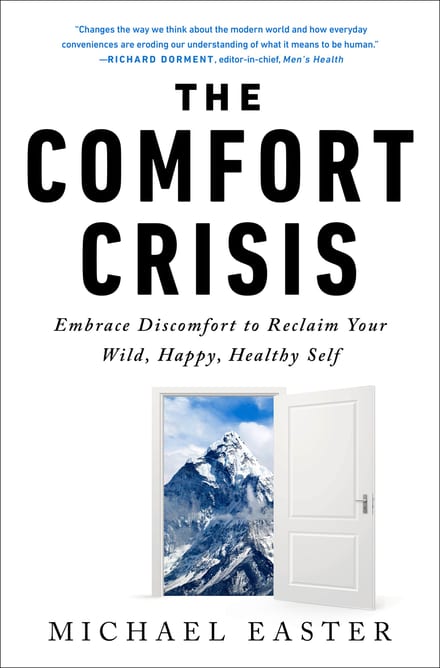
The Comfort Crisis: Embrace Discomfort To Reclaim Your Wild, Happy, Healthy Self
Embrace Discomfort To Reclaim Your Wild, Happy, Healthy Self
The full book runs ~304 pages — roughly 6 hours of reading. You get the key ideas here in 5 minutes.
The key ideas
- Notice comfort creep — yesterday's luxury becomes today's invisible baseline.
- Attempt a misogi: a genuine 50/50 shot at finishing, and no audience.
- Let boredom run; your own thinking only gets the floor in silence.
- Carry weight — rucking loads the body hard and the joints lightly.
- Go hungry sometimes; the built-in emergency system still runs when you let it.
- Contemplate your death daily, Bhutanese-style, as a filter on what's urgent.
The summary
Every discomfort our species grew up under — hunger, cold, silence, boredom, the effort of carrying things — has been engineered out of ordinary life, and we counted each removal as a win without ever checking the other side of the ledger. Michael Easter calls the process comfort creep. Yesterday’s luxury becomes today’s baseline, the baseline stops registering as comfort at all, and the floor quietly rises again. Americans now spend something like 93 percent of their time in enclosed environments — buildings and vehicles. A century ago most work was physical: farming alone employed close to 40 percent of the labor force, against under 3 percent today. Phoenix and Las Vegas exist because somebody invented air conditioning.
The book is reported rather than argued from a desk. Easter, a Men’s Health contributing editor who teaches at UNLV, went to the Alaskan Arctic on assignment with the hunter and filmmaker Donnie Vincent — a bush plane out of Kotzebue, then 33 days in one of the emptiest places left. That trip reset what he was writing about, and the reporting fans out from it.
Every problem we solved deleted a stress
The numbers he stacks up are blunt. More than 70 percent of American adults are overweight or obese. The Hadza of Tanzania, one of the last foraging societies, log over 14 times as much moderate-to-vigorous activity as Americans enrolled in large epidemiological studies. We spend more than 11 hours a day engaging with media of one kind or another.
None of this is an argument for asceticism, and Easter’s practical advice is deliberately incremental — put the phone down when boredom hits, get outside in stages. The claim is narrower and harder to dodge: a body assembled by scarcity behaves strangely when scarcity never shows up. The stresses that the environment used to deliver on its own now have to be scheduled on purpose, and almost nobody schedules them.
Misogi: pick something you might not finish
Marcus Elliott is a Harvard-trained physician who runs P3, the Santa Barbara sports-science lab the NBA leans on. His track record is the kind that makes teams listen — as the Patriots’ physiologist he cut the club’s hamstring injuries to three a season, from a mean of 21.5 over the previous five years.
Once a year Elliott does something for himself he named after misogi, a Japanese purification practice. Two rules. The task has to be hard enough that you have a genuine 50/50 shot at finishing it. And you can’t die. Two guidelines follow: make it odd enough that there’s no leaderboard to measure yourself against, and don’t post about it. The misogis Elliott organizes read as absurd on paper — hauling an 85-pound boulder along the floor of the Santa Barbara Channel, surfacing for air; paddleboarding 25 miles across that same channel. Keeping it private is the part people skip, and it’s the part that works: with no audience to perform for, the only thing holding you to it is you. Easter’s own attempt was a 32-mile run across the desert.
The discomforts we deleted: boredom, hunger, weight on your back
In the Arctic there wasn’t a bar of signal within 100 miles. Easter caught himself reading Clif Bar wrappers and the tags sewn into his gear. Then the itch passed and he started drafting magazine stories and chunks of this book in his head. Boredom, on this reading, isn’t an absence of stimulation — it’s the state in which your own thinking finally gets the floor. Researchers at the universities of Kansas and Utah found that backpackers scored about 50 percent better on the Remote Associates Test, a standard creativity measure, when tested on the fourth morning of a device-free trip: 6.08 correct out of ten, against 4.14 for people tested before setting out. Easter reports a related three-day effect, where the mental shift tends to land on the third day outside.
Hunger got the same treatment. Waiting out the caribou took two weeks, and across the hunt he ate roughly 2,000 calories a day while burning somewhere between 4,000 and 8,000. He came home ten pounds lighter — not as a diet, but as evidence that the built-in emergency system still runs when you let it.
Carrying weight is the third one, and the one he’s kept. A bull caribou runs 350 to 400 pounds; packing the meat out meant loads north of 100. Rucking — walking under a loaded pack — is the base layer of every military fitness program, and a Mayo Clinic bone specialist recommends weight-bearing walking to reverse bone loss. Weighted walking raises the energy cost of each step roughly in proportion to the load, so a 20-to-40-pound pack runs something like 20 to 50 percent above walking empty — and it beats up your joints far less than it sounds. In a University of Pittsburgh study tracking 451 soldiers for a year, running caused 18 injuries and lifting 7, against 5 from marching under load.
Bhutan, and the case for thinking about your death
Thimphu is a capital of about 115,000 people with no traffic light. Bhutan decided in the 1970s to measure Gross National Happiness rather than chase GDP, on the reasoning that output alone misses most of what makes a life good — health, education, culture, and the ecology the country depends on. What struck Easter hardest wasn’t the policy but the daily habit underneath it: Bhutanese are encouraged to contemplate their own death a few times a day. Not morbidly — as a filter. Hold a decision up against the fact that you’re going to die and most of what felt urgent stops feeling urgent.
The bottom line
Comfort isn’t the enemy; the absence of any counterweight to it is. The discomforts your body still expects — going hungry, being cold, being bored, carrying something heavy, doing a hard thing you might fail at — have to be put back deliberately, in doses, because nothing in modern life will hand them to you. Read it if the easy version of your life has started to feel oddly flat and you want a specific, physical set of things to do about it.
Fact check
Popular books repeat findings that later research has complicated. Where The Comfort Crisis makes a testable claim, here's what the evidence actually shows.
A University of Pittsburgh study of 451 soldiers shows walking under a loaded pack is dramatically safer than running or lifting — 18 injuries from running and 7 from lifting, against 3 from rucking.
The study is real and the running and lifting counts match its table exactly. The marching figure does not: of the 133 injuries recorded in a year, 5 were caused by marching, and the 3 is the smaller subset a reviewer judged preventable. The larger issue is that nobody measured exposure — the cause was unknown for 62 of the 133 injuries (46.6%), and soldiers run far more hours than they ruck, so raw counts cannot produce a per-hour injury rate for either activity.
- Lovalekar MT, Abt JP, Sell TC, Nagai T, Keenan K, Beals K, Lephart SM, Wirt MD. Descriptive Epidemiology of Musculoskeletal Injuries in the Army 101st Airborne (Air Assault) Division. Mil Med. 2016;181(8):900-6. PubMed
Four device-free days outdoors raise creative problem-solving by about 50 percent — backpackers averaged 6.08 out of ten on the Remote Associates Test against 4.14 for people tested before setting out.
Those numbers are reported accurately. What the design cannot establish is what produced them: the 56 Outward Bound participants were not randomly assigned — 24 took the test the morning before their trip and a different 32 took it on day four — and the two groups differed by about a decade in average age. The authors say plainly they cannot tell whether the gain came from nature, from four days away from devices, or from something else about the trip. Pooling 42 later studies, nature exposure does improve working memory and cognitive flexibility, but with low-to-moderate effect sizes rather than a 50 percent jump.
- Atchley RA, Strayer DL, Atchley P. Creativity in the wild: improving creative reasoning through immersion in natural settings. PLoS One. 2012;7(12):e51474. PubMed
- Stevenson MP, Schilhab T, Bentsen P. Attention Restoration Theory II: a systematic review to clarify attention processes affected by exposure to natural environments. J Toxicol Environ Health B Crit Rev. 2018;21(4):227-268. PubMed
Our ancestors were roughly 14 times more physically active than we are, and that collapse in daily movement is what drives modern obesity and metabolic disease.
The activity figure is solid and correctly attributed. Raichlen and colleagues measured 135 minutes a day of moderate-to-vigorous activity in Hadza foragers — over 14 times what participants in large US epidemiological studies log — sustained across the lifespan, with no rise in blood pressure with age and healthy cholesterol and CRP. The energy half does not follow. Using doubly labelled water, the same team found Hadza total daily energy expenditure was no different from Westerners' once body size was accounted for, which undercuts the idea that Western weight gain is simply the calories our ancestors burned and we no longer do.
- Raichlen DA, Pontzer H, Harris JA, Mabulla AZ, Marlowe FW, Snodgrass JJ, Eick G, Berbesque JC, Sancilio A, Wood BM. Physical activity patterns and biomarkers of cardiovascular disease risk in hunter-gatherers. Am J Hum Biol. 2017;29(2). PubMed
- Pontzer H, Raichlen DA, Wood BM, Mabulla AZ, Racette SB, Marlowe FW. Hunter-gatherer energetics and human obesity. PLoS One. 2012;7(7):e40503. PubMed
Walking with a loaded pack burns 20 to 300 percent more calories than walking without one.
The low end is about right; the high end is not reachable with a load a person can wear. Testing packs from zero to 75 percent of body mass, Bastien and colleagues found the metabolic power of walking rises in direct proportion to the weight carried, and recommended loads up to about a quarter of body mass for long-distance walking. Huang and Kuo put the increase at roughly 7.6 watts per extra kilogram, linear up to 40 percent of body weight. On those figures a 10-to-20 kilogram ruck costs on the order of 20 to 50 percent more energy than walking empty — a real gain, but quadrupling the burn would take a load heavier than the walker.
Frequently asked questions
What is The Comfort Crisis about?
Every discomfort our species grew up under — hunger, cold, silence, boredom, the effort of carrying things — has been engineered out of ordinary life, and we counted each removal as a win without checking the other side of the ledger. Michael Easter calls it comfort creep: yesterday's luxury becomes today's baseline, stops registering as comfort, and the floor quietly rises again. He tested the idea by reporting it, including 33 days in the Alaskan Arctic on a caribou hunt.
What are the key takeaways from The Comfort Crisis?
A body assembled by scarcity behaves strangely when scarcity never shows up: Americans spend about 93 percent of their time indoors, roughly 10 percent of jobs now involve manual labor against about 85 percent a century ago, and our ancestors were around 14 times more physically active. The stresses the environment used to deliver have to be scheduled on purpose. Marcus Elliott's misogi is one way — once a year, attempt something you have a genuine 50/50 chance of finishing, with no leaderboard and no posting about it, because quitting stays hard when no one is watching. Boredom is where your own thinking finally gets the floor, and University of Utah researchers found backpackers scored about 50 percent better on a standard creativity test after four device-free days outdoors. Carrying weight is the habit Easter kept: rucking burns 20 to 300 percent more calories than walking empty and produced 3 injuries among 451 soldiers, against 18 from running.
Who should read The Comfort Crisis?
Read it if the easy version of your life has started to feel oddly flat and you want a specific, physical set of things to do about it.
Is The Comfort Crisis worth reading?
It's reported rather than argued from a desk, and that's its strength — the Arctic hunt, Elliott's lab, Bhutan's habit of contemplating death a few times a day as a filter for what actually matters. The practical advice is also deliberately incremental rather than punishing: put the phone down when boredom hits, get outside in stages. If you want a straight protocol, be aware the adventure narrative carries a lot of the book, and the specific prescriptions come wrapped in a long journey to get to them.