
Reading path
Whose Work Got Counted
Five books on the contributions that were made and then not recorded — the mathematicians, the cells, the missing data, and two arguments about what to do now.
Four of these are about the same thing happening at different scales — a contribution made and then not written down — and the fifth is an argument about whose job it is to fix that. The order runs from the plainest statement of the problem, through two histories where you can name the people it happened to, to the data showing it wasn’t a series of one-offs, and ends on the book that gets argued with most. They disagree about the remedy, and reading them together is more useful than any of them alone.

We Should All Be Feminists
Start with the short one. Adichie's essay takes about an hour and does the job the other four need a book for: it names the default setting — who gets assumed competent, who gets asked to be likeable — in language nobody can call jargon.

Hidden Figures: The American Dream and the Untold Story of the Black Women Mathematicians Who Helped Win the Space Race
Now the case where the work is documented and the credit wasn't. Black women were doing NASA's orbital mathematics by hand out of a segregated office at Langley, and it took until 1960 for one of them to get her name on a report. The point isn't that they were exceptional — it's that they were a job category nobody had bothered to count.

The Immortal Life of Henrietta Lacks
Then the case where it wasn't work at all, it was a body. Cells taken from a Black tobacco farmer in 1951 without her knowledge went into labs on every continent while her family couldn't afford a doctor — and learned about it decades later.
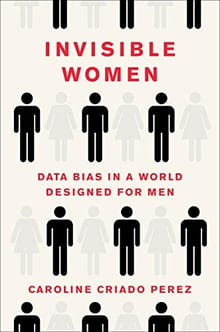
Invisible Women: Data Bias in a World Designed for Men
Here's the mechanism underneath both. Criado Perez shows the gap isn't malice so much as a default: crash dummies, drug trials, phone sizes and snow-clearing routes all built around a male body, because that's whose data got collected. Read after the two histories and the pattern stops looking like a series of accidents.

Lean In: Women, Work, and the Will to Lead
Finish with the argument, and expect to argue back. Sandberg's answer is that women should push into the room and negotiate harder — which drew the obvious objection that it asks the person with less power to fix a problem she didn't make. Put it last on purpose: after four books about structures, a book about individual effort is the one worth pushing against.