Book summary
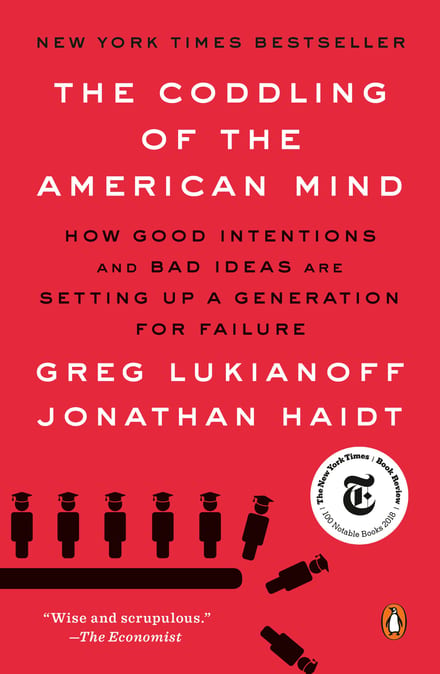
The Coddling of the American Mind: How Good Intentions and Bad Ideas Are Setting Up a Generation for Failure
How Good Intentions and Bad Ideas Are Setting Up a Generation for Failure
The full book runs ~352 pages — roughly 6 hours of reading. You get the key ideas here in 5 minutes.
The key ideas
- Infants shielded from peanuts developed allergies at 17%; those fed peanuts, only 3%.
- Three Great Untruths: you are fragile, trust your feelings, life is good versus evil.
- Safetyism treats emotional discomfort as danger, so avoidance replaces the exposure that builds strength.
- Microaggression training formalizes mind reading and replaces intent with the listener's felt impact.
- By 2016 one in five American girls reported a major depressive episode.
- Six threads converged: polarization, teen depression, fearful parenting, lost play, bureaucracy, justice.
The summary
In 2015 the LEAP study settled a question that had been hurting children for two decades. Researchers took 640 infants at high risk of peanut allergy; half the parents were told to follow standard advice and avoid all peanut exposure, half to feed their babies a peanut snack three times a week. At age five, 17% of the protected children had a peanut allergy. Among the deliberately exposed, 3%. The protection had helped cause the disease.
Greg Lukianoff and Jonathan Haidt build everything else on that reversal. The immune system is antifragile — Nassim Taleb’s word for systems that need stressors to develop properly — and so, they argue, are children. Prepare the child for the road, not the road for the child.
Three ideas that fail every test
To count as a Great Untruth, an idea must contradict ancient wisdom, contradict modern research on well-being, and harm those who embrace it. Three qualify:
- Fragility: what doesn’t kill you makes you weaker.
- Emotional reasoning: always trust your feelings.
- Us versus them: life is a battle between good people and evil people.
Nobody teaches these on purpose. They arrive in the rules and norms adults impose, usually with excellent intentions. The result is safetyism: safety as a sacred value, so no trade-off against it is allowed however trivial the risk.
“Safety” grew that large through what psychologist Nick Haslam calls concept creep: “trauma,” which in 1980 required an event “outside the range of usual human experience,” now turns on whatever an individual experiences as harmful. Brown students building a safe space during a 2015 debate on rape culture stocked it with cookies, coloring books, Play-Doh and a video of frolicking puppies. Harvard’s Richard McNally names the flaw: avoidance is a symptom of PTSD, not a treatment for it. Exposure therapy runs the other way.
The campus was teaching what therapy tries to undo
Lukianoff came to this through his depression and the cognitive behavioral therapy he credits with saving his life. CBT trains you to catch distortions: catastrophizing, dichotomous thinking, mind reading, labeling, emotional reasoning. Around 2013 he started hearing those patterns in students’ arguments about speech. Microaggression training is the case he presses hardest — Derald Wing Sue’s definition covers unintentional slights and locates the offense in the listener’s interpretation, which formalizes mind reading and swaps intent for impact.
Two emails show the cost. Claremont McKenna’s dean of students wrote to a student about serving those “who don’t fit our CMC mold”; read as exclusion and posted publicly, it ended in Mary Spellman’s resignation. At Yale, Erika Christakis questioned administrative guidance on Halloween costumes and asked students to work it out among themselves; she and her husband, Nicholas, left their posts at Silliman College. Colleagues backed them privately and stayed silent publicly — which, in sociologist Albert Bergesen’s anatomy of witch hunts, is the tell.
Us versus them, and what follows from it
Identity can be mobilized two ways. Martin Luther King Jr. and Pauli Murray drew larger circles — “When my brothers try to draw a circle to exclude me, I shall draw a larger circle to include them.” Common-enemy identity politics does the reverse, and the authors are blunt that the far right runs on it too, from the torchlit 2017 march at the University of Virginia to Heather Heyer’s murder.
On campus it produced something new. At Berkeley on February 1, 2017, protesters shut down a Milo Yiannopoulos talk with fires, Molotov cocktails and beatings — over $500,000 in damage, one arrest, no student discipline. A month later at Middlebury, protesters shut down Charles Murray and gave political scientist Allison Stanger a concussion that took six months of physical therapy. “They couldn’t look at me directly,” she wrote, “because if they had, they would have seen another human being.”
Five Berkeley op-eds ran under the headline VIOLENCE AS SELF-DEFENSE. Take the strongest form of that argument — words cause stress, stress causes harm, therefore words are violence — and it also convicts breaking up with someone or assigning homework. Only 1% of students polled said they would use violence to stop a speaker; 20% and 30%, in two others, called it acceptable when someone else did.
Six threads, no villain
Why 2013 to 2017? Six causes converged, none sufficient alone: political polarization (the party gap across ten policy questions widened 21 points after 1994, with left-leaning professors increasingly harassed from off campus); teen anxiety and depression; fearful parenting; the collapse of unsupervised play; expanding campus bureaucracy; and a rising passion for justice paired with the habit of reading outcome gaps as proof of bias.
The mental-health thread is the one they treat as decisive. By 2016 roughly one in five American girls aged 12 to 17 reported a major depressive episode that year; the boys’ rate rose from 4.5% to 6.4%. Self-harm ER visits for girls 15 to 19 rose from about 420 per 100,000 in 2009 to 630 in 2015. Following Jean Twenge, they tie this to smartphones saturating adolescence between 2007 and 2012, and to relational aggression becoming inescapable on a screen girls carry everywhere.
They mark their own limits. Screen-time effects are real but small. Severe childhood adversity does not make kids stronger — chronic toxic stress damages them, complicating the antifragility story for poorer students. And they drop their 2015 theory outright: colleges weren’t causing the crisis, they were responding to one that arrived with the students.
The bottom line
Overprotection is itself a danger. Young people are antifragile, so shielding them from discomfort — with speech codes, bias hotlines, or a childhood with no unsupervised hours — tends to make the discomfort larger rather than smaller. The fault, the authors insist, lies with adults and institutions, not with a generation they think is under real pressure and unfairly called spoiled. Read it if you teach, parent, or manage anyone under thirty, or want these fights explained by converging trends rather than villains.
Fact check
Popular books repeat findings that later research has complicated. Where The Coddling of the American Mind makes a testable claim, here's what the evidence actually shows.
Feeding peanut to high-risk infants instead of shielding them from it prevents peanut allergy — about 17% allergic under avoidance versus 3% under early exposure.
The LEAP trial randomized 640 infants with severe eczema, egg allergy or both to eat or avoid peanut until 60 months of age. Among the 530 who began with a negative skin-prick test, 13.7% of the avoidance group were allergic at five years against 1.9% of the consumption group; among the 98 who began already sensitized, 35.3% against 10.6%. The book's 17% and 3% are those two cohorts combined, and the direction is exactly as described — avoidance was the strategy that let the allergy develop.
- Du Toit G, Roberts G, Sayre PH, et al. Randomized trial of peanut consumption in infants at risk for peanut allergy. N Engl J Med. 2015;372(9):803-13. PubMed
American teenagers' depression and self-harm rates climbed sharply after about 2010, with the rise concentrated among girls.
Past-year major depressive episode among 12- to 17-year-olds rose from 8.7% in 2005 to 13.2% in 2017 in the National Survey on Drug Use and Health, and the pattern behaves like a birth-cohort effect rather than an age effect. Emergency-department visits for self-inflicted injury rose fastest in precisely the group the book names: among girls aged 10 to 14 the rate nearly tripled, from 109.8 per 100,000 in 2009 to 317.7 in 2015, and among girls 15 to 19 it reached 632.5 per 100,000 in 2015 after rising 7.2% a year from 2008. The summary's figure of roughly 420 per 100,000 in 2009 for the older girls is an interpolation — the published table reports only 389.3 for 2001 and 632.5 for 2015 — but the endpoint and the shape of the trend both hold.
- Twenge JM, Cooper AB, Joiner TE, Duffy ME, Binau SG. Age, period, and cohort trends in mood disorder indicators and suicide-related outcomes in a nationally representative dataset, 2005-2017. J Abnorm Psychol. 2019;128(3):185-199. PubMed
- Mercado MC, Holland K, Leemis RW, Stone DM, Wang J. Trends in Emergency Department Visits for Nonfatal Self-inflicted Injuries Among Youth Aged 10 to 24 Years in the United States, 2001-2015. JAMA. 2017;318(19):1931-1933. PubMed
Smartphones saturating adolescence between 2007 and 2012 drove the teen mental-health decline.
The timing fits and the underlying rise is real, but the measured link between screen use and adolescent well-being is very small. A specification-curve analysis across three datasets covering 355,358 adolescents found digital technology use explained at most 0.4% of the variation in well-being, which the authors judged too small to justify changing policy. Twenge's age-period-cohort work establishes the rise and its cohort signature but is correlational and cannot separate phones from the other five trends the book lists. Lukianoff and Haidt do concede the screen-time effects are small, so the defensible version of the claim is a plausible contributor rather than a demonstrated cause.
- Orben A, Przybylski AK. The association between adolescent well-being and digital technology use. Nat Hum Behav. 2019;3(2):173-182. PubMed
- Twenge JM, Cooper AB, Joiner TE, Duffy ME, Binau SG. Age, period, and cohort trends in mood disorder indicators and suicide-related outcomes in a nationally representative dataset, 2005-2017. J Abnorm Psychol. 2019;128(3):185-199. PubMed
Frequently asked questions
What is The Coddling of the American Mind about?
Greg Lukianoff and Jonathan Haidt argue that three bad ideas spread through American schools and campuses after 2013: that you are fragile, that you should always trust your feelings, and that life is a battle between good people and evil people. Their model is the peanut allergy reversal — the 2015 LEAP study found that protecting high-risk infants from peanuts left 17% allergic at age five, against 3% among those deliberately fed peanuts. Children, like immune systems, need stressors to develop, so well-meant protection can cause the harm it was meant to prevent.
What are the key takeaways from The Coddling of the American Mind?
Four ideas do most of the work. Antifragility: kids need small doses of difficulty, and shielding them from it makes them weaker. Safetyism: once safety becomes a sacred value, no trade-off against it is allowed, and "safety" creeps outward to cover emotional discomfort. Cognitive distortions: catastrophizing, mind reading, labeling and emotional reasoning are the exact habits cognitive behavioral therapy exists to break, and campus practices like microaggression training can teach them instead. And common-humanity identity politics — drawing a larger circle, as Martin Luther King Jr. and Pauli Murray did — works better than uniting people against a shared enemy. The six-thread explanation for 2013–2017 ties it together: polarization, teen anxiety and depression, fearful parenting, lost free play, campus bureaucracy, and a shift in what justice is taken to require.
Who should read The Coddling of the American Mind?
Parents, teachers, and anyone who manages or mentors people under thirty. It also suits readers who followed the campus controversies of the 2010s and want the underlying psychology rather than another round of outrage.
Is The Coddling of the American Mind worth reading?
Yes, if you want a careful causal account instead of a culture-war verdict. The book is unusually honest about its own limits: the authors say screen-time effects are statistically real but small, that severe childhood adversity genuinely does damage children rather than strengthen them, and that they abandoned their original theory once the data showed colleges were responding to a national mental health crisis rather than causing it. Readers who want a defense of current campus norms, or who find the word "coddling" itself off-putting, will likely bounce off it early.