Book summary
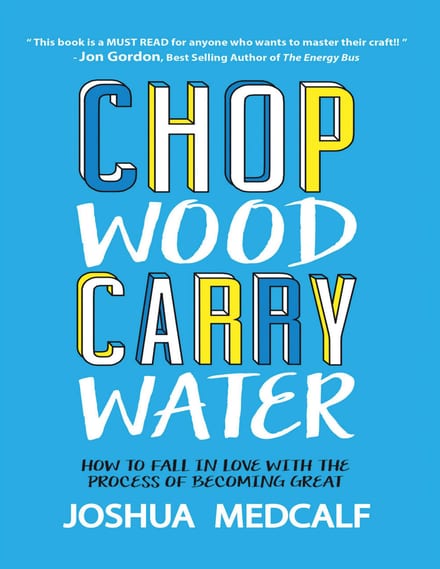
Chop Wood Carry Water
How to Fall In Love With the Process of Becoming Great
The full book runs ~120 pages — roughly 2 hours of reading. You get the key ideas here in 4 minutes.
The key ideas
- Master the mundane; every task builds your own house.
- Water your own grass instead of comparing to others.
- Trust invisible work; growth compounds underground before it shows.
- Feed your heart with what you consume and tell yourself.
- Treat setbacks as raw material for character and distance.
- Choose an unblockable mission over a deniable goal.
The summary
The one thing you actually control is who you become while doing the work. Everything else — the win, the ranking, the applause — sits outside your grip. That’s the lesson John keeps colliding with after he arrives at a samurai community to train as an archer, only to be handed a bucket and an axe. His teacher, Akira, tells him to chop wood and carry water. The archery will come. What John reads as a delay is in fact the training, because the mundane repetitions nobody sees are quietly building his character — and character, not technique, is what he’s really there to construct.
Every task builds your own house
Akira tells John about Kota, a master home builder who coasts through his final project, cutting corners because he assumes it’s for a client. When it’s finished, his boss hands him the keys: the house was his own retirement gift. “You are always building your own house,” Akira says — you may think you’re building for your team, your family, or your company, but the workmanship always comes home to you. So the care you bring to a task you find beneath you isn’t spent on the task. It’s poured into yourself.
That reframing changes how you meet every situation. Treat life as a series of tests to pass, and you’ll do the minimum to clear each bar. Treat it as a series of chances to grow, and you’ll eventually outrun the person still trying to prove themselves. Your worth, Akira insists, doesn’t rise and fall with results — it’s constant, and it comes from who you are, not what you produce. Chasing achievement for fulfillment is like drinking salt water: each accomplishment only sharpens the thirst.
The grass is greener where you water it
Fixating on the outcome tends to delay it. Stare at the distant summit while ice climbing instead of your next hold, and you slip. Comparison does the same damage from another angle — it drains your joy and pulls your eyes off your own progress. The grass isn’t greener on the other side; it’s greener where you water it. What you envy in other people is almost always the visible tip of invisible labor: the superstar you watch on game day put in uncounted private hours, drenched in sweat, with no one watching.
Trust that hidden work even when it shows nothing back. Ingvar Kamprad built IKEA from years of selling matchsticks door to door. The Chinese bamboo tree lays down a vast root system for five years with no growth above ground, then shoots up ninety feet in six weeks. The barren stretch isn’t dead time. It’s the foundation everything later stands on.
You fuel your heart with six things
Akira’s inventory is specific: what you watch, what you read, what you listen to, who you surround yourself with, how you talk to yourself, and what you visualize. Tend those well and you build confidence; tend them carelessly and discouragement creeps in, which derails more dreams than any shortage of talent. A crucial piece is the story you tell. Your memories are made less by your experiences than by the accounts you give of them, and most people quietly sabotage their own hard work by narrating it in the worst possible light. Constructive self-talk is one of the most powerful tools you have for reaching your potential.
Setbacks are part of the raw material. The earliest golf balls were smooth until players noticed that dented, scuffed ones flew farther — the rough side of the mountain is what shapes you into someone who can travel. The roll call of the rejected is long: Dr. Seuss turned down 26 times, Einstein written off by teachers as slow, Oprah fired as unfit for television, Walt Disney let go for lacking creativity. Failure isn’t the opposite of success. It’s an ingredient of it.
Commit to the controllables, surrender the outcome
Only effort and attitude are fully yours. Tie a goal to something you can’t govern — winning, other people’s approval — and you manufacture frustration. Akira’s alternative is a mission: a way of living no one can block. Before a tournament John locks onto winning, and Akira redirects him, because an opponent can deny you a win but no one can deny you a mission. To perform in the present you have to practice living there, and it helps to notice that “I have to” breeds a heavier internal energy than “I want to.”
When John breaks his arm, Akira greets the injury as an opportunity and has him list the skills he can still sharpen. Living by principles rather than shifting feelings keeps you steady when moods swing. And watch the company you keep: one crab in a bucket climbs out easily, but a bucket of crabs will drag each other down every time one starts to escape.
The bottom line
Greatness isn’t forged in the spotlight; it’s forged in the unglamorous repetitions that build your character. Fix your attention on effort and attitude — the only things you truly control — and let the result take care of itself. Read this if you’re grinding toward a big goal, or if you’ve tied your worth to outcomes and need a steadier place to stand.
Frequently asked questions
What is Chop Wood Carry Water about?
The one thing you actually control is who you become while doing the work — everything else, the win, the ranking, the applause, sits outside your grip. Told as the story of John, who trains to become a samurai archer but is handed a bucket and an axe, the book argues that the unglamorous repetitions nobody sees are what build character, and character is what really matters.
What are the key takeaways from Chop Wood Carry Water?
You are always building your own house — the care you bring to any task is poured into yourself, not the task. Treat life as chances to grow rather than tests to pass. The grass is greener where you water it, so stop comparing and trust hidden work, like the bamboo tree that roots for five years before shooting up ninety feet. You fuel your heart with six things: what you watch, read, and listen to, who you surround yourself with, how you talk to yourself, and what you visualize. Commit to the controllables — effort and attitude — and surrender the outcome, choosing a mission no opponent can block.
Who should read Chop Wood Carry Water?
Read this if you're grinding toward a big goal, or if you've tied your worth to outcomes and need a steadier place to stand. It fits athletes, students, and anyone frustrated by slow, invisible progress.
Is Chop Wood Carry Water worth reading?
It's worth it as a short, parable-driven read that makes process-over-outcome thinking stick through memorable stories — the bamboo tree, the crabs in a bucket, Kota's house. If you already know the mindset from other sources, some lessons will feel familiar, and the fable format is deliberately simple rather than deep. For a motivational reset focused on what you actually control, it delivers.