Book summary
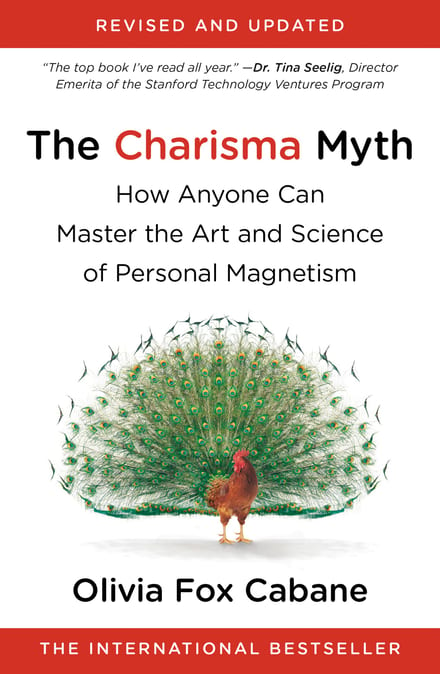
The Charisma Myth: How Anyone Can Master the Art and Science of Personal Magnetism
The full book runs ~272 pages — roughly 5 hours of reading. You get the key ideas here in 3 minutes.
The key ideas
- Blend power and warmth—both ability and willingness to help
- Master presence: full, undivided attention makes people feel special
- Choose your style: focus, visionary, authority, or kindness charisma
- Fix the inside, not the pose—body language leaks your state
- Use visualization to shift body language and reduce anxiety
- De-dramatize negativity and eliminate discomfort before it undermines you
The summary
Charisma looks like magic, but it runs on mechanics you can learn. The pull that certain people have over a room isn’t a gift they were handed at birth — it’s behavior they’ve trained. Steve Jobs began as an awkward presenter and worked his way into becoming one of the most captivating salespeople alive. We mistake charisma for an inborn trait because we only ever see the finished performance, never the practice behind it, and because no one manages to be charismatic every hour of the day. The catch is that charisma travels almost entirely through body language, and body language leaks your inner state whether you want it to or not. You can’t pose your way there. You have to actually generate the state — full attention, felt competence, real goodwill — and let the body follow.
The three ingredients: presence, power, warmth
Cabane breaks charisma into three parts. Presence is being completely in the conversation: eye contact, active listening, treating this exchange as the only thing happening. It’s hard, because we evolved to keep half an eye on every threat and opportunity — the one activity where people reliably give full attention, she notes, is sex. But when you manage genuine presence, people feel singled out, and you can build trust and rapport in minutes.
Power is your capacity to affect the world, through position, expertise, or sheer force of personality. Warmth is your willingness to turn that capacity toward someone else — empathy, kindness, the sense that you’re glad they’re here. Charisma needs both, because we’re drawn to people who are able and willing to help us. Power without warmth impresses but chills; warmth without power reads as eager, even servile. The classic illustration is a woman who dined with Gladstone and Disraeli during Britain’s 1868 election: “After dining with Mr. Gladstone, I thought he was the cleverest person in England. But after dining with Mr. Disraeli, I thought I was the cleverest person in England.” Gladstone had power; Disraeli had both. Disraeli won.
Pick a style that fits you
There’s no single way to be charismatic. Cabane describes four styles, and the right one depends on your personality, your goals, and the room. Focus charisma makes the other person feel like the only one in it — Bill Clinton’s signature. Visionary charisma inspires through a compelling picture of the future, the Steve Jobs mode. Authority charisma rests on being seen as expert and experienced, the way Michael Jordan commanded a court. Kindness charisma radiates genuine care and makes people feel valued, like the Dalai Lama. None outranks the others; you choose the one you can produce honestly.
Fix the inside, not the pose
Since body language reports on your mental state, the real work happens in your head. The most dependable tool is visualization: picture yourself doing the thing well, in vivid sensory detail, and your body language shifts on its own, because the brain treats imagination and reality much alike. It’s the placebo effect turned inward, and it’s exactly what elite athletes rehearse before they compete. Anxiety responds to a related trick — before a high-stakes moment, list the full range of outcomes, success and failure both. Naming the possibilities drains the catastrophizing.
Clear away discomfort and self-blame
The fastest way to lose charisma is to look uncomfortable, and discomfort has two sources. Physical: clothes that are too warm, shoes that pinch. Mental: anxiety, self-criticism. Either one seeps into your posture and face. The fix is a small routine — prevent it by planning ahead, catch it by staying aware of your own body, and remedy it directly, even by naming the problem out loud if you must. Negative emotions need a softer approach Cabane calls de-dramatizing: when shame or frustration lands, remind yourself it isn’t that serious, that everyone feels it, that you’re just a physical creature with certain chemicals moving through you right now. And when someone else acts in a way that stings, remember their behavior is about them, not you — a person who looks unhappy might be too hot, too cold, sick, or distracted. We each see only the slice of information relevant to us, and rarely the whole picture. One more lever: first impressions stick, because people confirm their initial read rather than revise it, so make others feel you’re like them early — dress for the context, mirror their language, keep to positive ground, and don’t underrate the handshake.
The bottom line
Charisma is a set of behaviors you produce by managing your inner state — generating real presence, a sense of your own power, and genuine warmth — not by faking a confidence you don’t feel. Anyone willing to visualize, clear discomfort, and stay present can build it. Read this if you want concrete, practicable techniques for becoming more magnetic at work and in life.
Fact check
Popular books repeat findings that later research has complicated. Where The Charisma Myth makes a testable claim, here's what the evidence actually shows.
Vividly picturing yourself performing well shifts your body language and improves the performance itself, because the brain treats imagined and real events much alike.
Mental practice does help, but by far less than the book's framing implies. The 1994 meta-analysis that established the effect found it positive and significant while varying with the type of task, the length of the practice and the gap between rehearsing and performing. A 2020 methodological replication covering 37 studies published between 1995 and 2018 put the pooled benefit at r = 0.13 after correcting for publication bias — real, durable, and small. Nothing in that literature shows imagination substituting for the real thing; it supplements physical practice.
- Driskell JE, Copper C, Moran A. Does mental practice enhance performance? J Appl Psychol. 1994;79(4):481-492. Source
- Toth AJ, McNeill E, Hayes K, Moran AP, Campbell M. Does mental practice still enhance performance? A 24 year follow-up and meta-analytic replication and extension. Psychol Sport Exerc. 2020;48:101672. Source
Charisma is a trainable skill rather than a fixed trait you are born with or without.
A randomized field experiment assigned 34 middle managers to charisma training or a control group and reassessed them three months later through coworker ratings (343 raters before, 321 after); a companion lab study videotaped 41 MBA students giving a speech, trained them, and had them redeliver it six weeks later for 135 independent assessors. Training raised rated charisma with a mean effect size of d = 0.62, and the gain carried through to ratings of leader prototypicality and emergence. The measured outcome is how observers rate the behaviour, not business results — but on the specific question of whether charismatic behaviour can be taught, the answer is yes.
- Antonakis J, Fenley M, Liechti S. Can charisma be taught? Tests of two interventions. Acad Manag Learn Educ. 2011;10(3):374-396. Source
First impressions stick, because people spend the rest of the encounter confirming their initial read rather than revising it.
The speed half holds up well. A meta-analysis of 38 results found that judgments made from under five minutes of someone's expressive behaviour predicted objective outcomes at r = .39, and slices shorter than 30 seconds were no less accurate than four- and five-minute ones. The stickiness half is weaker: across seven experiments, people fully reversed an implicit first impression of a stranger once new information made them reinterpret the original behaviour, and the revised impression still held three days later. Impressions form in seconds, but they do get rewritten — the new evidence has to recast the old, not merely contradict it.
- Ambady N, Rosenthal R. Thin slices of expressive behavior as predictors of interpersonal consequences: a meta-analysis. Psychol Bull. 1992;111(2):256-274. Source
- Mann TC, Ferguson MJ. Can we undo our first impressions? The role of reinterpretation in reversing implicit evaluations. J Pers Soc Psychol. 2015;108(6):823-849. PubMed
You cannot pose your way into charisma — body language reports your inner state, so the state has to change first.
Cabane is on firm ground about the strong version of the opposite advice. The 2010 study behind the power-posing idea reported that two one-minute expansive poses raised testosterone, lowered cortisol and increased risk tolerance; a larger replication found no effect on either hormones or risk tolerance. What survives is narrower and cuts the other way: a p-curve of the broader postural-feedback literature reported evidential value for poses changing how powerful people feel, a reading its authors were defending against critics. So posture is not purely a readout of an inner state — it feeds back on the subjective part, just not on the physiology.
- Carney DR, Cuddy AJ, Yap AJ. Power posing: brief nonverbal displays affect neuroendocrine levels and risk tolerance. Psychol Sci. 2010;21(10):1363-1368. PubMed
- Ranehill E, Dreber A, Johannesson M, Leiberg S, Sul S, Weber RA. Assessing the robustness of power posing: no effect on hormones and risk tolerance in a large sample of men and women. Psychol Sci. 2015;26(5):653-656. PubMed
- Cuddy AJC, Schultz SJ, Fosse NE. P-curving a more comprehensive body of research on postural feedback reveals clear evidential value for power-posing effects: reply to Simmons and Simonsohn (2017). Psychol Sci. 2018;29(4):656-666. PubMed
Frequently asked questions
What is The Charisma Myth about?
Charisma looks like magic, but it runs on mechanics you can learn. The book's central claim is that magnetism isn't an inborn gift — it's trained behavior, the way Steve Jobs went from an awkward presenter to a captivating one. Because charisma travels through body language, which leaks your inner state, you can't fake it; you have to actually generate the underlying mindset.
What are the key takeaways from The Charisma Myth?
Charisma has three ingredients — presence (being completely in the conversation), power (your capacity to affect the world), and warmth (your willingness to turn that capacity toward someone). There's no single style: focus (Bill Clinton), visionary (Steve Jobs), authority (Michael Jordan), and kindness (the Dalai Lama). Since body language reports your mental state, the real work is internal — visualization shifts your posture on its own, and listing the full range of outcomes drains anxiety. Clear away physical and mental discomfort, de-dramatize negative emotions, and remember first impressions stick.
Who should read The Charisma Myth?
Read this if you want concrete, practicable techniques for becoming more magnetic at work and in life. It's especially useful for people who assume charisma is something you either have or don't.
Is The Charisma Myth worth reading?
It's worth it because it treats charisma as a learnable skill and hands you specific tools — visualization, de-dramatizing, the presence-power-warmth model — rather than vague encouragement. The insistence on generating a genuine inner state instead of posing keeps it honest. Readers who want a quick set of tricks may be surprised how much it asks you to work on your own mind first, which is exactly the point.