Book summary
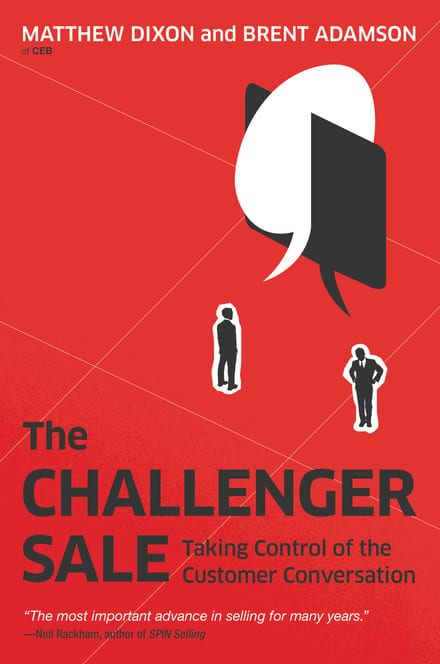
The Challenger Sale: Taking Control of the Customer Conversation
Taking Control of the Customer Conversation
The full book runs ~240 pages — roughly 4 hours of reading. You get the key ideas here in 5 minutes.
The key ideas
- Five rep profiles emerged from manager ratings of 6,000+ B2B sellers.
- Challengers made nearly 40% of high performers; Relationship Builders just 7%.
- Teach, tailor, take control — and hold constructive tension throughout.
- CEB found customers finish ~60% of the decision before contacting suppliers.
- Insight selling shapes the requirements before the customer writes them.
- Read the findings as vendor research: proprietary, self-reported, not peer-reviewed.
The summary
In complex business-to-business deals, the seller customers like best is not the seller who wins. That is the claim Matthew Dixon and Brent Adamson built this book around, and it landed hard in 2011 because it inverted what sales managers had been repeating for thirty years. The research behind it started somewhere else: a study at CEB, the Corporate Executive Board — since absorbed into Gartner — into what makes B2B customers loyal. By the firm’s account, 53% of that loyalty came down to the quality of the sales experience. Not the brand, not the product, not the price. So they went looking for what the reps who created that experience were actually doing.
Five profiles, and the popular one finishes last
The method was blunt. Managers at participating companies scored their reps against one another on 44 attributes and skills — goal orientation, business acumen, ability to negotiate — and the scores clustered into five recognizable types: the Hard Worker, the Lone Wolf, the Relationship Builder, the Reactive Problem Solver, and the Challenger. The companies were then asked to name their top 20% by performance against quota, and the researchers checked which type those stars belonged to.
Writing in Harvard Business Review the following year, Adamson, Dixon and Nicholas Toman put the headline result plainly: Challengers accounted for “nearly 40% of the high performers in our study”, and the number jumps to “54% in complex, insight-driven environments”. Two things there get mangled everywhere else. The figure describes the composition of star performers, not of the sales force at large, and the 54% applies specifically to complicated, insight-led selling — you will see it quoted as the overall number, which it isn’t.
The counterintuitive part is at the bottom of the table. Relationship Builders — the profile most sales cultures are built to produce, and about a fifth of all reps — generated the fewest stars of any type, just 7% of high performers. Challenger’s own account is that this profile “performed the worst in complex sales.” The diagnosis is that the strength is also the trap: someone whose instinct is to keep everyone happy struggles to deliver bad news, to talk about price, to go around a friendly contact to reach the person who can actually sign, or to hold a customer to a commitment.
The ground had already moved under the seller
Part of the argument is about timing. The same HBR piece cites a CEB study of more than 1,400 B2B customers who reported completing, on average, “nearly 60% of a typical purchasing decision” — researching options, setting requirements, benchmarking prices — before they ever spoke to a supplier. (Challenger states the same finding as 57%.) If the customer has already framed the problem and written the requirements, the rep who arrives asking good discovery questions is walking into a price comparison. The authors’ term for the alternative is insight selling: get in before the requirements exist, and shape them.
Teach, tailor, take control
The Challenger’s edge is broken into three behaviors, plus one that runs through all of them.
- Teach. Come in with a perspective on the customer’s business that they don’t already have — one that disrupts how they currently see the problem.
- Tailor. Deliver that message differently to the CFO than to the operations lead, because the thing that moves each of them is different.
- Take control. Talk about money without flinching, press for commitments, and keep the process moving rather than waiting to be told what happens next.
- Constructive tension. Push, and stay in the discomfort long enough for the customer to think differently, instead of retreating into agreement.
The teaching part has an actual choreography, which Challenger describes as six steps: open by showing you understand their business rather than asking them to explain it; reframe the problem as a symptom of something bigger; make the cost of doing nothing concrete with numbers; tell a story of a company like theirs living that cost; sell the new approach before you sell yourself; and only then put your own capabilities on the table. Challenger’s own way of putting it is that the seller’s job at the start of a conversation isn’t to ask what keeps the customer up at night — it’s to tell them what should.
The evidence is a vendor’s own research
Worth being straight about this. The Challenger study is proprietary survey work — more than 6,000 reps from 83 companies in the first wave, but manager ratings and self-reports at a single point in time, not a controlled experiment and not peer-reviewed. The firm that publishes the findings also sells the training, the hiring assessment and the coaching built on top of them. And the numbers drift within its own material: one Challenger page gives Challengers as 39% of high performers, another as 54%, which is the complex-sales figure doing double duty.
Academics did take the model seriously — the Journal of Personal Selling & Sales Management ran a review of it in 2014 by Adam Rapp, Daniel G. Bachrach, Nikolaos Panagopoulos and Jessica Ogilvie, examining “its novelty, merits and weaknesses.” Read the profiles as a useful sorting device rather than a measured law of nature and the book holds up fine.
One caution for anyone joining late: the Mobilizer, the customer-side stakeholder everyone quotes alongside this material, belongs to the stakeholder research CEB published from 2012 onward and developed in the 2015 follow-up The Challenger Customer — not to this book.
The bottom line
If your deals keep collapsing into price comparisons, the book’s answer is that being liked is not the asset you think it is — the reps who win complex sales bring the customer a view of their own business the customer didn’t have, and they will create tension defending it. Relationships still matter; on this account they are what you earn by teaching someone something valuable, not a substitute for it. Read it if you sell anything complicated to organizations, or manage people who do.
Fact check
Popular books repeat findings that later research has complicated. Where The Challenger Sale makes a testable claim, here's what the evidence actually shows.
Challengers account for nearly 40% of high-performing B2B sellers — 54% in complex, insight-driven selling — while Relationship Builders account for only 7%.
The figures are reported faithfully: CEB put Challengers at nearly 40% of high performers, rising to 54% in complex, insight-driven environments. But they rest entirely on the firm's own survey — managers at 83 companies rated more than 6,000 of their own reps, and each company nominated its own top 20% by quota attainment. That design shows which profile managers associate with people their employer already counts as stars; it cannot establish that the profile produced the results. When sales academics first examined the model systematically, in a 2014 review in the Journal of Personal Selling & Sales Management, they wrote it because no such examination existed, and the paper is a review and critique of the framework rather than an independent test of the percentages.
- Adamson B, Dixon M, Toman N. The end of solution sales. Harvard Business Review. 2012 Jul-Aug. Source
- Rapp A, Bachrach DG, Panagopoulos N, Ogilvie J. Salespeople as knowledge brokers: a review and critique of the challenger sales model. Journal of Personal Selling & Sales Management. 2014;34(4):245-259. Source
Being the seller the customer likes is not what wins complex deals; tailoring the message to each stakeholder is.
Independent evidence backs part of this. A meta-analysis pooling 155 samples and more than 31,000 salespeople found that adaptive selling — varying the approach by customer, close to the book's 'tailor' — raised self-rated, manager-rated and objective performance, whereas customer orientation raised only self-rated performance. The instinct to please really does flatter a rep's own view of their results more than their measured ones, which is roughly the book's point, and adaptive selling had a larger effect on performance than customer orientation did. The same analysis stops short of the book's framing, though: customer orientation raised job satisfaction and rose alongside adaptive selling rather than against it, which reads as a weaker lever rather than a liability.
- Franke GR, Park JE. Salesperson adaptive selling behavior and customer orientation: a meta-analysis. Journal of Marketing Research. 2006;43(4):693-702. Source
B2B customers complete roughly 57-60% of a purchase decision before they ever talk to a supplier.
The number is genuine but narrower than its reputation. It comes from a 2011 CEB survey of more than 1,500 decision makers and influencers at customers of 22 large B2B firms, asked how far through a recent purchase they had progressed before engaging a supplier's rep directly; the average was 57%, and CEB restated it in Harvard Business Review as 'nearly 60%' from a sample of more than 1,400 customers. It is a buyer's own estimate of their progress, not a measured process. It was also never a constant: in the same report the supplier-level averages ranged from under 45% to as high as 70%, so how much of the decision is already made when a rep arrives depends heavily on what is being sold.
- CEB Marketing Leadership Council, in partnership with Google. The Digital Evolution in B2B Marketing. Corporate Executive Board; 2012:2. (MLC Customer Purchase Research Survey, 2011; n = 1,500.) Source
- Adamson B, Dixon M, Toman N. The end of solution sales. Harvard Business Review. 2012 Jul-Aug. Source
Frequently asked questions
What is The Challenger Sale about?
Matthew Dixon and Brent Adamson argue that in complex B2B deals, the seller customers like best is not the seller who wins. Their research at CEB, the Corporate Executive Board, had managers score reps against one another on 44 attributes; the scores clustered into five types — Hard Worker, Lone Wolf, Relationship Builder, Reactive Problem Solver, and Challenger. When companies named their top performers, the Challenger — the rep who teaches, tailors and pushes back — came out ahead.
What are the key takeaways from The Challenger Sale?
Challengers accounted for nearly 40% of high performers in the study, rising to 54% in complex, insight-driven selling; Relationship Builders, the profile most sales cultures try to produce, generated just 7%. The Challenger edge breaks into three behaviors — Teach, Tailor, Take Control — plus constructive tension running through all of them. Teaching has a six-step choreography: show you already understand their business, reframe the problem, make the cost of inaction concrete, tell a story of a company like theirs, sell the new approach, and only then your own capabilities. The timing argument matters too: CEB found customers complete nearly 60% of a purchase decision before ever speaking to a supplier, so insight selling means arriving before the requirements exist.
Who should read The Challenger Sale?
Anyone selling something complicated to organizations, or managing people who do. It's most useful if your deals keep collapsing into price comparisons despite good relationships.
Is The Challenger Sale worth reading?
The core reframe is genuinely useful, and the teach-tailor-take-control structure is specific enough to act on. Be clear-eyed about the evidence: this is proprietary survey work — over 6,000 reps from 83 companies, but manager ratings and self-reports at a single point in time, not a controlled experiment or peer-reviewed research — published by the firm that also sells the training and hiring assessment built on it. Read the profiles as a sorting device rather than a law of nature. One note for latecomers: the Mobilizer everyone quotes alongside this material comes from the 2015 follow-up, The Challenger Customer.