Book summary
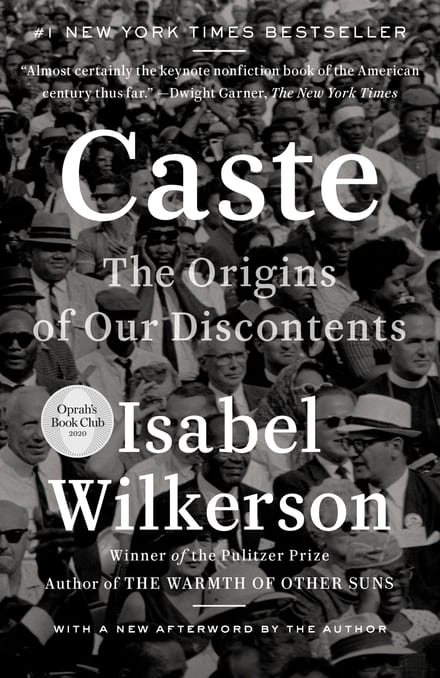
Caste: The Origins of Our Discontents
The full book runs ~496 pages — roughly 9 hours of reading. You get the key ideas here in 3 minutes.
The key ideas
- Caste outlasts racism by feeling like the natural order
- India, Nazi Germany, and America built the rigid caste systems
- Eight pillars—from divine will to terror—prop up every hierarchy
- Slavery was an American invention that survived through Jim Crow
- Group narcissism breeds supremacy, fear, and fascism
- Radical empathy is the way out of inherited hierarchy
The summary
What looks like American racism is the surface of something older. Beneath the personal feelings of prejudice sits a caste system—a human-built ranking that assigns worth at birth on the premise that some groups are simply superior to others. Wilkerson’s central claim is that this is why the hierarchy has outlasted every legal reform: caste isn’t hatred, and it isn’t usually personal. It runs, in her words, on “the worn grooves of comforting routines and unthinking expectations, patterns of a social order that have been in place for so long that it looks like the natural order of things.” You can change the laws and even the manners, and the ranking underneath keeps working, because to the people living inside it, it just feels like ordinary life.
She sees three great caste systems in history: India, Nazi Germany, and the United States. India’s is elaborate, layered into many subcastes from the Brahmins at the top down to the Dalits, the Untouchables, at the bottom. The American and Nazi versions were blunter and bipolar—white against Black, Aryan against Jew. And the American one, she stresses, is not a natural fact but an invention. Race itself was manufactured: European colonists arbitrarily sorted the people they met by skin color, even though every one of us descends from African tribes. Even the vocabulary was improvised. “Caucasian” was coined in 1795 by Johann Friedrich Blumenbach, a scientist who collected skulls and named Europeans after his favorite specimen, which happened to come from the Caucasus Mountains.
An American institution, built to last
The foundation was 246 years of slavery, which fixed African Americans at the bottom of the order. Wilkerson refuses to let it be softened into misfortune: slavery “was not merely an unfortunate thing that happened to black people. It was an American innovation,” created by and for the dominant caste’s elites and enforced by poorer whites who tied their fortunes to the caste system rather than to their consciences. This is also what separates caste from class. You can climb out of a class through money or marriage. You cannot buy your way out of a caste. When slavery ended, the ranking simply migrated into Jim Crow segregation, redlining that denied Black families loans and homes, and everyday violence. Meanwhile groups once treated as lesser—the Irish, the Italians—were eventually folded into “white” in the late 1800s. Black Americans never were.
The eight pillars
Wilkerson argues every caste system rests on the same eight supports:
- Divine will — scripture is read to bless the hierarchy as God-given.
- Heritability — you inherit your parents’ caste and cannot shed it.
- Endogamy — marriage and reproduction are policed within caste lines.
- Purity versus pollution — the lower caste is treated as contaminating, which is why Black Americans were once barred from public swimming pools.
- Occupational hierarchy — the least desirable work is reserved for the lowest caste.
- Dehumanization and stigma — the lowest caste is cast as less than human, making it usable, for instance, as medical guinea pigs.
- Terror as enforcement — beatings and lynchings kept the subordinate caste in place.
- Inherent superiority versus inferiority — daily customs constantly remind the lower caste of its rank.
The longer these pillars stand, the more ingrained and load-bearing they become—which is exactly why the system is so hard to pull down.
The fear at the top
As subordinate castes gained rights in the late twentieth century, the dominant caste felt the floor tilt. Wilkerson describes a false but powerful belief in a zero-sum game: any status Black Americans gained had to be status whites were losing. The anxiety was physical, showing up as stress-related illness, and political—the number of American hate groups doubled during Obama’s first term. The costs remain lethal; Black people are five times more likely to be killed by police than white people. Underneath is what she calls group narcissism, an inflated self-worth borrowed from group identity that can curdle into a euphoric sense of supremacy. That path leads toward fascism, as Nazi Germany showed—and the borrowing ran both ways. The Nazis modeled their segregation and punishment laws partly on America’s, studied its lynching rituals, and Hitler marveled at the American “knack for maintaining an air of robust innocence in the wake of mass death.” The contrast Wilkerson draws is stark: Germany now builds memorials to the victims, while America still fights over whether to take down monuments to slavery’s defenders. The pandemic exposed the same divide again, as the dominant caste worked from home with employer healthcare while subordinate castes staffed essential jobs without it.
Radical empathy is the exit
Wilkerson doesn’t end in despair, and her clearest example is small and human. A plumber came to her house wearing a hat that hinted at his politics, assumed she couldn’t be the owner, rudely asked for “the lady of the house,” and looked ready to do the bare minimum. Then she mentioned her late mother, he opened up about his own father, and within minutes the prejudices fell away and he fixed the problem with real care. That is radical empathy: actively listening to and learning from people unlike you until you genuinely understand their world. “The price of privilege,” she writes, “is the moral duty to act when one sees another person treated unfairly. And the least that a person in the dominant caste can do is not make the pain any worse.”
The bottom line
America’s racial order has survived every legal fix because it’s not really about individual prejudice—it’s a caste hierarchy that feels natural to the people inside it, and structures don’t dissolve just because the laws change. Seeing it clearly as something constructed, then choosing person-to-person empathy over inherited habit, is the slow way out. Read this if you want to understand why the hierarchy persists, and what dislodging it would actually require.
Fact check
Popular books repeat findings that later research has complicated. Where Caste makes a testable claim, here's what the evidence actually shows.
Black Americans are five times more likely than white Americans to be killed by police.
The disparity is real but roughly half that size. The most careful national estimate, a 2019 analysis of police-involved deaths in PNAS, puts lifetime risk for Black men at about 96 deaths per 100,000 against about 39 per 100,000 for white men — about 2.5 times the risk, or roughly a 1 in 1,000 chance over a lifetime. For women the gap is about 1.4 times. Ratios near five generally come from narrower slices, such as unarmed victims or a single age band, rather than the overall lifetime figure.
- Edwards F, Lee H, Esposito M. Risk of being killed by police use of force in the United States by age, race-ethnicity, and sex. Proc Natl Acad Sci U S A. 2019;116(34):16793-16798. PubMed
The number of American hate groups doubled during Obama's first term.
The count that exploded was antigovernment "Patriot" groups, not hate groups. The Southern Poverty Law Center's own tallies — the source of these figures — show hate groups nearly flat across the transition, 926 in 2008 and 932 in 2009, and still at what it called near-historic highs rather than double by 2012. Patriot groups, meanwhile, went from 149 in 2008 to 512 in 2009, then 1,274 in 2011 and 1,360 in 2012, expanding four years running. The organized far-right surge Wilkerson points to was real, and steeper than doubling, but it belongs to a different category from the one the number is attached to.
"Caucasian" was coined in 1795 by Johann Friedrich Blumenbach, who named the category after a skull from the Caucasus that he considered especially beautiful.
Correct on the date, the person and the skull. Blumenbach introduced "Caucasian" as one of five human varieties in the 1795 third edition of his medical thesis, and chose the label because he judged a Georgian woman's skull in his collection "the most handsome and becoming" and held that the most beautiful people lived on the southern slope of Mount Caucasus. A 2007 BMJ history of the episode treats that aesthetic basis as one of Blumenbach's defining errors — which is the point Wilkerson is making, that the vocabulary of race was improvised rather than discovered.
- Bhopal R. The beautiful skull and Blumenbach's errors: the birth of the scientific concept of race. BMJ. 2007;335(7633):1308-9. PubMed
Nazi lawmakers studied American race law and drew on it when drafting their own.
The Yale legal historian James Q. Whitman's book-length study of the question found the Nazis took "a real, sustained, significant, and revealing interest in American race policies," and that American citizenship and antimiscegenation statutes "proved directly relevant" to both principal Nuremberg Laws, the Citizenship Law and the Blood Law. Whitman also documents the detail Wilkerson repeats: where Nazi jurists rejected an American rule, it was sometimes because they found it too harsh rather than too liberal.
- Whitman JQ. Hitler's American Model: The United States and the Making of Nazi Race Law. Princeton, NJ: Princeton University Press; 2018. Source
Frequently asked questions
What is Caste about?
Caste argues that what looks like American racism is the surface of something older: a caste system, a human-built ranking that assigns worth at birth on the premise that some groups are simply superior. That's why the hierarchy has outlasted every legal reform — caste isn't hatred and usually isn't personal; it runs on routines and expectations that feel like the natural order of things.
What are the key takeaways from Caste?
Wilkerson compares three caste systems — India, Nazi Germany, and the United States — and shows race itself was manufactured, with even 'Caucasian' coined in 1795 after a favorite skull. Caste differs from class because you can't buy your way out of it. Every caste system rests on eight pillars: divine will, heritability, endogamy, purity versus pollution, occupational hierarchy, dehumanization, terror as enforcement, and inherent superiority. As subordinate castes gain rights, the dominant caste fears a zero-sum loss, feeding group narcissism that can curdle toward fascism. The exit she offers is radical empathy — genuinely listening to and learning from people unlike you.
Who should read Caste?
Read this if you want to understand why the racial hierarchy persists despite legal reforms, and what dislodging it would actually require. It suits readers ready to look past individual prejudice to the structure underneath.
Is Caste worth reading?
It's worth it for a reframing that explains what anti-discrimination laws alone can't — the eight-pillar analysis and the India–Germany–US comparison give the argument real force, and it closes with practical human hope rather than despair. Readers looking for a policy roadmap may find the ending, centered on person-to-person empathy, more modest than the diagnosis. As a lens for seeing a familiar problem clearly, it's powerful.