Book summary
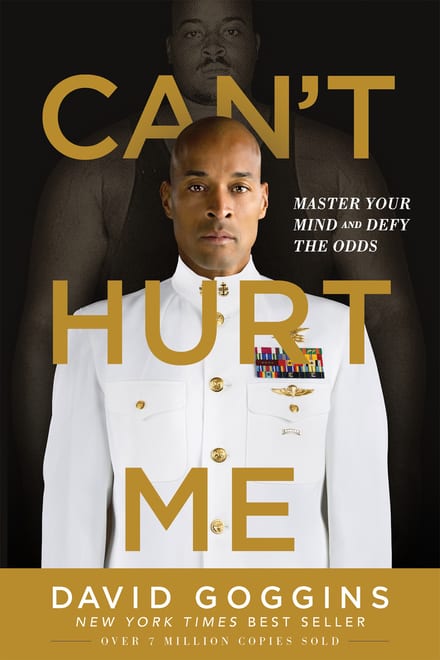
Can't Hurt Me: Master Your Mind and Defy the Odds
The full book runs ~364 pages — roughly 7 hours of reading. You get the key ideas here in 2 minutes.
The key ideas
- Push past 40%: discomfort is not your real limit
- Stock a Cookie Jar of past victories for hard moments
- Win the morning before excuses wake up
- Reject shortcuts: only relentless work forges change
- Keep promises to yourself to build self-respect
- Seek discomfort deliberately to discover your true capacity
The summary
When your body screams stop, you’re nowhere near finished. That’s the claim at the heart of Goggins’s memoir, and he earned the right to make it. He was born in 1975 in New York into a childhood built on fear. From the age of six he worked at his father’s roller-disco rink until past midnight, then fell asleep in class the next day. His father beat him and his mother until, when David was eight, the two of them fled; his older brother stayed behind. The toxic stress of those years altered his brain chemistry, cost him patches of hair and skin pigment, left him with a stutter, and wrecked his ability to learn. Teachers called him stupid. He cheated his way through school and was barely literate as a teenager. A fear of swimming ended his shot at the Air Force. He became a pest exterminator, ate to cope, and ballooned to nearly 300 pounds.
Then a documentary about Navy SEALs rearranged his life. He was a hundred pounds too heavy with less than three months to qualify, so he built a punishing daily regimen starting at 4:30 a.m. and lost the weight anyway. He survived SEAL training, then went looking for harder things: ultramarathons, an Ironman World Championship, and Badwater 135, a 135-mile race across Death Valley billed as the toughest foot race on earth, which he ran to raise money for the families of SEALs killed in Afghanistan. To even qualify he ran the San Diego One Day, a hundred miles, in 19 hours with no special training. He finished Badwater in 30 hours, fifth place.
Your mind quits long before you have to
Out of all that, Goggins distilled the 40% Rule. Most people, he argues, give roughly 40 percent of their true effort before they quit, mistaking the first real discomfort for a hard ceiling. Your brain is wired to protect you, and part of how it does that is by lying, insisting you’re empty when the tank is still more than half full. Push through the pain and the self-limiting beliefs and the other 60 percent is waiting there. This isn’t about ignoring genuine injury. It’s about learning that the voice telling you to stop is usually just your mind trying to conserve energy, and that the same reserve exists whether you’re grinding through a race, a job you hate, or a habit you’re trying to break.
The Cookie Jar of past victories
To reach that reserve on demand, Goggins uses what he calls the Cookie Jar. Every hard thing he’s already survived goes in the jar as a cookie: escaping his father, dropping a hundred pounds in three months, finishing Badwater. When a moment feels unbearable, he reaches in and pulls one out as proof he’s endured worse and come through. The method works by shifting your frame of reference. Suffering always feels unprecedented while you’re inside it, and the jar reminds you it isn’t. Better still, the jar rewards you for seeking hardship, because every challenge you refuse to quit becomes another cookie you can draw on later.
Win the morning, and keep the promise
Goggins starts his day at 4 a.m. with a six-to-ten-mile run, bikes 25 miles to a desk job, and squeezes in a gym session or another run at lunch. The point isn’t self-punishment for its own sake; it’s momentum. Do the hard thing first, while your resolve is highest and your excuses are still asleep, and your real goals get the best of your energy instead of the scraps left over at the end of the day. It also builds something quieter and more important: the habit of doing exactly what you told yourself you’d do. Keep those promises and you start to trust your own word, which is the foundation everything else stands on.
There are no shortcuts
Ask Goggins what actually changed his life and the answer is plain: work. No hack, no supplement, no burst of inspiration. He showed up every day and did things that felt terrible, without waiting to feel ready — the kind of deliberate hardship the Japanese tradition calls shugyo. The man who can run a hundred miles began as a barely literate exterminator who was afraid of water, and nothing but relentless daily effort closed the gap between the two. Most people, he insists, never discover what they’re capable of because they won’t stay uncomfortable long enough to find out. They want the result without the process, and the process is the only thing that works.
The bottom line
You are almost certainly capable of far more than you believe, and the only way to prove it is to keep going past the point where it starts to hurt. Read this if you suspect you’ve been coasting at 40 percent and want to know what the other 60 feels like.
Fact check
Popular books repeat findings that later research has complicated. Where Can't Hurt Me makes a testable claim, here's what the evidence actually shows.
When you feel finished you have used about 40 percent of your true capacity, leaving 60 percent in reserve.
There is a large reserve at the moment of quitting, and it is bigger than most people assume. Cyclists ridden to exhaustion at 242 W could still produce 731 W of maximal voluntary power seconds later — three times the workload they had just failed to sustain — though well below the 1,075 W they managed while fresh, and perceived effort rather than muscle failure tracked how long they lasted. That supports the shape of Goggins's argument but not the number: no study yields a fixed 40/60 split, and how much is left depends on the task, the person and the day.
- Marcora SM, Staiano W. The limit to exercise tolerance in humans: mind over muscle? Eur J Appl Physiol. 2010;109(4):763-70. PubMed
The sustained fear and violence of his childhood physically altered his brain and wrecked his ability to learn.
This part of the memoir is not motivational licence. A review in Nature Reviews Neuroscience describes maltreatment-related childhood adversity as the leading preventable risk factor for mental illness and substance abuse, with documented effects on sensory systems, network architecture, and the circuits handling threat detection, emotional regulation and reward. Learning difficulties, stuttering and school failure are among the recognised downstream consequences rather than excuses for them.
- Teicher MH, Samson JA, Anderson CM, Ohashi K. The effects of childhood maltreatment on brain structure, function and connectivity. Nat Rev Neurosci. 2016;17(10):652-66. PubMed
That childhood stress is what caused his patches of lost hair and lost skin pigment.
Stress is a widely reported trigger for alopecia areata and vitiligo, but the evidence tying either to life events is thinner than the popular account. A review of the whole dermatological literature concluded that only preliminary evidence exists for stressful life events bringing on or worsening any skin disease, with retrospective designs and uncontrolled confounders undermining the studies that found links. A case-control study of 31 vitiligo patients found no difference from controls in the overall number of stressful events — only in the count of specifically uncontrollable ones — alongside lower social support and higher alexithymia.
- Picardi A, Abeni D. Stressful life events and skin diseases: disentangling evidence from myth. Psychother Psychosom. 2001;70(3):118-36. PubMed
- Picardi A, Pasquini P, Cattaruzza MS, et al. Stressful life events, social support, attachment security and alexithymia in vitiligo. A case-control study. Psychother Psychosom. 2003;72(3):150-158. PubMed
Frequently asked questions
What is Can't Hurt Me about?
When your body screams stop, you're nowhere near finished. David Goggins's memoir traces his path from an abusive, fear-filled childhood and a nearly 300-pound body to Navy SEAL, ultramarathoner, and one of the toughest endurance athletes alive. The through-line is that most of us quit long before we've reached our real limits, and relentless daily hardship is what closes the gap.
What are the key takeaways from Can't Hurt Me?
The 40% Rule: most people give roughly 40 percent of their true effort before they quit, because the brain lies and says you're empty when the tank is still more than half full. The Cookie Jar: bank every hard thing you've survived and reach in for proof when a new moment feels unbearable. Win the morning by doing the hard thing first, and keep the promises you make to yourself so you learn to trust your own word. And there are no shortcuts — the only thing that works is showing up every day and doing what feels terrible.
Who should read Can't Hurt Me?
Read this if you suspect you've been coasting at 40 percent and want to know what the other 60 feels like. It suits anyone chasing a hard goal who needs a blunt push past their self-imposed ceiling.
Is Can't Hurt Me worth reading?
It's worth it for the raw, hard-won story and a handful of memorable mental tools like the 40% Rule and the Cookie Jar that you can actually apply. The philosophy is deliberately extreme — deliberate daily suffering, 4 a.m. runs — so readers looking for a gentle or balanced approach may find it punishing rather than inspiring. Take the mindset, adjust the intensity to your own life.