Book summary
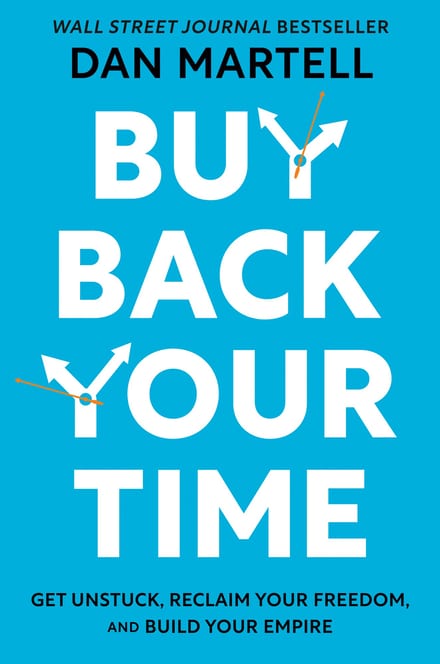
Buy Back Your Time: Get Unstuck, Reclaim Your Freedom, and Build Your Empire
Get Unstuck, Reclaim Your Freedom, and Build Your Empire
The full book runs ~272 pages — roughly 5 hours of reading. You get the key ideas here in 5 minutes.
The key ideas
- Hire for capability, not capacity, or you build a job you hate.
- Price your hour: revenue ÷ 2,000, then delegate below a quarter of it.
- Audit two weeks of calendar in red and green; buy back the red first.
- Sort work by money and energy — the DRIP matrix, and aim for Production.
- Record yourself working and let the hire write the documentation.
- Demand problems arrive as 1-3-1: one problem, three options, one recommendation.
The summary
You don’t hire people to grow your business. You hire people to buy back your time — and the growth arrives afterward, as a consequence of a founder finally spending their week on the few things only they can do. Dan Martell’s whole book turns on that inversion, and on the arithmetic that makes it a decision rather than a feeling.
His credibility comes from an unusual route in. At seventeen he was in a stolen car in a police chase that ended against the side of a house, and he served six months in jail. He was moved on to Portage, a rehab facility for troubled youth, where an old computer and a book on Java pointed him elsewhere. Over the decade that followed he built and sold three software companies — Spheric Technologies, Flowtown and Clarity — was named Canada’s top angel investor in 2012, and has since backed more than fifty startups including Intercom and Udemy. He now runs a coaching business for software founders, which supplies both his case studies and, as you’ll see, the book’s commercial motive.
Hiring for capacity is what builds the job you hate
The default hire answers the question who can do this task? Martell wants you asking a different one: what can I take off my calendar so I can spend the week in work I’m actually good at? That’s the difference between hiring for capacity and hiring for capability.
Hire for capacity and the business absorbs more volume, which is what you wanted, but every new person routes questions back through you. You stop doing the work and start unblocking the people doing the work — a job nobody offered you and you never accepted. Founders don’t burn out because they grew. They burn out because of how they grew. Martell’s fix starts before the job description: rather than one person per task, group related jobs into a single role — invoicing, client activation and receivables in one seat.
Put a price on your hour, then respect it
Here’s the number that makes the rest of the book operational. Take your annual revenue and divide it by 2,000 working hours to get your effective hourly rate. A million-dollar business gives you $500 an hour. Now divide that by four. Anything you could pay someone $125 an hour or less to do, you should not be doing yourself.
The quarter is where the margin lives: paying a fraction of your own rate for work you’d otherwise do is roughly a fourfold return, so it stops reading as an expense and starts reading as a trade. What makes the math uncomfortable is the work it condemns. The invoicing you’re weirdly fast at, the tinkering with the website, the inbox you keep at zero — priced against your own hour, those are the most expensive things in your week.
Money is one axis; energy is the other
Rate alone will send you wrong, because some well-paid work still hollows you out. So Martell has you run a Time and Energy Audit: go back through the last two weeks of your actual calendar and mark in red everything that drained you and in green everything that gave you energy. Buy back the red first.
Plot those two axes and you get the DRIP matrix, four quadrants for sorting a calendar:
- Delegation — low money, low energy. Hand it off first; it’s costing you twice.
- Replacement — high money, low energy. Real revenue work that still flattens you — give it to someone better at it and glad to have it.
- Investment — high energy, low money today. Training, relationships, health, building systems. It pays later.
- Production — high on both. The work that earns most and lights you up.
Production is the target, and it’s small. Martell pairs it with his 95/5 rule — roughly 95 percent of your results come from 5 percent of what you do — and asks for 90 protected minutes in that quadrant every day.
Hand work over on camera, not in a manual
Most delegation fails at the transfer. You write a procedure nobody reads, or you explain it once, watch it come back wrong, and quietly take it back. The Camcorder Method flips who does the writing: record your screen while you do the task and narrate what you’re thinking, then have the person watch the recording and write the documentation themselves. Their draft tells you whether they understood it before you’re depending on them.
Then you have to stop them handing decisions back. Martell’s 1-3-1 rule sets the terms for bringing a problem to you: one clearly stated problem, three solutions you’ve already considered, one recommendation. Your job shrinks to yes or no. He runs the same logic on spending — an individual contributor can spend $50 without asking, a manager $500, a director $5,000, an executive $50,000, all of it reported after the fact rather than approved before it. Small sums of money buying back large amounts of founder attention is the entire book in miniature.
The bottom line
Treat every hire as a purchase where the thing you’re buying is hours: price your hour, find the work below a quarter of it that also drains you, and buy that back before you hire anyone to make the company bigger. The frameworks are unusually concrete for this genre, and the DRIP matrix earns its place by refusing to let you judge a task on money alone.
Be clear about who this works for. It assumes a business with enough revenue and discretion over spending to hire, which makes it a poor fit for employees — you can borrow the energy audit, but not the math. And the book is the front door to Martell’s coaching business, so the pitch runs alongside the advice. Read it if you own a company, the revenue is fine, and the calendar is the thing that’s broken.
Fact check
Popular books repeat findings that later research has complicated. Where Buy Back Your Time makes a testable claim, here's what the evidence actually shows.
Roughly 95 percent of your results come from 5 percent of what you do.
Output really is far more lopsided than the bell curve organizations plan around: across 198 samples covering 633,263 people, 186 of them (93.9%) fit a power-law distribution better than a normal one. But the measured concentration is nowhere near 95/5. In the authors' own worked example, the top 5% of workers produced 26% of total output and the top percentile produced 10%. The skew is real and it matters; the specific ratio is rhetoric, and the research measures spread across people rather than across one person's tasks.
- O'Boyle E Jr, Aguinis H. The best and the rest: revisiting the norm of normality of individual performance. Personnel Psychology. 2012;65(1):79-119. Source
Paying someone else to do the work that drains you is a good trade rather than an expense.
The money-for-time swap has been tested directly. Across surveys of 6,271 adults in the United States, Canada, Denmark and the Netherlands, people who paid to outsource disliked tasks reported higher life satisfaction (d = 0.24), and only about 28% of respondents were buying time in a given month. A field experiment with 60 working adults given $40 to spend on two consecutive weekends found greater end-of-day positive affect after a time-saving purchase (mean 4.00) than after a material one (3.71). What the evidence supports is the well-being half of Martell's argument; no study tests his fourfold-return arithmetic.
- Whillans AV, Dunn EW, Smeets P, Bekkers R, Norton MI. Buying time promotes happiness. Proc Natl Acad Sci U S A. 2017;114(32):8523-8527. PubMed
Being the person every question routes through is what wears founders down, so a block of protected, uninterrupted time each day is the fix.
Interruption costs something, but not the thing most people assume. In a controlled study of 48 people doing simulated office email work, interrupted tasks were finished faster than uninterrupted ones (about 20.3 and 20.6 minutes against 22.8 at baseline), with no loss of accuracy or politeness — people compensated by working faster and writing less. The price showed up as strain: after roughly 20 minutes, interrupted work produced significantly higher stress (9.5 and 9.1 against 6.9 on a 20-point scale), plus more frustration, time pressure and effort. Protecting a daily block is defensible on burnout grounds, which is Martell's actual argument, but not on raw throughput.
- Mark G, Gudith D, Klocke U. The cost of interrupted work: more speed and stress. In: Proceedings of the SIGCHI Conference on Human Factors in Computing Systems (CHI '08). ACM; 2008. Source
Frequently asked questions
What is Buy Back Your Time about?
It inverts why founders hire: you don't hire people to grow the business, you hire them to buy back your time, and growth arrives afterward as a consequence of spending your week on the few things only you can do. Dan Martell turns that into arithmetic rather than a feeling, so delegation becomes a decision you can calculate.
What are the key takeaways from Buy Back Your Time?
Hiring for capacity — finding someone to do a task — builds the job you hate, because every new person routes questions back through you; hire for capability instead, and group related jobs into one role. Price your hour by dividing annual revenue by 2,000 working hours, then divide by four: anything you could pay someone a quarter of your rate or less to do, you shouldn't be doing. Money is only one axis, so run a Time and Energy Audit over the last two weeks of your calendar, marking draining work red and energising work green, and sort it with the DRIP matrix — Delegation, Replacement, Investment, Production — with 90 protected minutes a day in Production. Hand work over with the Camcorder Method: record yourself doing the task and have the other person write the documentation. And stop decisions coming back with the 1-3-1 rule — one problem, three solutions considered, one recommendation.
Who should read Buy Back Your Time?
It's for owners of a business where the revenue is fine but the calendar is broken. It assumes enough revenue and discretion over spending to hire, so employees can borrow the energy audit but not the math.
Is Buy Back Your Time worth reading?
The frameworks are unusually concrete for this genre, and the DRIP matrix earns its place by refusing to let you judge a task on money alone. Two honest caveats: the whole system rests on having revenue and the freedom to spend it, and the book is the front door to Martell's coaching business for software founders, so the pitch runs alongside the advice.