Book summary
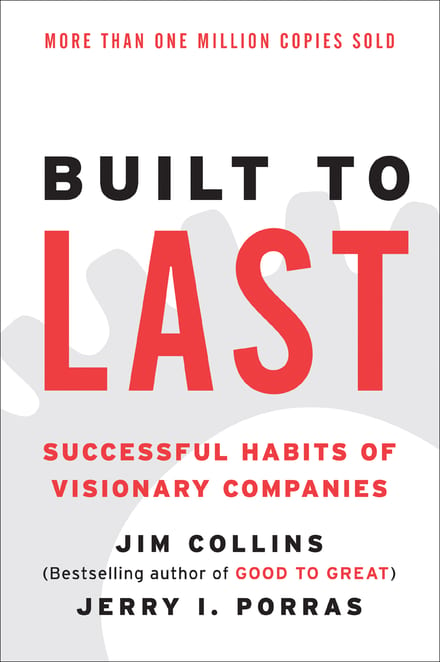
Built to Last: Successful Habits of Visionary Companies
Successful Habits of Visionary Companies
The full book runs ~355 pages — roughly 7 hours of reading. You get the key ideas here in 5 minutes.
The key ideas
- A dollar in the eighteen visionary companies in 1926 was worth $6,356 by 1990.
- Only three of eighteen began with a great idea; HP tried automatic urinal flushers.
- Merck gave away its river-blindness cure; profits, George Merck said, follow the patient.
- Boeing staked roughly a quarter of its net worth on the 707 prototype.
- Nordstrom's whole handbook: 'Use your good judgment. There will be no additional rules.'
- Across 1,700 years of company history, only four CEOs were hired from outside.
The summary
In 1988 two Stanford researchers got stuck: who is the charismatic visionary leader of 3M? Nobody could name him. The company had run through ten generations of chief executives, so no single genius or lucky product could explain it. Collins and Porras spent six years on the answer. They surveyed seven hundred CEOs, took the twenty companies named most often, cut everything founded after 1950, and were left with eighteen: Merck, Sony, Boeing, 3M, Wal-Mart, Disney among them. Then the move that makes the book work: each was paired with a rival from the same era and industry. Boeing against McDonnell Douglas. Motorola against Zenith. Wal-Mart against Ames. The comparisons aren’t failures; they beat the market. Whatever both groups share explains nothing; only the differences count. A dollar in the general market on January 1, 1926, was worth $415 by the end of 1990. A dollar in the comparison companies, $955. A dollar in the eighteen, $6,356.
The company is the ultimate creation
Hewlett and Packard started a company in 1937 without knowing what it would make. They tried a bowling foul-line indicator, an automatic urinal flusher, and a shock machine for losing weight. Sony’s founders brainstormed after incorporating and considered bean-paste soup. 3M began as a failed mine whose stock traded at two shares for a shot of cheap whiskey. Only three of the eighteen launched on a genuinely great idea, against eleven of the comparisons; early entrepreneurial success turned out to be negatively correlated with becoming visionary.
Their distinction is telling time versus building a clock. George Westinghouse was a brilliant inventor who founded fifty-nine other companies and was right that AC would beat Edison’s DC. Charles Coffin, GE’s first president, invented nothing — he built America’s first industrial research laboratory. Westinghouse’s greatest creation was a power system; Coffin’s was General Electric. Which is why you’ve never heard of William McKnight, who ran 3M for fifty-two years.
The Genius of the AND
Merck developed Mectizan, a cure for river blindness, knowing its million patients couldn’t pay. When no government stepped in, Merck gave it away and funded distribution. Ideals or good business? Both. “Medicine is for the patient,” George Merck said in 1950. “It is not for the profits. The profits follow.” Pfizer’s president then said “we aim to get profit out of everything we do,” and bought fourteen companies in four years. In seventeen of eighteen pairs the visionary company was the more ideological — and made more money.
Johnson & Johnson’s 1943 Credo ranks stockholders fifth, behind doctors, employees, managers and communities. In 1982, after seven deaths in Chicago, J&J pulled every Tylenol capsule in America, an estimated $100 million. Days later Bristol-Myers faced tampered Excedrin and recalled only in Colorado. But content isn’t the point: Philip Morris makes the list too, defiant and proud of cigarettes. What separates these companies is that the ideology is lived, not that you’d like it. Profit, the authors write, is like oxygen: necessary, not the point of life.
Preserve the core, change everything else
The ideology is the only permanent thing; strategy, structure, products and cultural norms should all be open for demolition. IBM stumbled, they argue, by confusing blue suits and mainframes with what it actually believed.
Progress gets stimulated two ways. One is the BHAG, the Big Hairy Audacious Goal. In 1952 Boeing gambled roughly a quarter of its net worth on a prototype for a commercial jet no airline wanted, and built the 707. In 1965 it committed to the 747, which could have killed the company; asked what he’d do if the first one crashed on takeoff, chairman William Allen said he’d rather discuss something pleasant, like a nuclear war. A good BHAG outlives whoever set it — the moon mission didn’t stall when Kennedy died.
The other way is messier. J&J got into baby powder because a doctor complained about skin irritation and was mailed some talc; that accident opened a consumer business worth 44 percent of revenue. Wal-Mart’s greeters began as one manager’s anti-shoplifting experiment. 3M’s masking tape came from a young employee overhearing a paint shop’s profanity — and 3M institutionalized the accident: 15 percent of technical time on projects of your own choosing, a quarter of each division’s sales from products under five years old. Branch, then prune.
You either fit or you’re ejected
None of it is comfortable. Nordstrom’s employee handbook is a single card: “Rule #1: Use your good judgment in all situations. There will be no additional rules.” Sales per hour are ranked and posted in the back room, secret shoppers grade your smile, half of new hires are gone within a year. Summed across indoctrination, tightness of fit and elitism, the visionary companies were more cult-like in fourteen of eighteen pairs. Buy in and you may never be happier; don’t, and you’re ejected like a virus.
They also grow their own. Across seventeen hundred years of combined company history, only four CEOs were ever hired directly from outside. Jack Welch joined GE at twenty-four and spent twenty years inside before the top job; his predecessor began planning that succession seven years ahead, from ninety-six internal candidates. And nobody is allowed to feel finished: P&G set its own brands at each other’s throats from 1931, and Marriott’s chairman visited up to two hundred properties a year while Howard Johnson, Jr. said “we are a reacting company” — his was sold in 1979 and resold six years later for less than half the price.
The bottom line
Enduring companies aren’t led by prophets. They’re engineered by people who care more about the institution than about being right, and who bolt real mechanisms onto both halves of the job: keep the handful of things you’d hold even if they cost you, churn everything else. Read it if you’re building something you want to outlive you; skip it if you want tactics for this quarter, since the evidence runs in decades and stops in the mid-1990s.
Fact check
Popular books repeat findings that later research has complicated. Where Built to Last makes a testable claim, here's what the evidence actually shows.
The eighteen visionary companies turned a 1926 dollar into $6,356 by 1990 against $415 for the market, and the six habits the study found explain that outperformance.
The arithmetic is not in dispute, but a sample chosen because it already won cannot test what caused the winning. Benchmarking US company performance from 1965 to 2008 against a Markov-chain model of pure randomness, Henderson, Raynor and Ahmed found that genuinely sustained superior performers do exist above the chance rate — yet false positives, long winning runs produced by luck alone, occur often enough to fool many observers, so only very stringent thresholds separate the two. A 65-year return figure for eighteen firms picked for their reputations clears no such threshold.
- Henderson AD, Raynor ME, Ahmed M. How long must a firm be great to rule out chance? Benchmarking sustained superior performance without being fooled by randomness. Strateg Manage J. 2012;33(4):387-406. Source
Companies guided by an ideology that goes beyond profit make more money than their profit-focused rivals — in seventeen of eighteen pairs the more ideological company also outperformed financially.
Purpose by itself shows no relationship to financial results. Using roughly 500,000 employee survey responses, Gartenberg, Prat and Serafeim found that what predicted higher future accounting and stock-market performance was purpose combined with clarity about the path to it — and specifically as reported by middle managers and professional staff, not by senior executives or hourly workers. Stated values don't pay; values the middle of the organization can act on do.
- Gartenberg C, Prat A, Serafeim G. Corporate purpose and financial performance. Organ Sci. 2019;30(1):1-18. Source
Setting a Big Hairy Audacious Goal — Boeing staking roughly a quarter of its net worth on the 707 — is a dependable mechanism for driving a company forward.
Difficult, specific goals do raise performance, but a review in Academy of Management Perspectives argued the benefits have been overstated while the systematic harms went ignored: narrowed focus that starves everything not measured, distorted risk preferences, more unethical behaviour, inhibited learning, eroded culture and weakened intrinsic motivation. Betting a quarter of net worth on one prototype is the distorted risk preference that review describes, and the book's examples are drawn from the companies where the bet paid. The mechanism is real; its reliability is not.
- Ordóñez LD, Schweitzer ME, Galinsky AD, Bazerman MH. Goals gone wild: the systematic side effects of overprescribing goal setting. Acad Manage Perspect. 2009;23(1):6-16. Source
Enduring companies grow their own leaders — only four CEOs in seventeen hundred years of combined history came from outside — so hiring an outsider is a warning sign.
A longitudinal study of CEO successions in the US airline and chemical industries from 1972 to 2002 found that a new chief executive's 'outsiderness' had no main effect on post-succession performance. Whether the outside hire helped or hurt depended on context: how munificent the environment was, how the firm had performed beforehand, and whether the senior team turned over too. Long-lived firms do promote from within, but the evidence does not make that the cause of their longevity.
- Karaevli A. Performance consequences of new CEO 'outsiderness': moderating effects of pre- and post-succession contexts. Strateg Manage J. 2007;28(7):681-706. Source
Frequently asked questions
What is Built to Last about?
It's a six-year study of eighteen companies that stayed great for decades — Merck, Sony, Boeing, 3M, Wal-Mart, Disney among them — each paired against a rival from the same era and industry so that only the differences between them count. The conclusion is that enduring companies aren't made by charismatic prophets or brilliant product ideas, but by people who treat the organization itself as the thing they're building. A dollar in the eighteen in 1926 was worth $6,356 by 1990, against $955 in the comparison companies.
What are the key takeaways from Built to Last?
Clock building, not time telling: build something that keeps working after you're gone instead of being the genius with the answers. The Genius of the AND over the Tyranny of the OR: real ideals and real profits, not a choice between them. Preserve the core and stimulate progress: keep a lived ideology fixed and put strategy, structure and products up for demolition. Progress comes two ways — the BHAG, a Big Hairy Audacious Goal like Boeing betting the company on the 747, and messy evolution, trying a lot of things and keeping what works. Then a demanding, cult-like culture, CEOs grown from inside, and mechanisms that stop anyone feeling finished.
Who should read Built to Last?
Founders, executives and anyone building an institution they want to outlast them — particularly if you suspect your company depends too heavily on one person. It also works as a corrective for anyone who assumes a great idea or a star leader is what separates lasting companies from ordinary ones.
Is Built to Last worth reading?
The paired research design is what makes it land: every claim comes with a rival that had the same opportunity and didn't take it, so the examples argue rather than decorate. Clock building, core ideology and BHAGs have become standard vocabulary for good reason. The catch is the timescale — the evidence runs in decades and stops in the mid-1990s, so if you want tactics for this quarter, skip it.