Book summary
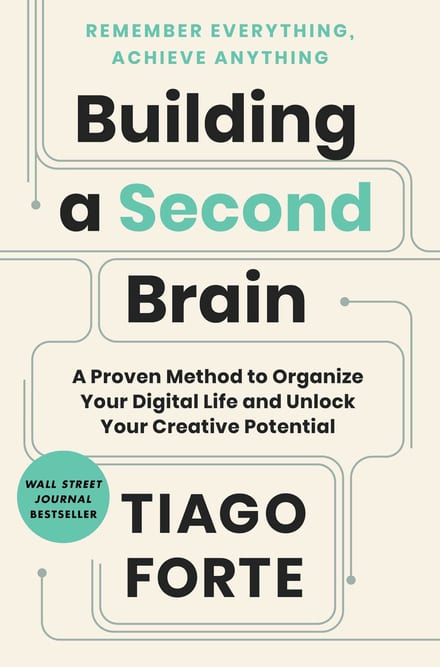
Building a Second Brain
A Proven Method to Organize Your Digital Life and Unlock Your Creative Potential
The full book runs ~240 pages — roughly 4 hours of reading. You get the key ideas here in 4 minutes.
The key ideas
- Offload memory to a reliable external note-taking system
- Capture only what resonates—inspiring, useful, personal, or surprising
- Organize by project and action, not by topic
- Distill notes in layers so future-you finds insight fast
- Create by remixing your library of past thinking
- Anchor everything with checklists, reviews, and noticing habits
The summary
You don’t have a memory problem. You have a storage problem you keep trying to solve with your head. Your mind evolved to make connections and generate ideas, not to warehouse every fact, quote, and stray insight you collect — and when you force it to, you drown. Research from the International Data Corporation found that the average knowledge worker spends 26 percent of the day just hunting for scattered information, and finds it only about half the time. Tiago Forte’s fix is a Second Brain: an external, digital system that captures what matters, files it by where it’ll be useful, and hands it back as raw material when you sit down to create.
Forte stumbled onto the idea while chronically ill. A mysterious throat condition stumped his doctors for years, so he started documenting every symptom, treatment, and piece of research in one place. That record led to a diagnosis — and to a realization that organized notes have a power of their own. There’s even neuroscience behind it: when people consistently use a tool to extend their reach, the brain remaps its image of the body to include the tool. A note-taking app can genuinely become part of your mind. Forte’s method for building one is a four-step loop he calls CODE: Capture, Organize, Distill, Express.
Capture only what resonates
Taylor Swift takes notes. So does Jerry Seinfeld. Serious creative output is assembled from fragments collected over years, but the trick is restraint — you’re curating an information diet, not hoarding. Save only what strikes you as inspiring, useful, personal, or surprising: the quote that stops you mid-scroll, the takeaway from a meeting, the shower thought you’ll lose by lunch. Skip anything too big or that needs a special app to open.
To aim your attention, keep a running list of a dozen questions you genuinely care about — “How do I live less in the past?”, “What makes eating well easier?” Richard Feynman worked this way, holding a set of favorite problems in mind and testing every new idea against them. “Every once in a while there will be a hit,” he said, “and people will say, ‘How did he do it? He must be a genius!’” The genius was the system. And don’t sort as you capture; that’s friction. Grab the note now, organize later.
Organize by where you’ll use it
Most filing systems fail because they’re built like libraries, sorted by subject for storage. You’re not a librarian; you’re trying to finish things. So file by usefulness with PARA — four buckets. Projects are efforts with a clear start and end: ship the proposal, plan the trip, write the post. Areas are ongoing responsibilities with no end date: health, finances, parenting. Resources are things you might reference someday. Archives hold what’s done or abandoned.
When something new comes in, walk down the ladder. Which project does this serve? If none, which area? If none, which resource? If nothing fits, archive it. That keeps the system lean and pointed at action instead of becoming a monument to everything you’ve ever read.
Distill in layers
A note you can’t understand six months later is dead weight. Progressive summarization keeps it alive by condensing in passes. The full capture is layer one. Bold the key phrases. Highlight the best of the bold. For your most valuable notes, add a one-line summary up top. Each layer should shrink the last by roughly 80 percent. The failure mode is highlighting everything — do that and you’ve done nothing. Be ruthless, so future-you can grab the insight in seconds without rereading the whole thing.
Express by remixing what you have
The point of all this isn’t tidy storage; it’s output. When you build a presentation or an essay, you’re not starting from a blank page — you’re pulling from a library of your own past thinking, ready to be recombined. Resurface it by searching, browsing your folders, or letting an old note collide with a new one. Share early and often, because other people’s feedback gives you fresh angles on things you already know.
Three habits hold the whole system together. Project checklists make sure you start and finish work the same reliable way, reusing what you’ve done before. Weekly and monthly reviews let you step back and adjust. Noticing habits train you to spot small chances to edit, highlight, or move a note so it’s easier to find later. Structure and creativity aren’t enemies — when the information is organized, your mind finally has room to think. Chase what excites you and let the system carry the rest.
The bottom line
Treat notes as raw material for future work, not a filing cabinet: capture only what resonates, organize by project, distill in layers, and create by remixing. Offloading the storage is what frees your mind to actually think. Read this if you’re drowning in saved articles and half-finished ideas but never seem to have time to make anything.
Fact check
Popular books repeat findings that later research has complicated. Where Building a Second Brain makes a testable claim, here's what the evidence actually shows.
When you consistently use a tool to extend your reach, the brain remaps its image of the body to include the tool — so a note-taking app can become part of your mind.
The neuroscience behind the analogy is real but much narrower than the conclusion drawn from it. Iriki's macaques, trained to rake in distant food, had bimodal neurons in the caudal postcentral gyrus whose visual receptive fields expanded to cover the length of the rake and the space it could reach. Humans show a related effect: after using a mechanical grabber, people's own arm movements changed as though the limb had grown longer. But a re-analysis of seven crossmodal-congruency experiments concluded that tool use does not literally extend peripersonal space, and every one of these studies involves a physical implement held in the hand — no experiment has shown the brain remapping its body schema around software.
- Iriki A, Tanaka M, Iwamura Y. Coding of modified body schema during tool use by macaque postcentral neurones. Neuroreport. 1996;7(14):2325-30. PubMed
- Cardinali L, Frassinetti F, Brozzoli C, Urquizar C, Roy AC, Farnè A. Tool-use induces morphological updating of the body schema. Curr Biol. 2009;19(12):R478-9. PubMed
- Holmes NP. Does tool use extend peripersonal space? A review and re-analysis. Exp Brain Res. 2012;218(2):273-82. PubMed
Offloading what you need to remember into a reliable external system frees your mind to do the thinking.
Saving information externally measurably improves learning of whatever comes next. Across three experiments, people who saved a file of studied material before reading a second file remembered the second file's contents significantly better than those who could not save it. The benefit vanished when the saving was unreliable — which is exactly the condition Forte's method depends on, and an argument for one trusted system over scattered apps. The broader offloading literature frames this as a trade: externalizing storage improves performance on the task in front of you, at the cost of weaker unaided memory for what you offloaded.
Progressive summarization — bolding key phrases, then highlighting the best of the bold, layer by layer — is an effective way to keep what you read usable.
Highlighting and summarizing are the two weakest techniques in the evidence base when the goal is retention. A review of ten study techniques rated both 'low utility', meaning they do not reliably improve later performance, while practice testing and distributed practice earned the only 'high utility' ratings. Forte's version is aimed at fast retrieval from a file you will reopen, not at recall from memory, and that use has not been tested either way — so the method is not refuted so much as unevidenced. The safe reading: layered highlighting may make your notes easier to skim later, but expect no learning benefit from the act of highlighting itself.
- Dunlosky J, Rawson KA, Marsh EJ, Nathan MJ, Willingham DT. Improving Students' Learning With Effective Learning Techniques: Promising Directions From Cognitive and Educational Psychology. Psychol Sci Public Interest. 2013;14(1):4-58. PubMed
Frequently asked questions
What is Building a Second Brain about?
You don't have a memory problem — you have a storage problem you keep trying to solve with your head. The book proposes a Second Brain: an external, digital system that captures what matters, files it by where it'll be useful, and hands it back as raw material when you sit down to create. The point is to offload storage so your mind is free to make connections and generate ideas.
What are the key takeaways from Building a Second Brain?
The core is a four-step loop called CODE. Capture only what resonates — inspiring, useful, personal, or surprising — rather than hoarding everything. Organize by where you'll use it with PARA: Projects, Areas, Resources, Archives. Distill in layers using progressive summarization, bolding and highlighting so each pass shrinks the last by about 80 percent. Express by remixing your own past notes instead of starting from a blank page. Project checklists, weekly reviews, and noticing habits hold it all together.
Who should read Building a Second Brain?
Read this if you're drowning in saved articles and half-finished ideas but never seem to have time to make anything. It fits knowledge workers, writers, and creators who collect a lot but struggle to turn it into finished output.
Is Building a Second Brain worth reading?
It's worth it if your problem is scattered information and stalled projects — the CODE and PARA frameworks give you a concrete, repeatable system, and the emphasis on capturing by resonance and organizing by action is genuinely useful. If you already have a note habit that works, some of it will feel like formalizing what you do. The strongest idea is simple: treat notes as raw material for future work, not a filing cabinet.