Book summary
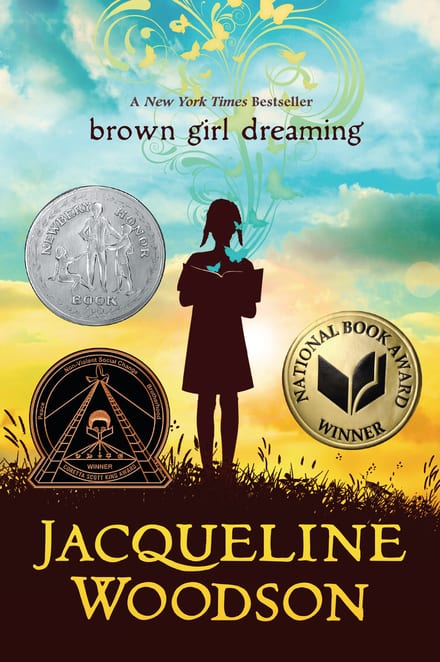
Brown Girl Dreaming
The full book runs ~368 pages — roughly 7 hours of reading. You get the key ideas here in 5 minutes.
The key ideas
- Built from short free-verse poems, each holding one moment in white space
- Sequence replaces cause, so the gaps between memories stay visible
- Two places argue over her: her father's North, her grandparents' Greenville
- Civil rights reaches a child sideways, through what adults quietly refuse
- A faith handed down before she could choose it, told without score-settling
- Slow reading becomes homage to ancestors forbidden to learn to read
The summary
Jacqueline Woodson’s premise in Brown Girl Dreaming is that a childhood doesn’t come back to you as a story. It comes back as separate lit moments with dark between them — a porch, a smell, one sentence somebody said once — and any form that smooths those moments into continuous narrative is being false to how remembering works. So she built her childhood out of short free-verse poems, each holding one moment inside a lot of empty page. Memory, she told Fresh Air in 2014, “comes in these small moments with all of this white space around it.” Writing the book as a straight narrative, she said ten years later, “would have been a lie.”
That makes the form the book’s first idea, not its packaging: read this as a plot and you miss it.
The white space is doing the work
Terry Gross told Woodson that the verse made the memoir easier to read than prose would have been: so little on each page, so much space around the words. Each poem sets down one image and stops. What links them is sequence rather than cause — this, then this, then this, with no tidy account of the gap between. The unknown stays in.
The first poem fixes the date and the place, February 12, 1963, University Hospital in Columbus, Ohio, and then immediately points somewhere else: she is born in Ohio, but the poem already has South Carolina’s stories running through her like rivers.
The North and the South argue over her
Her parents separated when she was very young, and her mother took the children from Ohio — Woodson was still an infant — to her own parents in Greenville, South Carolina, to Nicholtown, an all-Black community inside a city that, in Woodson’s account, went on living by segregation long after Jim Crow was formally finished. Later the children moved north again, to their mother in Brooklyn.
The book turns that biography into a standing argument between two places. In the poem “journey,” her father’s voice makes the northern case: he got her mother out of the South as fast as he could, and no Woodson was ever going to ride at the back of a bus. His verdict is “You can keep your South Carolina.” Against it stands Greenville — the grandparents, the family stories, her mother’s whole side — and a South Woodson says stayed in her: she still says hi to strangers, still isn’t afraid of silence.
The civil rights era reaches the book through that split, and it reaches it unevenly. Woodson was born into the movement’s loudest years, but she was small, in a Black neighborhood where, by her account, the adults spent little time discussing white people and a great deal on resistance: which department store the family would not walk into, and the steady insistence that being counted as lesser wasn’t true. History gets in sideways, through what the grown-ups quietly refuse to do.
A faith handed down before she could choose it
After their mother left for New York, Woodson’s grandmother pulled the children further into the religion she had always known, and they became Jehovah’s Witnesses. The poem “faith” sets out the sequence without softening it: with the mother gone, nobody is left to say the children can choose their own faith when they are old enough. Let the Bible “become your sword and your shield,” the grandmother tells them — and the poem ends by admitting that the children don’t yet know who they are fighting or what for.
Woodson left the faith at fifteen, and the book carries no score-settling about it. She has described Witnesses as unfailingly kind, and credits the long, dull hours at the Kingdom Hall with teaching her to run stories in her head out of sheer boredom. It’s an account of what a belief handed a child and what it cost her, with neither half cancelled.
The slow reader was the writer all along
This is what the whole book is built toward. Her sister read fast and got called the brilliant one; Woodson didn’t and wasn’t. Teachers, she says, wrote on her report card that “Jacqueline can do better. Jacqueline should try harder.” She read with a finger under the words until, as she put it in her TED talk, she was “untaught to do this, told big kids don’t use their fingers,” and she reread passages until they gave up how they had been made. Her own later verdict on that child: “I was reading like a writer.”
The book lets both things stay true at once — the girl certain she is the slow one, and the writer forming inside the slowness. In one poem, read on NPR by Woodson and an eighth-grade reader trading lines, they arrive in a single breath: “I believe in my sister’s brilliance and the two easy books I love to read.”
Woodson ties the reading back to Nicholtown, where, as she puts it in the TED talk, everyone was descended from people who had not been allowed to learn to read or write. Slowness stops being a lack and becomes a stance: she reads slowly, she says, “to pay homage to my ancestors.”
The bottom line
Woodson’s case is that the honest shape for a remembered life is fragments with the gaps left showing, and that what the adults around a child call a deficiency can turn out to be a writing life arriving early. The book won the 2014 National Book Award for Young People’s Literature and, in 2015, a Newbery Honor, the Coretta Scott King Author Award and a Sibert Honor — the last of those an award for informational books, a telling place for a book of poems to land. Read it if you want the civil rights era at a child’s eye level, if you grew up between two places that each wanted all of you, or if anyone ever told you that you read too slowly.
Fact check
Popular books repeat findings that later research has complicated. Where Brown Girl Dreaming makes a testable claim, here's what the evidence actually shows.
The Greenville, South Carolina of Woodson's childhood went on living by segregation long after Jim Crow was formally over.
Greenville was one of fifteen South Carolina cities whose districts desegregated under federal order in 1964, but that step moved only a few Black students into previously all-white schools and most schools stayed all-white or all-Black. Real integration came on February 17, 1970, when Greenville County Schools reassigned more than 12,000 students and 500 teachers mid-year to reach roughly 80 percent white and 20 percent Black at every school — the board and administration had four days to build the plan. South Carolina was the last state in the nation forced to desegregate its public school system.
Frequently asked questions
What is Brown Girl Dreaming about?
Jacqueline Woodson's childhood, told in short free-verse poems rather than continuous narrative — because, she says, a childhood doesn't come back to you as a story. It moves between Ohio, her grandparents' Nicholtown in Greenville, South Carolina, and her mother's Brooklyn, with the civil rights era reaching each place at a different speed. Underneath it runs the story of a girl everyone called the slow reader who turned out to be a writer.
What are the key takeaways from Brown Girl Dreaming?
The form is the first idea: each poem sets down one moment and stops, so what links them is sequence rather than cause and the gaps stay visible. The book stages a standing argument between the North her father chose and the South her mother's family kept. It gives an honest account of a faith handed to a child before she could choose it, without settling scores. And it turns slowness into a stance — Woodson says she reads slowly to pay homage to ancestors who were not allowed to learn to read at all.
Who should read Brown Girl Dreaming?
Anyone who wants the civil rights era at a child's eye level rather than a textbook's, anyone who grew up between two places that each wanted all of them, and anyone who was ever told they read too slowly.
Is Brown Girl Dreaming worth reading?
Yes — it won the 2014 National Book Award for Young People's Literature and, in 2015, a Newbery Honor, the Coretta Scott King Author Award and a Sibert Honor. The verse makes it fast to read and hard to skim, and the restraint is deliberate. If you want a full historical account of the movement, or a plot with a shape, this isn't that book; it's a childhood in fragments, and it leaves the gaps in on purpose.