Book summary
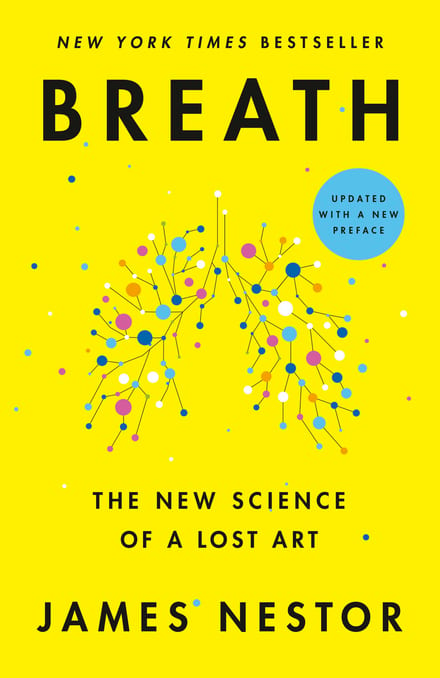
Breath: The New Science of a Lost Art
The full book runs ~334 pages — roughly 6 hours of reading. You get the key ideas here in 4 minutes.
The key ideas
- Breathe through your nose to filter, warm, and regulate air.
- Mouth breathing raises blood pressure and deforms faces over time.
- Soft modern diets shrank our jaws, airways, and teeth.
- Lung capacity predicts lifespan better than genetics or diet.
- Slow to six breaths per minute to retain vital CO₂.
- Extreme breathing techniques can override the autonomic nervous system.
The summary
How you breathe matters more than how much. The difference between the nose and the mouth, and between fast shallow breaths and slow controlled ones, can reshape your face, alter your health, and even predict how long you’ll live. Modern medicine has mostly looked past this, treating chronic congestion as normal and tinkering with sinus symptoms rather than their causes.
The nose is not optional
Your nasal passages and sinuses developed specifically to process air; your mouth did not. Breathing through your nose filters, warms, and moistens the air, and it releases nitric oxide, a chemical that lowers blood pressure and regulates heart rate. The nasal cycle, in which your two nostrils trade dominance through the day, helps balance temperature, blood pressure, and brain chemistry. Breathe through your mouth and you bypass all of it.
Mouth breathing also does active harm. It lowers pressure in the airway, which lets the soft tissues at the back of the mouth flex inward, leaving less room and making breathing harder — so mouthbreathing begets more mouthbreathing. When Nestor breathed only through his mouth for ten days as part of a study, his blood pressure climbed, his pulse raced, his temperature dropped, his sleep fell apart, his oxygen levels fell, and he felt miserable and foggy. An experiment with monkeys was starker still: two years of mouth breathing severely deformed their heads and teeth, though normal breathing eventually restored them. About half of us breathe mostly through our mouths.
We shrank our own airways
We’ve devolved in ways that sabotage breathing. When our ancestors switched to cooked, tenderized food, their brains grew larger — but the bigger brain crowded the sinuses and pushed out the nose, and the airway narrowed. Modern processed diets, soft and barely chewed, have weakened and shrunk our facial structures further, which is why snoring and asthma have become common. Cultures without the modern diet mostly don’t suffer these problems. In the 1830s, researcher George Catlin traveled among more than 50 indigenous groups whose diets ranged from all-meat to nearly vegetarian; almost all had wide mouths, broad nasal openings, near-perfect teeth, and excellent health, and all breathed through their noses. Catlin adopted the habit himself, cured his own respiratory trouble, and wrote a book urging people to “shut your mouth.”
The damage can be reversed. New orthodontic findings show that chewing motions stimulate stem cells that grow facial bone. Nestor used a Homeoblock mouthpiece that simulates extra chewing for a few weeks; it widened his airways, realigned his jaw, and spurred two cubic centimeters of new facial bone.
Slower breath, longer life
The single best predictor of lifespan turned out not to be genetics, diet, or exercise, but lung capacity. And the way to build it isn’t to breathe more — it’s to breathe less, and slower. Carl Stough, a choir director with no medical training, helped patients with chronic lung disease after realizing they never fully exhaled; teaching them to engage the diaphragm and empty their lungs boosted their capacity, and he later applied the method to Olympic athletes.
Spiritual traditions across many faiths landed independently on breaths of about 5.5 seconds during prayer and meditation — as do nature-based practices like Japanese forest bathing. The reason is chemistry. Slow, shallow breathing retains more carbon dioxide, which dilates blood vessels, improves circulation, and makes oxygen delivery more effective. The balance of oxygen and carbon dioxide matters more than the sheer amount of oxygen, which is why oxygen bars do nothing — you simply exhale the excess. Training the body to tolerate slightly more CO₂ can even raise VO₂ max, the best gauge of cardiorespiratory fitness. Just five to ten minutes a day helps: inhale for about 5.5 seconds, exhale for 5.5 seconds, breathing shallowly through the diaphragm, for roughly six breaths and 5.5 liters of air a minute. As a bonus fact from the same physiology, the lungs are the body’s weight-regulating system — for every ten pounds of fat you lose, about eight and a half leave through your breath as carbon dioxide.
Extreme breath, extreme states
Because the lungs interact constantly with the autonomic nervous system, pushing your breathing to extremes can produce seemingly superhuman feats. Tibetan monks use Tummo, or “inner fire,” to stay warm in the cold. The yogi Swami Rama could slow his heart nearly to a stop or drive it to 300 beats a minute and shift his temperature and brain waves through breath and visualization. Wim Hof ran a half-marathon barefoot and shirtless in the Arctic using short, aggressive bursts of breath. These methods are controversial and not for casual practice. Stanislav Grof, an early LSD researcher, developed Holotropic Breathwork to induce hallucinations through heavy breathing after the drug was banned, and carbon dioxide therapy deliberately triggers brief panic attacks followed by deep calm to treat anxiety. Ancient Eastern traditions grasped this power long ago through ideas like prana and chi, the life force carried on the breath.
The bottom line
Breathe through your nose, slow to about six breaths a minute, and engage your diaphragm — small changes that can widen your airways, lower your blood pressure, and lengthen your life. Read this if you snore, struggle with anxiety, want better athletic stamina, or simply want to fix a bodily function you’ve been doing wrong your whole life.
Fact check
Popular books repeat findings that later research has complicated. Where Breath makes a testable claim, here's what the evidence actually shows.
Lung capacity is the single best predictor of how long you will live — a better predictor than genetics, diet or exercise.
Lung function really does predict mortality, and strongly. In the Buffalo Health Study's 29-year follow-up of 554 men and 641 women, those in the lowest fifth of FEV1 had 2.24 times the all-cause mortality of the highest fifth in men and 1.81 times in women, after adjusting for age, body mass index, blood pressure, education and smoking; the Framingham data Nestor draws on found the same pattern for vital capacity and cardiovascular disease. What no study has done is rank lung capacity against genetics, diet and exercise head to head, which is what the book's superlative requires. Much of the signal is also cumulative damage — smoking, pollution, undiagnosed disease — showing up in the spirometer, rather than evidence that training your breathing lengthens life.
- Schünemann HJ, Dorn J, Grant BJ, Winkelstein W Jr, Trevisan M. Pulmonary function is a long-term predictor of mortality in the general population: 29-year follow-up of the Buffalo Health Study. Chest. 2000;118(3):656-64. PubMed
- Kannel WB, Hubert H, Lew EA. Vital capacity as a predictor of cardiovascular disease: the Framingham study. Am Heart J. 1983;105(2):311-5. PubMed
Chronic mouth breathing reshapes the face and narrows the airway, and the changes reverse once nasal breathing resumes.
Mouth-breathing children do have measurably different facial skeletons. A meta-analysis of ten cephalometric studies found their mandibular plane sat about 4.10 degrees steeper (SNGoGn) and the palatal-mandibular angle 4.92 degrees wider than nasal breathers, with a retruded mandible (SNB -1.96), labially tipped upper incisors and a narrower upper airway (SPAS -3.48 mm). The catch is direction: these are cross-sectional comparisons of children who mostly had obstructed noses or enlarged adenoids to begin with, so the studies establish the association without settling whether mouth breathing caused the face or the face caused the mouth breathing. Nestor's reversibility claim rests on Harvold's rhesus monkey experiments, not on human trials — no controlled study has shown adult facial bone reverting once nasal breathing is restored.
- Zhao Z, Zheng L, Huang X, Li C, Liu J, Hu Y. Effects of mouth breathing on facial skeletal development in children: a systematic review and meta-analysis. BMC Oral Health. 2021;21(1):108. PubMed
Slowing to about six breaths a minute — roughly 5.5 seconds in, 5.5 seconds out — retains carbon dioxide, dilates blood vessels and measurably improves health.
The blood pressure effect is real but modest. Pooling 17 randomized trials of breathing at 10 breaths per minute or slower, at least five minutes a day on three or more days a week for four weeks, gave reductions of 5.62 mmHg systolic (95% CI -7.86 to -3.38) and 2.97 mmHg diastolic (-4.28 to -1.66), with high heterogeneity between trials. A systematic review of slow breathing also found consistent increases in heart rate variability, more alpha and less theta EEG power, and self-reported calm and alertness. What the literature does not establish is the book's mechanism — that carbon dioxide retention is what does the work — or that 5.5 seconds is a uniquely correct interval rather than one point in a range from roughly four to ten breaths a minute that produces similar effects.
- Chaddha A, Modaff D, Hooper-Lane C, Feldstein DA. Device and non-device-guided slow breathing to reduce blood pressure: A systematic review and meta-analysis. Complement Ther Med. 2019;45:179-184. PubMed
- Zaccaro A, Piarulli A, Laurino M, Garbella E, Menicucci D, Neri B, Gemignani A. How Breath-Control Can Change Your Life: A Systematic Review on Psycho-Physiological Correlates of Slow Breathing. Front Hum Neurosci. 2018;12:353. PubMed
For every ten pounds of fat you lose, about eight and a half leave the body through your breath as carbon dioxide.
This one is right, and the arithmetic is the point of the paper it comes from. Meerman and Brown balanced the atoms in triglyceride oxidation and found that 84% of the mass of fat lost is exhaled as carbon dioxide and the remaining 16% leaves as water, so 10 lb of fat lost means roughly 8.4 lb breathed out. The lungs are the main excretory organ for fat. The one thing the figure does not imply is the reverse — breathing harder or faster does not burn fat, because the rate is set by metabolic demand, not by ventilation.
- Meerman R, Brown AJ. When somebody loses weight, where does the fat go? BMJ. 2014;349:g7257. PubMed
Frequently asked questions
What is Breath about?
How you breathe matters more than how much. The book makes the case that breathing slowly through your nose, rather than fast and through your mouth, can reshape your face, lower your blood pressure, and even predict how long you'll live. It argues modern medicine has mostly ignored this, treating chronic congestion as normal instead of fixing its causes.
What are the key takeaways from Breath?
Breathe through your nose, not your mouth: the nose filters and warms air and releases nitric oxide, while mouth breathing raises blood pressure, wrecks sleep, and feeds on itself. Slower is better too — the single best predictor of lifespan turned out to be lung capacity, and slow breaths around 5.5 seconds in and out retain more carbon dioxide, which improves circulation. Soft modern diets shrank our airways, but chewing can regrow facial bone, and pushing breath to extremes (Tummo, Wim Hof's method) can produce startling physical states.
Who should read Breath?
Read it if you snore, struggle with anxiety, want better athletic stamina, or simply want to fix a bodily function you've been doing wrong your whole life. Anyone curious about a small daily change with outsized health effects will find something usable.
Is Breath worth reading?
It's worth it for the core, practical fix: breathe through your nose, slow to about six breaths a minute, engage your diaphragm — small changes with real payoffs. The mix of hard physiology, history, and self-experiments makes it engaging, though the later chapters on extreme practices like Holotropic Breathwork are, by the book's own admission, controversial and not for casual use. Skip those parts if you just want the everyday basics.