Book summary
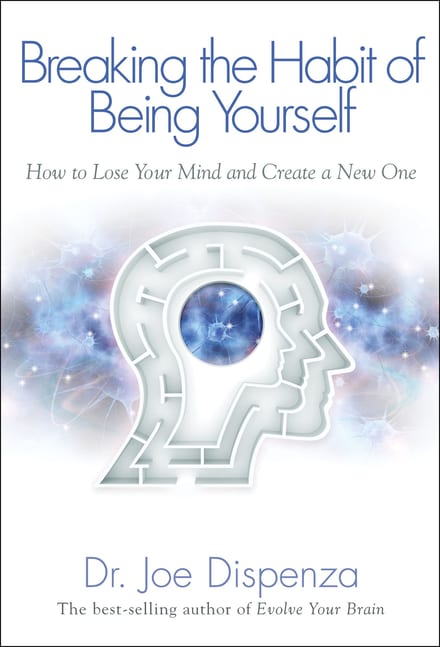
Breaking the Habit of Being Yourself
How to Lose Your Mind and Create a New One
The full book runs ~352 pages — roughly 6 hours of reading. You get the key ideas here in 5 minutes.
The key ideas
- Recognize 95% of you is memorized, automatic subconscious programming.
- Understand your body is chemically addicted to past emotions.
- Feel gratitude and joy before the desired reality arrives.
- Rehearse a new self until thoughts produce real emotions.
- Meditate to shift from analytical Beta to creative Alpha.
- Align inner state with outer action to signal the field.
The summary
You are, more than you’d like to admit, a habit. By your mid-thirties, Joe Dispenza argues, roughly 95% of who you are has hardened into memorized behaviors, automatic emotional reactions, and subconscious programs. You wake into the same moods, react to the same triggers, and rehearse the same worries, and each repetition wires those patterns deeper. The uncomfortable part of his claim is that this isn’t just mental. Your body has grown chemically addicted to the emotions you feel every day, which is why becoming someone new feels less like a decision and more like withdrawal.
Your body is addicted to the past
Every thought sets off a biochemical reaction in the brain, which signals the body, which makes you feel the way you were thinking. Then the feeling loops back and you start thinking the way you feel. Run that circuit long enough and an emotion stops being a passing response and becomes a fixture. A reaction that lasts hours or days is a mood; stretched across weeks or months it’s a temperament; carried for years it sets into a personality trait. When something in the present resembles an old wound, the body reproduces the exact chemistry of the past—grief, anger, fear—as if the original event were happening again.
This is why change is so hard. The body, hooked on its familiar chemical state, fights any attempt to break the pattern, flooding you with cravings, doubts, and excuses that talk you back into the old self. Dispenza calls the forces that keep you stuck the Big Three: your environment, your body, and time. Living in survival mode—where you can fire the fight-or-flight response merely by anticipating a threat or replaying a memory—keeps you fused to all three. Chronic stress hormones don’t just feel bad; he points to research that they dysregulate genes and can drive disease.
The brain can’t tell rehearsal from reality
Here’s the lever. The brain doesn’t distinguish a vivid inner experience from an outer one. In studies of mental practice, people who only imagined playing piano exercises showed nearly the same brain changes as those who physically played. Gandhi held a picture of the future as though it were already real, and lived toward it. If you rehearse a new version of yourself until the thought produces a genuine emotion, you start teaching your body a future that hasn’t arrived yet.
Dispenza maps learning onto three brain regions. You begin by thinking: the neocortex forms new connections as you take in knowledge. You move to doing: applying that knowledge creates an experience, and the limbic brain releases chemicals that generate a new feeling, so the body now knows what the mind learned. Finally you reach being: repeat the experience until it becomes automatic and it settles into the cerebellum, the seat of the subconscious. A new state of being, he says, produces a new personality, and a new personality produces a new personal reality. As he puts it, “Knowledge without experience is merely philosophy; experience without knowledge is ignorance.”
Change the inner state before the outer world
Most of us run on a Newtonian logic: wait for something good to happen, then feel good. Dispenza flips it, drawing on quantum physics. An atom is almost entirely energy, and the observer effect suggests that attention itself collapses possibility into event. The field, he writes, “responds not to what we want; it responds to who we are being.” The practical instruction is to feel gratitude and joy before the thing you want arrives, signaling that it already has. Epigenetics gives the argument its most grounded support: your environment signals your genes, so shifting your internal environment shifts gene expression. In one study he cites, diabetics who watched a comedy and reached an elevated emotional state altered twenty-three gene expressions and improved their blood-sugar regulation.
The book leans on dramatic personal stories to make the case. Bill, after thirty years of resentment, stopped feeding those survival emotions, rehearsed an ideal self, and reports curing recurring cancer. Pamela released a bitter bond to her ex-husband in meditation and within days received an unexpected promotion and long-overdue child support. Jose meditated past his usual sense of self and woke to find ten warts gone. Take these as the book presents them; the mechanism it proposes underneath is always the same—inner state first.
The four-week rewrite
Dispenza’s method is meditation, which he defines as becoming familiar enough with yourself to slip past the analytical mind and reach the subconscious. The shift is from being your old self to observing it. He lays it out over four weeks. Week one: move your brain waves from the busy Beta state to the calmer, creative Alpha state by closing your eyes and trading thinking for watching. Week two: pick one self-limiting emotion—anger, fear, suffering—name it out loud, and hand it to a greater power to resolve in an unexpected way. Week three: catch your automatic thoughts and actions, write them down, and every time you notice the old habit, say “Change!” to weaken the wiring. Week four: invent the new self by asking “What is the greatest ideal of myself?” and rehearsing it until the thought produces real feeling. Hold the state, keep your inner life and outer actions aligned, and the payoff, he promises, shows up as synchronicities and openings. A memory stripped of its emotional charge, he writes, becomes wisdom.
The bottom line
The core idea is that you are a set of hardwired loops your body has learned to crave, and that meditation plus emotionally charged mental rehearsal can loosen them and install a new self. Read this if you’re drawn to the mind-over-matter end of self-help and want a concrete daily protocol, though you’ll want to hold its bolder claims lightly.
Fact check
Popular books repeat findings that later research has complicated. Where Breaking the Habit of Being Yourself makes a testable claim, here's what the evidence actually shows.
By your mid-thirties roughly 95% of who you are has hardened into memorized subconscious programming.
No study produces the 95% figure, and personality measurably keeps moving well past 35. A meta-analysis of longitudinal studies found social dominance, conscientiousness and emotional stability rise most between ages 20 and 40, agreeableness changes only in old age, and 4 of 6 trait categories showed significant change in middle and old age. Diary research does support the smaller point underneath it: behaviour performed almost daily in stable contexts runs without conscious guidance, which is why people's thoughts wander during it. Automatic is not the same as fixed.
- Roberts BW, Walton KE, Viechtbauer W. Patterns of mean-level change in personality traits across the life course: a meta-analysis of longitudinal studies. Psychol Bull. 2006;132(1):1-25. PubMed
- Wood W, Quinn JM, Kashy DA. Habits in everyday life: thought, emotion, and action. J Pers Soc Psychol. 2002;83(6):1281-97. PubMed
People who only imagined playing a piano exercise showed nearly the same brain changes as those who physically played, because the brain cannot tell rehearsal from reality.
The brain-mapping half is a real result. In the study behind this claim, five days of two-hour daily piano practice enlarged the motor cortex areas targeting the finger flexors and extensors and lowered their activation threshold, and a second experiment in the same paper compared mental with physical practice on that measure. Skill is where the equivalence breaks down. A meta-analysis of 13 trials with 370 participants found imagery practice moderately improved maximal voluntary strength against doing nothing, but physical practice still came out ahead when the two were compared directly. Imagination shifts the cortical map; it does not substitute for the reps.
- Pascual-Leone A, Nguyet D, Cohen LG, Brasil-Neto JP, Cammarota A, Hallett M. Modulation of muscle responses evoked by transcranial magnetic stimulation during the acquisition of new fine motor skills. J Neurophysiol. 1995;74(3):1037-45. PubMed
- Paravlic AH, Slimani M, Tod D, Marusic U, Milanovic Z, Pisot R. Effects and dose-response relationships of motor imagery practice on strength development in healthy adult populations: a systematic review and meta-analysis. Sports Med. 2018;48(5):1165-1187. PubMed
Diabetics who watched a comedy and reached an elevated emotional state altered twenty-three gene expressions and improved their blood-sugar regulation.
The number is reported accurately. Screening 18,716 genes in the blood cells of type 2 diabetes patients, researchers found 23 whose expression differed significantly after a comic story compared with a lecture — 8 upregulated and 15 downregulated at 1.5 hours. The direction cuts against the uplifting reading, though: all four immune-response genes among them were downregulated, and the authors said more focused work was needed before anyone drew broader conclusions. A separate small study from the same group found laughter blunted the two-hour rise in postprandial blood glucose, so the glucose effect is real but short-lived, and neither result shows emotion reshaping gene expression at will.
- Hayashi T, Urayama O, Kawai K, Hayashi K, Iwanaga S, Ohta M, Saito T, Murakami K. Laughter regulates gene expression in patients with type 2 diabetes. Psychother Psychosom. 2006;75(1):62-5. PubMed
- Hayashi K, Hayashi T, Iwanaga S, Kawai K, Ishii H, Shoji S, Murakami K. Laughter lowered the increase in postprandial blood glucose. Diabetes Care. 2003;26(5):1651-2. PubMed
The quantum observer effect means that where you place your attention collapses possibility into physical reality.
In the physics, the observer is any interaction with the surrounding environment, not a mind paying attention. Zurek's review of decoherence describes the environment monitoring a system's observables and destroying the interference between them, a process called einselection that enforces classical behaviour and specifically eliminates the large-scale superpositions the mind-over-matter reading depends on. It happens whether or not anyone is watching, and at everyday scales it happens far too fast for observation to leave any opening. Nothing in the formalism connects where a person directs attention to which job, illness or relationship arrives.
- Zurek WH. Decoherence, einselection, and the quantum origins of the classical. Rev Mod Phys. 2003;75:715. Source
Frequently asked questions
What is Breaking the Habit of Being Yourself about?
Joe Dispenza argues that by your mid-thirties roughly 95% of who you are has hardened into memorized behaviors, automatic emotional reactions, and subconscious programs. The uncomfortable twist is that your body has grown chemically addicted to the emotions you feel every day, so becoming someone new feels less like a decision and more like withdrawal. The book's promise is that meditation plus emotionally charged mental rehearsal can loosen those loops and install a new self.
What are the key takeaways from Breaking the Habit of Being Yourself?
Every thought triggers a feeling that loops back into more of the same thought, so an emotion carried long enough sets into a personality, and the 'Big Three', environment, body, and time, keep you fused to the past. The lever is that the brain can't tell vivid rehearsal from reality, as studies of imagined piano practice show. Change your inner state before the outer world, supported by epigenetics, and follow a four-week meditation method: shift from Beta to Alpha brain waves, release a limiting emotion, catch old habits and say 'Change!', then rehearse an ideal self until it produces real feeling.
Who should read Breaking the Habit of Being Yourself?
Read it if you're drawn to the mind-over-matter end of self-help and want a concrete daily protocol rather than just theory. It suits people ready to commit to a structured meditation practice aimed at changing ingrained patterns.
Is Breaking the Habit of Being Yourself worth reading?
It's worth it for the actionable four-week method and its accessible take on how thoughts, feelings, and habits reinforce each other. Just hold its bolder claims lightly: the dramatic personal stories of cured cancer and vanished warts are presented as the book frames them, and the quantum-physics reasoning is more inspirational than proven, so read it as a practice guide, not established science.