Book summary
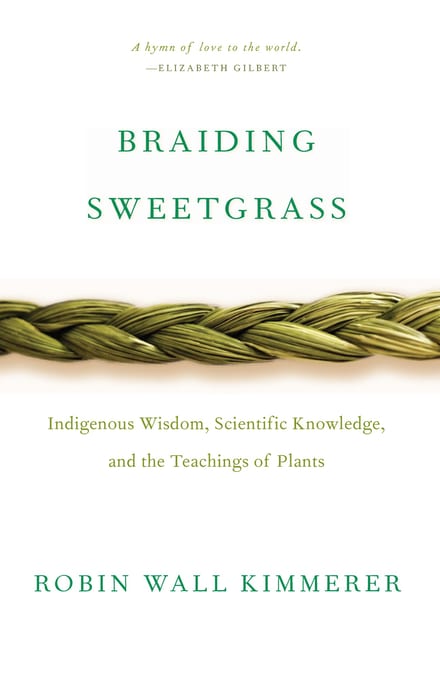
Braiding Sweetgrass: Indigenous Wisdom, Scientific Knowledge and the Teachings of Plants
Indigenous Wisdom, Scientific Knowledge and the Teachings of Plants
The full book runs ~408 pages — roughly 7 hours of reading. You get the key ideas here in 5 minutes.
The key ideas
- Treat the living world as a gift that obligates, not a commodity that settles.
- Read Skywoman as a covenant: you were given a place, so give back.
- Replace the pronoun it with ki, a name for a living being.
- Follow the Honorable Harvest: never the first, never the last, never more than half.
- Plant the Three Sisters: corn supports beans, beans feed soil, squash blocks weeds.
- Know the sweetgrass study found compensation, not the flourishing usually retold.
The summary
The same object can reach you as a commodity or as a gift, and the two leave you in completely different positions. Pay for socks and you owe nothing once the receipt prints; take socks knitted by your aunt and you are bound to her. Robin Wall Kimmerer builds an entire ecological ethic on that difference. She is a plant ecologist at the SUNY College of Environmental Science and Forestry and an enrolled member of the Citizen Potawatomi Nation, and her argument is that her two inheritances are not rivals. Science is very good at describing how a living thing works. It says nothing about how you should behave toward it. A culture that keeps only the first half ends up holding an inventory of resources and no idea what it owes them.
Skywoman arrives owing something
The book’s spine is the Haudenosaunee story of Skywoman, told in many versions across the Six Nations; in Kimmerer’s, she falls through a hole in the sky where the great Tree of Life had stood. Geese catch her. Muskrat dives for mud from the bottom of the water and gives his life bringing it up. Turtle offers his back, and the mud becomes land. Then Skywoman opens the bundle she carried down with her, seeds plucked from the Tree of Life, and scatters them across the new earth.
Notice what she does not do: arrive owning anything. She lands already in debt to the animals who saved her, and settles it by planting. Kimmerer reads this as the founding covenant between newcomer humans and the older residents of the world: you were given a place, so give something back. Set beside a creation story in which a garden is lost and the earth handed over to be subdued, it is a different set of instructions for people on the same ground.
A language in which almost nothing is an “it”
Potawatomi is built mostly out of verbs, and both its nouns and its verbs come in animate and inanimate forms. You hear a blue jay with a different verb than you hear an airplane. Water, fire, rocks and places all fall on the living side of that line. English runs the other way: it reserves he and she for humans and files every other living being under it — the same pronoun it gives a bulldozer.
That grammar was suppressed on purpose. Kimmerer’s grandfather was taken to the Carlisle Indian School, where children were forbidden their own language, and in the same period the beings her ancestors called relatives were renamed natural resources. Her repair is small and specific, and it came after the book, in a 2017 essay for Orion. She asked her language elder, Stewart King, for a word holding the plain fact of being, and he gave her Aakibmaadiziiwin, a being of the earth. From aaki at its start, the part that means land, she proposes an English pronoun: ki for a living being, kin for many of them. The robin is not singing up the sun. Ki is.
Rules that keep the gift moving
The Honorable Harvest is her name for a body of protocol that was never written down and gets passed on instead through small daily acts. Paraphrased, it runs roughly:
- Ask permission of the one whose life you want, and abide by the answer.
- Never take the first. Never take the last.
- Never take more than half, and take only what you need.
- Take in the way that does least harm, and use everything you take.
- Share it, give something back, and be grateful.
Read it as a rule for picking berries and it sounds quaint; apply it to a mining lease or a shopping cart and it turns demanding. The economic argument underneath is that gifts create obligation while purchases end it, and that scarcity is something markets need and living systems mostly don’t. In Potawatomi, the syllable min means both berry and gift; the plants are named for what they give away. Wealth, in that framing, is having enough to pass some on.
What the sweetgrass study actually showed
Kimmerer’s lab put the traditional claim on trial. Laurie Reid, a master’s student working under her at ESF, ran a two-year field experiment across three New York plantings — including the Mohawk community farm at Kanatsiohareke — testing the two methods basket makers use: pulling up a handful of tillers by the roots, or taking single stems. Both went in at a 50 percent harvest, against plots nobody touched.
Harvesting stimulated new growth, and it also raised the death rate of existing shoots, and the two effects roughly cancelled. After two years, the change in tiller density in the harvested plots was not significantly different from the untouched controls. Reid’s 2005 thesis concluded that a 50 percent traditional harvest does not push the population into decline, because the grass compensates.
That is a quieter result than the version usually retold, in which picked sweetgrass flourishes while ungathered sweetgrass withers. What the data support is narrower and more interesting: this plant evolved alongside people taking from it, and the reflexive assumption — that leaving it strictly alone must be the safest thing — is the one that failed. The Three Sisters make the same point in a garden bed. Corn gives the beans a pole to climb, the beans send nitrogen into the soil through bacteria on their roots, squash shades out weeds, and the arrangement includes the person who planted it.
The bottom line
Kimmerer’s case is that ecological repair is a relationship problem before it is a technical one. You defend what you are in debt to, and gratitude with an obligation attached carries you further than guilt — so the useful question is not how little damage you can get away with, but what you intend to give back.
Read it if you want the science and the ethics in one hand, and can sit with a book that moves at the pace of a walk rather than a checklist.
Fact check
Popular books repeat findings that later research has complicated. Where Braiding Sweetgrass makes a testable claim, here's what the evidence actually shows.
Sweetgrass thrives when people harvest it in the traditional way, and declines when it is left alone.
The study behind the story is real and the direction is right, but the result is quieter than the retelling. Laurie Reid's master's thesis in Kimmerer's lab tested 50 percent annual harvest by two traditional methods — pulling bunches with the rhizome, or cutting single tillers — against untouched controls, in twelve 1 m2 plots at each of three restored New York sites including the Kanatsiohareke Mohawk Farm, over the 2002 and 2003 seasons. Harvesting significantly raised new tiller recruitment, but it also raised tiller mortality, and the change in overall density in the harvested plots was not significantly different from the controls at any of the three sites; density rose in the control plots too. What the data support is Reid's own conclusion: a 50 percent traditional harvest does not push the population into decline, because the grass compensates.
- Reid LA. The Effects of Traditional Harvesting Practices on Restored Sweetgrass Populations [master's thesis]. Syracuse (NY): State University of New York College of Environmental Science and Forestry; December 2005. 73 p. Source
The Three Sisters — maize, beans and squash interplanted — produce more from a plot than the same crops grown separately.
Field trials back this. Growing the crops as monocultures and as polycultures over two seasons at differing nitrogen and phosphorus levels, the maize/bean/squash and maize/bean plots out-produced the monocultures on a land-equivalent basis, and the gain came from complementarity — maize rooting shallower, bean exploring the profile evenly, squash shifting with phosphorus — rather than from one crop carrying the mix. Jane Mt. Pleasant's yield accounting puts the Haudenosaunee system at 12.25 million kcal and 349 kg of protein per hectare, above any component monoculture, enough to feed about 13 people a year on energy and 16 on protein. The advantage is a whole-system one: in her field data the maize yield holds up in the mixture while beans and squash yield considerably less than they do alone.
- Zhang C, Postma JA, York LM, Lynch JP. Root foraging elicits niche complementarity-dependent yield advantage in the ancient 'three sisters' (maize/bean/squash) polyculture. Ann Bot. 2014;114(8):1719-33. PubMed
- Mt. Pleasant J. Food Yields and Nutrient Analyses of the Three Sisters: A Haudenosaunee Cropping System. Ethnobiology Letters. 2016;7(1):87-98. Source
- Mt. Pleasant J, Burt RF. Estimating Productivity of Traditional Iroquoian Cropping Systems from Field Experiments and Historical Literature. Journal of Ethnobiology. 2010;30(1):52-79. Source
Frequently asked questions
What is Braiding Sweetgrass about?
Robin Wall Kimmerer is a plant ecologist at the SUNY College of Environmental Science and Forestry and an enrolled member of the Citizen Potawatomi Nation, and the book sets those two inheritances side by side. Science is very good at describing how a living thing works, but it says nothing about how you should behave toward it. Her case is that the same object reaches you either as a commodity, which you owe nothing once the receipt prints, or as a gift, which binds you — and that ecological repair starts with choosing the second.
What are the key takeaways from Braiding Sweetgrass?
The Haudenosaunee story of Skywoman sets the terms: she arrives owing the animals who saved her and settles the debt by planting seeds. Potawatomi grammar treats water, fire, rocks and places as animate, and Kimmerer proposes ki and kin as English pronouns for living beings in place of it. The Honorable Harvest is her name for the protocol — ask permission and abide by the answer, never take the first or the last, never more than half, use everything you take, give something back. The Three Sisters garden shows the same reciprocity in practice: corn gives beans a pole to climb, beans send nitrogen into the soil, squash shades out weeds, and the person who planted them is part of the arrangement.
Who should read Braiding Sweetgrass?
Read it if you want the science and the ethics of the living world in one hand — readers drawn to ecology, Indigenous knowledge, or the question of what we owe the places we live in. It suits someone happy to sit with a book that moves at the pace of a walk rather than a checklist.
Is Braiding Sweetgrass worth reading?
Yes, if you want an argument rather than instructions. Its strength is making gratitude concrete — obligation rather than guilt — and it puts a traditional claim to a real test: a two-year field experiment run in Kimmerer's lab found that a 50 percent harvest left tiller density no different from untouched plots, a quieter result than the version usually retold, in which picked sweetgrass flourishes and ungathered sweetgrass withers. Readers who want data-first ecology or a list of actions will find the pace slow.