Book summary
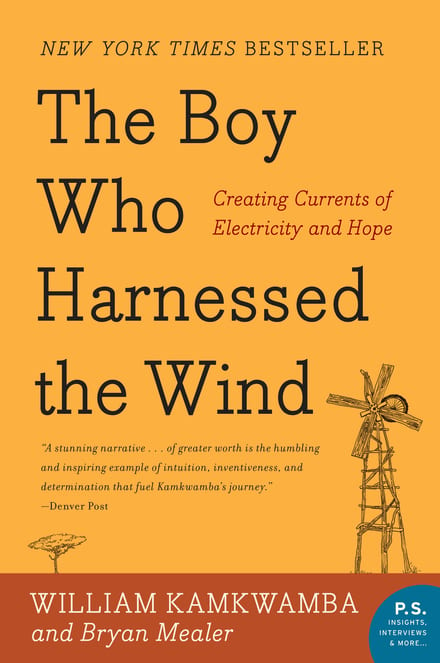
The Boy Who Harnessed the Wind: Creating Currents of Electricity and Hope
Creating Currents of Electricity and Hope
The full book runs ~320 pages — roughly 6 hours of reading. You get the key ideas here in 5 minutes.
The key ideas
- Built a working windmill from scrapyard junk and pipe
- Learned physics from donated textbooks he could barely read
- Blocked from school by $80 yearly fees, not ability
- Watched a famine arrive as prices spiked 340%
- Twelve watts of power reorganised an entire village
- Reframes who gets assumed capable of doing science
The summary
The machine at the heart of this memoir cost almost nothing. It was a bicycle frame, a tractor fan, an old shock absorber, plastic pipe melted soft over a fire, and a tower of blue gum poles — everything but one part pulled out of a scrapyard. That is what William Kamkwamba and Bryan Mealer keep returning to: what a fourteen-year-old in rural Malawi needed to stop being at the mercy of the weather was already lying around his district — some in a junk pile, the rest on a shelf in a small donated library. What stood between him and it was $80 a year in school fees his family could not pay. The book reads as a famine memoir. What it argues about is access.
A famine you could watch coming
Kamkwamba puts the household arithmetic in two sentences in his 2009 TED talk: “My family ate one meal per day, at night. Only three swallows of nsima for each one of us.” Seven children, all sisters but him; a father farming dry fields.
The wider record matches the shape of it. Flooding in early 2001 left that April’s harvest 200,000 tonnes of maize short, and when the government suspended maize price fixing in October, the emergency-nutrition journal Field Exchange recorded that overnight the price “rose by 340%, from 5MK/kg to 17MK/kg, in many parts of the country.” Fifty-nine percent of Malawian households had run through their food stocks by the end of December. The president declared a state of emergency on 27 February 2002.
The family survived. The tuition did not. Malawian secondary school is fee-paying, and the Wall Street Journal, reporting from his village in December 2007, put it at $80 a year — enough to end his education at fourteen. In his account that is what started the project: he looked at his father and at the dry fields, he told TED, and it was “the future I couldn’t accept.”
The library had the missing part
So he turned to the small library stocked with textbooks donated from abroad. He could not read English well, and Mealer described the workaround on public radio: the first book, a British text called Explaining Physics, “had these really beautiful illustrations and diagrams,” so Kamkwamba matched a caption like figure ten to the picture it labelled and learned the surrounding words from there.
The second book is the one that mattered. Using Energy was an eighth-grade American science textbook by the University of Georgia’s Mary M. Atwater, first published in 1993 and sent to Malawi through McGraw-Hill’s international donation program. It had windmills on the cover. Onstage at TED in 2007 he named it plainly — he read Using Energy, “I get information about doing the mill”, and then, to a big ovation, “I tried, and I made it.”
Notice what he took and what he didn’t. Asked whether he had copied the design, he said no: the book’s windmill had three blades and his had four, “just because I want to increase power.” Asked if he had tested three first, he said he had.
Twelve watts, and what twelve watts is worth
Nothing about the build is impressive on its own terms, and the book is unembarrassed by that. He melted PVC pipe over a fire and flattened it into blades. Having no drill, he heated a nail and drove it through the plastic, reheating it between holes because it cooled on the way. A shock absorber became the shaft, a tractor fan the hub, a bicycle frame the body. The one piece he couldn’t scavenge was a bicycle dynamo, too expensive to buy; a friend bought it for him. By the University of Georgia’s account, the build took about six months.
Asked at TED how much electricity it made, he answered: twelve watts. One bulb at first, he says, then four bulbs and two radios, with switches and a circuit breaker he modelled on an electric bell — wired through a thin copper wire and a car battery, the switches cut from flip-flops. His own language had no word for it, so he called it magetsi a mphepo, electric wind.
Twelve watts is a rounding error on a national grid and it reorganised a village. By the time the Journal visited in late 2007 he had built three, the tallest 39 feet, running ten six-watt bulbs, a radio and a TV, and neighbours were walking up the hill to charge their phones. The irrigation pump he had actually wanted came later. The first machine only made electricity.
Misala
The village verdict, in the word the book keeps, was misala — crazy. “At first, we were laughing at him,” his mother, Agnes Kamkwamba, told the Journal; they thought he was “doing something useless.” His own version is that people watched him gathering scrap and concluded he had lost his mind.
The suspicion outlived the success. When drought returned in 2005, he says, people pointed at the spinning tower and called it a witch tower chasing the rain clouds away. He does not tell that story as a story about ignorance. His framing is about who gets assumed to be capable of science, and what he says has shifted is the old belief that “it’s only people from the West for European people who can be doing something for the science.”
The bottom line
On Kamkwamba’s telling, the scarce thing in his village was never intelligence and never really materials — it was permission to find out how things work, priced at $80 a year. He got around it with a donated textbook he could barely read, a junk pile, and six months of being laughed at. Twelve watts was enough to change what his neighbours thought a person like him could do.
Read it for a first-hand account of famine that refuses pity, or an engineering story told from inside the village rather than about it. Good to hand a teenager; uncomfortable for anyone who designs aid programmes.
Fact check
Popular books repeat findings that later research has complicated. Where The Boy Who Harnessed the Wind makes a testable claim, here's what the evidence actually shows.
Malawi's 2001-02 food crisis was severe enough to reduce a maize-farming household to one meal a day.
Contemporaneous emergency-nutrition reporting matches the book's account. Flooding in early 2001 left the April harvest 200,000 MT of maize short; when maize price fixing was suspended in October 2001 the price rose 340% overnight, from 5MK/kg to 17MK/kg in many parts of the country; 59% of households countrywide had exhausted their food stocks by the end of December, rising above 70% by February. A state of emergency was declared on 27 February 2002, and UNDP's review records between 500 and 1,000 deaths from hunger or hunger-related disease in the southern and central regions between January and April 2002. The crisis is often described as a drought, but the trigger was flooding compounded by the sell-off of the strategic grain reserve and the end of price fixing.
The first windmill produced about 12 watts, enough to run four light bulbs and two radios in the family house.
Kamkwamba gave the figure himself onstage at TED in 2007: asked how much electricity the machine made, he answered 12 watts, and said it lit four bulbs and two radios. The University of Georgia, whose faculty member wrote the textbook he worked from, describes the same output independently. That load runs on 12 watts because the windmill charged a car battery through a thin copper wire rather than driving the bulbs directly, as the Wall Street Journal reported from the village in December 2007; the later, taller machines were larger, running ten six-watt bulbs plus a radio and a TV.
- Kamkwamba W. How I built a windmill. TEDGlobal 2007, Arusha, Tanzania. Transcript. Source
- Childs M. Moving Windmills. UGA Today, University of Georgia; 19 October 2009. Source
- Childress S. A Young Tinkerer Builds a Windmill, Electrifying a Nation. The Wall Street Journal; December 2007. Reprinted by YaleGlobal Online. Source
He worked out how to build the windmill from a donated American school textbook, Using Energy, which had windmills on its cover.
The book is identifiable down to the edition: Using Energy was Mary M. Atwater's eighth-grade science textbook, first published in 1993, one of dozens sent to his village by the McGraw-Hill International Book Donation Program, the International Book Bank and the American Institute for Research. Retellings routinely collapse two books into one. Bryan Mealer's account on public radio has the sequence right: the first was a British text, Explaining Physics, whose illustrations and figure numbers let Kamkwamba teach himself the surrounding English words, and Using Energy, with the windmills on the cover, came second and supplied the machine.
An $80-a-year secondary school fee is what ended his formal education at fourteen.
The Wall Street Journal, reporting from Masitala in December 2007, gives the figure as $80 a year and names it as the reason he had stopped attending. The sum was a genuine barrier rather than a nominal one: Malawi's GNI per capita was $210 in 2001 and $250 in 2002 on the World Bank's Atlas method, so a single child's secondary fees came to roughly a third of average annual income per person, in a household with seven children.
Frequently asked questions
What is The Boy Who Harnessed the Wind about?
At fourteen, William Kamkwamba was pushed out of school in rural Malawi because his family could not pay $80 a year in fees, in the middle of a famine. He built a windmill anyway, from a bicycle frame, a tractor fan, an old shock absorber and plastic pipe melted soft over a fire. The book reads as a famine memoir, but its argument is about access: nearly everything he needed was already in his district, some of it in a junk pile and the rest on a shelf in a small donated library.
What are the key takeaways from The Boy Who Harnessed the Wind?
The 2001-02 Malawi famine arrived in plain sight. After maize price fixing was suspended in October 2001 the price rose 340%, from 5MK/kg to 17MK/kg in many parts of the country, and 59% of households had run through their food stocks by the end of December; his family ate one meal a day, three swallows of nsima each. The physics came from donated textbooks he could barely read: he matched captions to the diagrams in a British text called Explaining Physics, then found windmills on the cover of Using Energy, an American eighth-grade science book by Mary M. Atwater. The machine he built made twelve watts, one bulb at first and later four bulbs and two radios, and that was enough to reorganise a village and shift what his neighbours thought a person like him could do.
Who should read The Boy Who Harnessed the Wind?
Anyone who wants a first-hand account of famine that refuses pity, or an engineering story told from inside the village rather than about it. Good to hand a teenager, and uncomfortable for anyone who designs aid programmes.
Is The Boy Who Harnessed the Wind worth reading?
It is honest that nothing about the build is impressive on its own terms, from the heated nail used to punch holes through plastic to the friend who bought the one part he could not scavenge, and that is what makes twelve watts land as hard as it does. Readers hoping for a technical breakthrough will find a modest machine and a story about what it was worth in a place with no power. The uncomfortable part, if your work touches development, is that the barrier was $80 a year.