Book summary
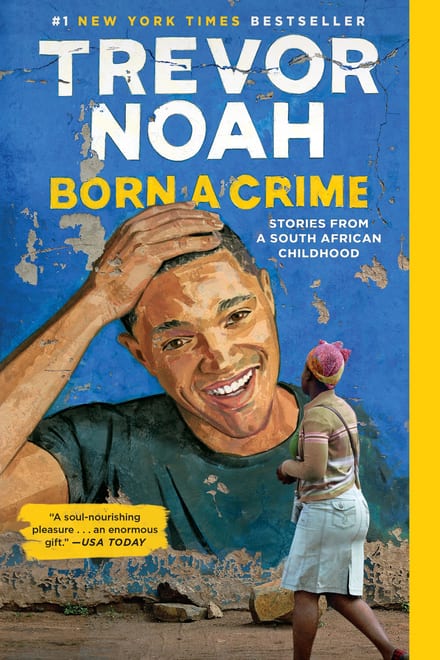
Born a Crime
Stories from a South African Childhood
The full book runs ~304 pages — roughly 6 hours of reading. You get the key ideas here in 5 minutes.
The key ideas
- Born illegal: mixed-race proof his parents broke apartheid law
- Patricia's reckless faith and grit shaped his whole survival
- Classified 'colored,' he belonged nowhere and walked apart from both parents
- Language, more than color, let him blend into any group
- Poverty bred hustle: pirated CDs, DJing, and township corners
- Abusive stepfather Abel shot Patricia in the head—she miraculously lived
The summary
Trevor Noah was, literally, evidence of a crime. His mother, Patricia Nombuyiselo Noah, is Black and Xhosa. His father, Robert, is white, Swiss/German. Under apartheid, sex between them carried a five-year prison sentence, so the boy they made was proof that a law had been broken. He was born on February 20, 1984, in Johannesburg’s Hillbrow Hospital, a half-white, half-black child who violated any number of statutes just by breathing. His father isn’t on the birth certificate; officially, Robert was never his father at all. What follows is how a child who wasn’t supposed to exist found his footing in a country with no place for him.
The woman who made him
Every page of this book comes back to Patricia — fearless to the point of reckless, and fiercely, immovably Christian. When Trevor was nine, their broken-down Volkswagen wouldn’t start on a Sunday, so she hauled him across Johannesburg by minibus to three separate churches anyway, because the Devil, she reasoned, didn’t want them to worship. That day nearly killed them: a menacing Zulu driver turned on his Xhosa mother, and she threw nine-year-old Trevor and his baby brother from the moving minibus, then screamed at him to run. That stubbornness had shaped her whole life. Raised in Soweto, she ran away at twenty-two to live in downtown Johannesburg, illegal for a Black woman. She hid in public restrooms, learned the city’s rules from Xhosa prostitutes, disguised herself in maid’s overalls, and landed a secretarial job at a pharmaceutical company at a time when a Black woman learning to type was, he writes, like a blind person learning to drive. Arrested again and again, she paid the fine and went back to work. Her decision to have a mixed child was made the same way: she wanted it, found a way, did it. She’d drive her family straight through burning riot blockades because she had places to be. “If God is with me,” she’d say, “who can be against me?”
A childhood spent in-between
Apartheid, Trevor explains, was perfect racism, a police state that classified everyone. Because he was neither Black nor white, he was labeled “colored,” and his mother worked the gap in the rules: it was illegal to be mixed, but legal to be colored. So a colored neighbor named Queen would walk beside him pretending to be his mother while Patricia trailed behind, playing the maid. He couldn’t safely walk with either parent. Once, as a toddler, he spotted his father across a park and sprinted after him yelling “Daddy!” — and Robert, panicked, ran away. Trevor watched Nelson Mandela walk free when he was five, then watched the “Bloodless Revolution” spill very real Black blood as Inkatha and the ANC, Zulu and Xhosa, turned on each other; he saw a charred body on the roadside on his way to school. And when he left a mixed private school for a government one, the playground split cleanly by color and forced on him a question he’d dodged his whole life: pick a side.
Language was his passport
Color made Trevor a stranger everywhere; language made him belong. His mother spoke English, Xhosa, Zulu, Afrikaans, Sotho, and German, and used them like keys. In a shop where a clerk told his guard in Afrikaans to follow “those blacks” in case they stole, she replied in flawless Afrikaans and watched him crumble. Trevor learned the same trick, becoming a chameleon: his skin never changed, but he could change how you saw it. Once, Zulu men trailed him plotting a mugging in a language they assumed he didn’t understand, so he spun around and cheerfully offered to help them mug someone else. They laughed and apologized. “Language,” he realized, “even more than color, defines who you are to people.”
Poverty, and the hustle
They lived on next to nothing. Meat was a luxury; in lean months they ate “sawdust” scraps meant for dogs, or boiled dog bones for soup and sucked out the marrow. After high school there were no jobs, so Trevor built his own economy in the township of Alexandra: pirating CDs on a home computer, DJing parties, running a dance crew off a low brick wall. While white classmates took gap years in Europe, he took a gap year on the corner.
Abel, and the bullet
When the Volkswagen kept dying, Patricia found a mechanic named Abel — the man who became her husband, Trevor’s stepfather, and, in Trevor’s words, “the man who tortured us for years and put a bullet in the back of my mother’s head.” Abel was charming and, when drunk, monstrous. He beat Patricia while police shrugged it off as a boys’ club matter. She divorced him to protect her finances but stayed tangled in his life, mother to his sons Andrew and Isaac. It ends in horror: Abel shooting Patricia, once in the backside and then, execution-style, aiming at her head as the gun misfired four times before a final shot tore through the back of her skull and out through her face. She survived. The doctor could only call it a miracle. She was out of the hospital in four days, back at work in seven, joking that Trevor was now officially the best-looking one in the family. Asked how she had no insurance, she said she did: Jesus, and the son who paid the bill.
The bottom line
Underneath the comedy, this is about how one relentless, faithful, hard-headed woman raised a boy the whole legal system said should not exist, and armed him with enough love, language, and nerve to survive anything. Apartheid is the backdrop, but Patricia is the heart, and Trevor’s real inheritance is her refusal to be broken by a world built to break her. Read it if you want a memoir that makes you laugh out loud and then quietly guts you — about identity, belonging, and a mother-son bond that outran every danger it met.
Frequently asked questions
What is Born a Crime about?
Trevor Noah's memoir opens on a literal fact: under apartheid, sex between his Black Xhosa mother and his white Swiss father carried a five-year prison sentence, so his very existence was proof a law had been broken. Born in 1984 in Johannesburg, he was a child with no legal place in his own country. The book is the story of how a boy who wasn't supposed to exist found his footing, with his fearless, devoutly Christian mother, Patricia, at the heart of every page.
What are the key takeaways from Born a Crime?
The throughline is Patricia's refusal to be broken, from running away to live illegally in Johannesburg to driving her family straight through riot blockades. Trevor grows up in-between, classified 'colored' and unable to walk safely beside either parent, and learns that language, even more than color, decides who you are to people, using six tongues as keys to belong anywhere. It's also about poverty and hustle in Alexandra, and the terror of his stepfather Abel, who beat Patricia and later shot her in the head; she survived.
Who should read Born a Crime?
Read it if you want a memoir that makes you laugh out loud and then quietly guts you, one about identity, belonging, and a mother-son bond that outran every danger it met. It rewards anyone curious about apartheid told from the inside, at a child's eye level.
Is Born a Crime worth reading?
Yes. Underneath the comedy it's a moving portrait of one relentless, faithful woman and the love, language, and nerve she armed her son with. The tone swings hard from hilarious to harrowing, especially the ending with Abel's violence, so readers expecting a light celebrity memoir should know it goes to dark places, and is better for it.