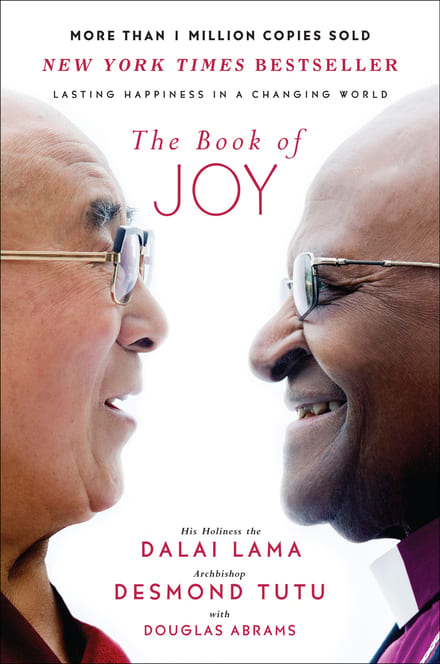
Book summary
The Book of Joy: Lasting Happiness in a Changing World
Lasting Happiness in a Changing World
The full book runs ~441 pages — roughly 8 hours of reading. You get the key ideas here in 5 minutes.
The key ideas
- Joy outlasts happiness because it doesn't depend on circumstances going your way.
- Chase it directly and you miss the bus — joy arrives as a by-product.
- The Dalai Lama reframed fifty-six years of exile as opportunity, not loss.
- Eight pillars: perspective, humility, humor, acceptance, forgiveness, gratitude, compassion, generosity.
- Forgiveness separates the act from the actor: remember it, refuse the hatred.
- Attending to someone else's suffering measurably lessens the weight of your own.
The summary
On the tarmac at Dharamsala’s tiny airport, Desmond Tutu — cancer back, leaning on a cane — reached up and kissed the Dalai Lama on both cheeks. The Dalai Lama, taken from his parents at two and raised in a palace where nobody kissed anyone, flinched, then laughed. Each called the other his “mischievous spiritual brother.” Waiting in the wings before a joint talk once, the Dalai Lama had pretended to choke him. “Hey, the cameras are on us,” Tutu said. “Act like a holy man.” Douglas Abrams filmed the week that followed: five days of dialogue on one question. How do you stay joyful after life has taken the thing you love most?
Joy is bigger than happiness
Tutu corrects the premise on day one. “Joy subsumes happiness. Joy is the far greater thing.” Happiness rides on circumstance; joy doesn’t. His image is a woman in labor, who knows what pain is coming, accepts it, and afterward feels something no one can measure. And you cannot go get it: “If you set out and say, I want to be happy, clenching your teeth with determination, this is the quickest way of missing the bus.”
The science Abrams gathers agrees. Pleasure habituates — the first bowl of ice cream is sublime, the third causes indigestion. Richard Davidson’s neuroimaging finds four independent brain circuits behind lasting well-being — and one of the four is devoted to generosity.
Why are you not morose?
Tutu asks it bluntly. Fifty-six years exiled from a country you love more than anything. Why aren’t you sad?
The answer comes in two moves. First, the eighth-century master Shantideva: “If something can be done about the situation, what need is there for dejection? And if nothing can be done about it, what use is there for being dejected?” Tutu cackles — people know that with their heads and worry anyway. So the Dalai Lama shows the second move with his hands. He cups them into a small circle: when I look only at Tibet, I worry. Then he breaks the circle open — the world, the Hui Muslims in China, everyone else suffering — and the worry shrinks. Not comparison. Enlargement.
Then the reframe that made the room gasp. Exile brought him scientists, other traditions, friendships like this one; staying would have kept him in the golden cage of the Potala. “So, personally, I prefer the last five decades of refugee life.” And a Tibetan saying: “Wherever you have friends that’s your country, and wherever you receive love, that’s your home.”
Most of the suffering is homemade
Two full days go to the obstacles — fear, anger, grief, despair, loneliness, envy, illness, death. The Dalai Lama’s defense is mental immunity: build the mind’s health in advance so small disturbances stop flooring you. Tutu keeps pushing back, and their disagreement is the most useful thing in the book. Feelings arrive uninvited, he says, and most of the damage comes from the guilt we glue on top. “You are made for perfection, but you are not yet perfect. You are a masterpiece in the making.”
On anger, the Dalai Lama tells schoolchildren about his old driver, who cracked his head on the car fender, lost his temper, and then banged his head against it again and again on purpose. Underneath anger, he argues, sits fear. On grief, Tutu refuses the stoic pose: he wept on the first day of the Truth and Reconciliation Commission and told his colleagues he was unfit to chair it. Locking feelings away is what “causes them to fester.” And on despair he separates hope from optimism — optimism is a feeling and flips when things turn, while hope “is in the pit of your tummy,” what held South Africa together when Chris Hani was assassinated weeks before its first free election.
Eight pillars, four of the mind and four of the heart
Days four and five converge on the list: perspective, humility, humor, acceptance — then forgiveness, gratitude, compassion, generosity. Perspective means examining a problem from six angles before deciding what it is. Humility means “I am just one human being talking to other human beings.” Humor is a working tool: Tutu calmed a furious township funeral crowd with a joke about God burning the first batch of humans in the kiln and pulling the second out underdone. Acceptance is not resignation — he never accepted apartheid’s inevitability, only its reality. Compassion isn’t crawling under the rock with the person being crushed; it’s helping lift it off.
Forgiveness carries the most weight because it costs the most. Tutu describes mothers at the Commission facing the man who lured their sons into a booby trap — one threw a shoe at him, and then their spokeswoman crossed the room, embraced him and said, “My child, we forgive you.” The Dalai Lama’s hero is Richard Moore, blinded at nine by a British soldier’s rubber bullet in Northern Ireland, who sought the soldier out to forgive him and ended up his friend. Forgiveness is not forgetting: separate the actor from the act, oppose the act, refuse the hatred. Then his own unresolved case. Too tired one night to hear what his father wanted to tell him, he put it off until morning; his father died that evening. “I’ve never known what it was he wanted to tell me.”
The bottom line
Joy here is not a reward for a life that went well. It’s what opens up when you stop arranging everything around yourself — and both men, from opposite traditions, make the same strange claim: the fastest way out of your own pain runs through somebody else’s. That the teasing never stops is part of the argument. Near the end the Dalai Lama tells Tutu, “I think, at time of my death… I will remember you.” Read it if you’re carrying something heavy, or want the case for kindness made by two people who paid for the right to make it.
Fact check
Popular books repeat findings that later research has complicated. Where The Book of Joy makes a testable claim, here's what the evidence actually shows.
Richard Davidson's neuroimaging work has identified four independent brain circuits behind lasting well-being, one of them devoted to generosity.
Davidson's own peer-reviewed statement of the idea, published in 2020 with Cortland Dahl and Christine Wilson-Mendenhall, sets out four dimensions of well-being — awareness, connection, insight and purpose — and presents them as a training-based framework assembled from psychology and neuroscience, not as four independent circuits located in the brain. Generosity is not one of the four in that formulation. The related assumption that well-being training visibly reshapes the brain has also fared poorly under strict testing: Davidson's own lab pooled two randomized trials of 218 meditation-naive people and found no evidence that an 8-week mindfulness course altered gray matter volume, gray matter density or cortical thickness against either a waitlist or an active control.
- Dahl CJ, Wilson-Mendenhall CD, Davidson RJ. The plasticity of well-being: a training-based framework for the cultivation of human flourishing. Proc Natl Acad Sci U S A. 2020;117(51):32197-32206. PubMed
- Kral TRA, Davis K, Korponay C, Hirshberg MJ, Hoel R, Tello LY, Goldman RI, Rosenkranz MA, Lutz A, Davidson RJ. Absence of structural brain changes from mindfulness-based stress reduction: two combined randomized controlled trials. Sci Adv. 2022;8(20):eabk3316. PubMed
Turning your attention to someone else's suffering measurably lessens the weight of your own.
Kindness and well-being do move together, but the link is modest: a meta-analysis of 201 studies covering 198,213 people put the correlation between prosociality and well-being at r = .13, under 2% of the variance. The association was stronger for eudaimonic well-being — meaning, purpose, a life that feels worthwhile — than for moment-to-moment pleasant feeling, which matches the book's own distinction between joy and happiness. Most of the underlying studies are correlational, so some of the effect is happier people choosing to help more. Real, then, and pointed in the direction the book claims, but much smaller than the framing of helping others as the fastest route out of your own pain suggests.
- Hui BPH, Ng JCK, Berzaghi E, Cunningham-Amos LA, Kogan A. Rewards of kindness? A meta-analysis of the link between prosociality and well-being. Psychol Bull. 2020;146(12):1084-1116. PubMed
Pleasure wears off with repetition while joy does not.
The first half is solid — habituation to repeated pleasure is the hedonic treadmill, and the third bowl of ice cream really does deliver less than the first. But the adaptation research behind it has been revised in ways that complicate the neat split: Diener, Lucas and Scollon's review of the evidence concluded that people do not simply drift back to a neutral baseline, that baselines differ from person to person, and that some events shift well-being permanently. A 15-year study of more than 24,000 Germans found large individual differences in adaptation to marriage and widowhood, with many people never returning to their earlier level. Nothing in that literature identifies a separate, habituation-proof state called joy; the distinction belongs to the book, not to the evidence.
- Diener E, Lucas RE, Scollon CN. Beyond the hedonic treadmill: revising the adaptation theory of well-being. Am Psychol. 2006;61(4):305-314. PubMed
- Lucas RE, Clark AE, Georgellis Y, Diener E. Reexamining adaptation and the set point model of happiness: reactions to changes in marital status. J Pers Soc Psychol. 2003;84(3):527-539. PubMed
Frequently asked questions
What is The Book of Joy about?
It records a week of conversations in Dharamsala between the Dalai Lama and Archbishop Desmond Tutu, held for the Dalai Lama's eightieth birthday and narrated by Douglas Abrams. The question they keep returning to is how you stay joyful after life has taken the thing you love most — both men lost their countries, one to invasion and one to apartheid. Their answer is that joy is not a mood you catch but a capacity you build, and it grows through suffering rather than around it.
What are the key takeaways from The Book of Joy?
Joy is bigger than happiness because it doesn't depend on circumstances, and chasing it directly is the surest way to miss it. Most suffering is self-made: the Dalai Lama's answer is mental immunity, strengthening the mind before trouble arrives, while Tutu insists feelings arrive uninvited and the real damage comes from the guilt we add. The book converges on eight pillars of joy — perspective, humility, humor and acceptance as qualities of the mind; forgiveness, gratitude, compassion and generosity as qualities of the heart. Forgiveness means separating the actor from the act: you oppose what was done and refuse the hatred.
Who should read The Book of Joy?
Anyone carrying grief, illness, exile or a loss that hasn't resolved, and anyone who wants the argument for kindness made by two people who paid for the right to make it. It also suits readers curious about where Buddhist and Christian practice agree without either side flattening the other.
Is The Book of Joy worth reading?
Yes, largely because of how it's built — the ideas arrive attached to specific lives, from mothers at the Truth and Reconciliation Commission forgiving their sons' killer to a man blinded at nine who tracked down the soldier who shot him. The teasing between the two friends keeps it from turning solemn. Readers wanting a step-by-step method may find the middle discursive, since much of it is two old men circling a question rather than answering it, though a set of practices is collected at the end.