Book summary
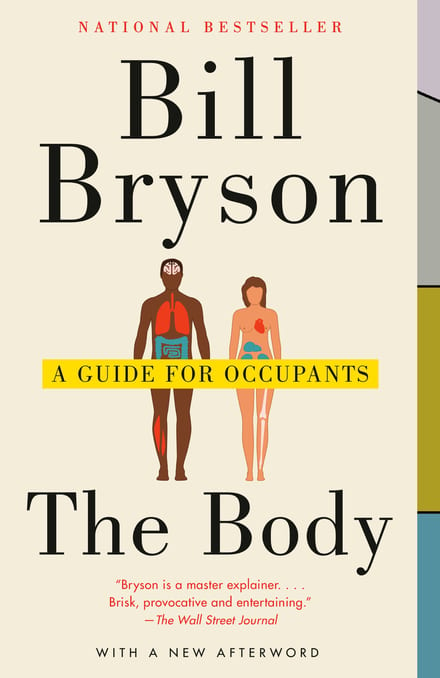
The Body: A Guide for Occupants
The full book runs ~465 pages — roughly 9 hours of reading. You get the key ideas here in 7 minutes.
The key ideas
- Assembled from 59 common elements, yet impossible to build
- Skin regulates, immune system kills daily cancers, heart beats billions
- Perception deceives: smell, vision, memory, and pain are deeply subjective
- Hormones and tiny glands quietly wield enormous power
- Lifestyle diseases now kill more than infections we once feared
- We extend life longer than we improve its final quality
The summary
You are an improbable machine built from unremarkable parts. It takes 59 elements to assemble a human, though 99% of you is just carbon, oxygen, hydrogen, nitrogen, calcium, and phosphorus. One group priced the raw materials at $151,578; another at $168. The number barely matters, because no one can turn the ingredients into a person. The real miracle isn’t the materials — it’s the cellular coordination that makes you conscious, self-repairing, and linked by DNA to a lineage billions of years deep. Bill Bryson’s tour of the body keeps circling one uncomfortable fact: much of what feels settled about how you work is still educated guessing.
A body more capable than you notice
Your skin, the largest organ, does far more than hold you together — it regulates temperature, reads the world through touch, and shelters trillions of microbes you can’t digest food without. Even touch is smarter than it seems. The brain doesn’t just register how something feels, it decides how it ought to feel: that’s why a lover’s caress is wonderful and an identical touch from a stranger is unbearable, and why you can’t tickle yourself. Meanwhile your immune system quietly hunts down the one to five cells that turn cancerous in you every day. You breathe about 20,000 times daily, and your heart — sitting more centrally in your chest than most people assume, not off to the left — beats some 3.5 billion times before it stops.
For all that competence, the gaps are humbling. Fingerprints have no confirmed purpose. The brain has shrunk over the last 10,000 years and nobody knows why. Asthma keeps getting more common with no agreed cause. And consciousness itself, after centuries of study, still can’t be explained.
Perception is stranger than it seems
You can distinguish at least a trillion odors, yet smell is so personal that two people rarely experience the same scent the same way; losing it entirely, anosmia, affects a few percent of people. Vision runs on two kinds of photoreceptors — rods that see in dim light without color, and cones that split bright light into blue, green, and red. Most “color blindness” is simply a missing cone type. Taste leans heavily on smell rather than the tongue alone. And the one expression every human society reads the same way is a smile, which is a pleasant thing to know about a species this strange.
Small glands, big consequences
Hormones are chemical messengers made in one place that act in another, and we’ve only recently grasped how many there are: about 20 were known in 1958, at least 80 today. Their power shows starkly in diabetes, where missing insulin was a death sentence until a synthetic version arrived. Robert Wadlow, at 8 feet 11 inches one of the tallest people who ever lived, grew that way because a faulty pituitary gland flooded him with growth hormone — a tiny gland with outsized effects.
Your 206 bones aren’t just scaffolding; they make blood cells, store minerals, and even secrete a hormone. The hand is an engineering marvel, with three dedicated thumb muscles that let us manipulate tools no other animal can. But standing upright was a bargain with costs. Bipedalism gave us longer necks and bigger knees, and in exchange handed down chronic back pain, worn joints, and dangerously difficult childbirth.
Sleep, pain, and the honest “we don’t know”
Sleep swallows a third of your life and clearly earns its keep — consolidating memory, regulating hormones, supporting immunity — yet why the process requires losing consciousness remains unexplained. Pain is a similar paradox: indispensable as a warning system, ruinous when it turns chronic, and still not fully understood. Because pain is so subjective — swayed by expectation, mood, even placebos — lasting relief stays out of reach, and the search for it has produced calamities like the opioid crisis.
Bryson is blunt about the limits of medical progress. In 2011, for the first time, non-communicable diseases like heart disease and stroke overtook infections as the leading cause of death — a sign of both success and modern lifestyles. But he warns we are no better prepared for a serious outbreak than we were during the Spanish flu a century ago; we’ve simply been lucky. And money doesn’t buy outcomes: the United States spends more on health care than anyone yet ranks 31st in life expectancy, weighed down by overtreatment driven by litigation and profit. One striking counterpoint — a 2016 New Zealand study found diabetics treated by highly compassionate doctors had 40% fewer severe complications, a benefit rivaling the most intensive drug therapy.
The end, plainly
As we live longer, dying has slowed down: about 60% of deaths now come after a protracted decline, and we’ve gotten better at extending life than at making its final stretch worth living. Aging itself stays poorly understood, universal across species but still a thicket of competing theories. After death, the body keeps teeming with life — bacterial, not yours — and in a sealed coffin the unembalmed can take five to forty years to decompose. The average grave draws visitors for about fifteen years, so most of us fade from the earth more slowly than from memory. Cremated, you come to about five pounds of ash. “And that’s you gone. But it was good while it lasted, wasn’t it?”
The bottom line
You are a self-repairing improbability that science can describe in astonishing detail and still can’t fully explain — from consciousness to sleep to why you feel pain. Read this if you want to come away amazed at how much your ordinary body does, and how much about it remains a genuine mystery.
Fact check
Popular books repeat findings that later research has complicated. Where The Body makes a testable claim, here's what the evidence actually shows.
Humans can distinguish at least a trillion different odors.
The trillion figure comes from a 2014 Science paper that extrapolated from how well volunteers told apart mixtures of odor molecules. Two independent reanalyses published in eLife the following year found the extrapolation unsound: Gerkin and Castro showed the estimation framework could produce almost any number from the same data, and that the formula actually yields an upper bound, meaning humans can discriminate at most a trillion stimuli rather than at least that many. Meister reached a similar conclusion from the geometry of odor space. The honest current answer is that nobody knows how many odors people can tell apart.
- Bushdid C, Magnasco MO, Vosshall LB, Keller A. Humans can discriminate more than 1 trillion olfactory stimuli. Science. 2014;343(6177):1370-1372. PubMed
- Gerkin RC, Castro JB. The number of olfactory stimuli that humans can discriminate is still unknown. Elife. 2015;4:e08127. PubMed
- Meister M. On the dimensionality of odor space. Elife. 2015;4:e07865. PubMed
A 2016 New Zealand study found that diabetics treated by highly compassionate doctors had 40% fewer severe complications, a benefit rivaling the most intensive drug therapy.
The 40% figure traces to a 2012 study of 20,961 diabetic patients in Parma, Italy, not to New Zealand: patients of high-empathy physicians had acute metabolic complications at 4.0 per 1,000 against 6.5 to 7.1 per 1,000 for physicians scoring lower, an odds ratio of 0.59. In absolute terms that is about three fewer hospitalizations per thousand patients, and the design was observational, so empathy scores may stand in for other things attentive doctors do. A later UK cohort of 628 people with type 2 diabetes found lower all-cause mortality at higher practitioner empathy (hazard ratio 0.49 for the middle tertile) but no significant reduction in cardiovascular events. The 2016 New Zealand diabetes-and-compassion study was a different thing entirely: an 8-week self-compassion course for 63 patients that cut depression and lowered HbA1c by roughly 1%.
- Del Canale S, Louis DZ, Maio V, Wang X, Rossi G, Hojat M, Gonnella JS. The relationship between physician empathy and disease complications: an empirical study of primary care physicians and their diabetic patients in Parma, Italy. Acad Med. 2012;87(9):1243-1249. PubMed
- Dambha-Miller H, Feldman AL, Kinmonth AL, Griffin SJ. Association between primary care practitioner empathy and risk of cardiovascular events and all-cause mortality among patients with type 2 diabetes: a population-based prospective cohort study. Ann Fam Med. 2019;17(4):311-318. PubMed
- Friis AM, Johnson MH, Cutfield RG, Consedine NS. Kindness matters: a randomized controlled trial of a mindful self-compassion intervention improves depression, distress, and HbA1c among patients with diabetes. Diabetes Care. 2016;39(11):1963-1971. PubMed
The United States spends more on health care than any other country yet ranks only 31st in life expectancy.
The spending gap is real and large: in 2016 the US spent 17.8% of GDP on health care against 9.6% (Australia) to 12.4% (Switzerland) across ten other high-income countries, and its life expectancy was the lowest of the eleven at 78.8 years, versus a group mean of 81.7. Administrative costs took 8% of US health spending against 1% to 3% elsewhere, and per-capita drug spending was $1,443 against $466 to $939. The precise rank depends on which countries and which year are counted, so 31st is one plausible number rather than a fixed fact, but the direction is not in dispute: US life expectancy fell for three consecutive years after 2014, driven by rising midlife deaths from drug overdoses, alcohol and suicide.
Frequently asked questions
What is The Body about?
Bill Bryson takes a curious tour through the human body, the improbable machine built from unremarkable parts, 59 elements that no one can turn back into a person. The real miracle isn't the raw materials but the cellular coordination that makes you conscious and self-repairing. Again and again he circles one uncomfortable fact: much of what feels settled about how you work is still educated guessing.
What are the key takeaways from The Body?
Your body is quietly more capable than you notice, from skin that reads the world and shelters trillions of microbes to an immune system hunting the cancerous cells you make daily. Perception is stranger than it seems, taste leans on smell, and hormones are powerful messengers we've barely catalogued. Standing upright was a bargain that traded back pain and hard childbirth for our hands and lungs, and huge questions, why we sleep, why we feel chronic pain, why we age, stay genuinely unanswered. Money doesn't buy health: the US spends the most yet ranks 31st in life expectancy.
Who should read The Body?
Read it if you want to come away amazed at how much your ordinary body does, and how much about it remains a genuine mystery. It's for the generally curious, no science background required.
Is The Body worth reading?
Yes, if you enjoy fact-packed, witty popular science that leaves you marveling at your own biology. Bryson's honesty about the limits of medical knowledge is refreshing. It wanders from topic to topic rather than building a single argument, so anyone wanting a structured reference or a focused thesis should look elsewhere.