Book summary
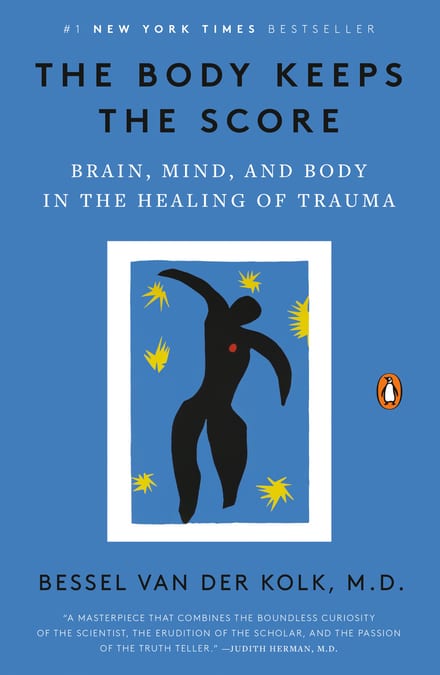
The Body Keeps the Score: Brain, Mind, and Body in the Healing of Trauma
The full book runs ~520 pages — roughly 10 hours of reading. You get the key ideas here in 4 minutes.
The key ideas
- Trauma silences the brain's language and logic centers during flashbacks
- Vigilance rewires perception, making survivors scan constantly for danger
- Traumatic memories stay frozen, sensory, and unchanged over decades
- EMDR and neurofeedback rewire stuck memories and calm the brain
- Yoga, mindfulness, and breath reconnect survivors to their bodies
- Safe relationships and trust break trauma's isolation
The summary
You cannot talk your way out of trauma, because trauma disables the part of the brain that does the talking. That is the core discovery behind Bessel van der Kolk’s decades treating combat veterans, abuse survivors, and traumatized children. Trauma doesn’t settle into the tidy story a person can recount on a therapist’s couch. It lodges in the nervous system, and when something triggers it, the brain regions responsible for language and reason go dark. This is why explanation alone so often fails, and why genuine recovery has to move through the body.
Trauma shuts down the thinking brain
Van der Kolk watched this happen inside a scanner. He asked patients to listen to a recorded script describing their own worst experience while he tracked their brain activity. Marsha, a forty-year-old teacher, had survived a car accident that killed her five-year-old daughter and the child she was carrying. As the script played, her left hemisphere — the seat of rational thought — slowed and effectively switched off, leaving her unable to grasp that the memory wasn’t happening in the present. Her Broca’s area, which produces speech, went quiet too, so she couldn’t put words to any of it. Her stress hormones surged and stayed high far longer than a healthy person’s would. A flashback, in other words, isn’t remembering. The body re-enters the emergency as if it were real, right now.
It becomes a permanent filter
Trauma doesn’t only replay the past; it reshapes how survivors see everything. Van der Kolk showed children a harmless picture of a father repairing a car while his kids look on. Children without trauma spun cheerful stories — the car gets fixed, everyone goes out to eat. Traumatized children saw catastrophe: one imagined a child smashing the father’s head with a hammer, another predicted the car would fall and crush him. They had learned to scan for danger, and that vigilance hardens into a lens they carry into adulthood, coloring relationships and decisions for decades.
The damage isn’t only psychological. Trauma is far more common than most people assume — in 2014 alone, 12 million women were victims of rape, more than half of them under fifteen at the time — and its effects reach into the body. Chronic stress wears down the immune system, leaving survivors prone to physical illness. Marilyn, a former nurse, insisted she’d had a happy childhood; she hadn’t. Sexually abused as a girl, she lashed out at men who touched her even in her sleep, and developed an autoimmune disease that damaged her eyesight — the body keeping a score the mind refused to acknowledge.
Traumatic memory is frozen and sensory
Ordinary memories soften and drift. Ask people about an important life event and they recall the general feeling — happy, nervous — but not the exact smells or what everyone wore. Traumatic memories behave differently. They stay saturated with sensory detail, so a single cue can reopen the whole wound. One survivor could no longer go to parties because a particular smell of alcohol dropped her straight back into the assault. They are also eerily stable. In a Harvard study that tracked memories from 1939 to 1945, the accounts of participants untouched by combat shifted over the years, while the memories of WWII veterans with PTSD stayed unchanged even forty-five years later. That consistency isn’t a mark of accuracy; it’s the signature of a memory that never got processed and filed away as past.
The body is the way back
Because trauma is stored in the body and the nervous system, the treatments that work reach it there rather than through insight alone. EMDR — eye movement desensitization and reprocessing — looks almost too simple to matter: the patient tracks the therapist’s finger back and forth across their field of vision while recalling the trauma. Yet it helps integrate the memory into ordinary recollection, so that it finally becomes an event that happened rather than one that is happening. Neurofeedback works on the brain’s electrical rhythms. Soldiers who spend long stretches in a war zone produce fewer alpha waves — the pattern linked to calm and focus — which leaves them unable to relax and can make traumatized children look like they have ADHD. In neurofeedback, patients watch a live display of their own brain activity and learn to generate more alpha waves, seeing the result the instant they succeed. It is proven and effective, yet still rarely used.
Gentler practices matter just as much. Yoga teaches survivors to inhabit their bodies again and to notice difficult sensations instead of numbing them with alcohol, drugs, or overwork. Mindfulness — staying aware of feelings and physical sensations without judgment — eases depression, stress, and chronic pain, and strengthens the brain regions that regulate emotion. And connection heals. When van der Kolk ran a therapy group for veterans, they opened up to each other quickly but took weeks to trust him, a man who hadn’t been to war. Trauma isolates people and breeds mistrust of anyone who hasn’t lived it, which is exactly why friends, family, therapists, and peer groups are so central to getting free of it.
The bottom line
Trauma is a physical imprint on the brain and body, not a bad memory to be reasoned away — so healing has to engage the body through movement, breath, safe relationships, and therapies like EMDR and neurofeedback. If you carry trauma, or love or treat someone who does, this book explains why some wounds won’t respond to words alone and what actually reaches them.
Fact check
Popular books repeat findings that later research has complicated. Where The Body Keeps the Score makes a testable claim, here's what the evidence actually shows.
You cannot talk your way out of trauma — recovery has to work through the body rather than through words and insight.
The best-evidenced PTSD treatments are still talking therapies that ask patients to describe and rework the traumatic memory. The 2023 VA/DoD guideline gives its only strong-for psychotherapy recommendation to cognitive processing therapy, prolonged exposure, or EMDR, and recommends those over medication. A Cochrane review of 70 trials and 4,761 participants found individual trauma-focused CBT and EMDR reduced clinician-rated PTSD symptoms compared with waitlist or usual care. Van der Kolk is right that flashbacks disrupt speech and reasoning in the moment; that does not mean verbal therapies fail to reach trauma.
- Schnurr PP, Hamblen JL, Wolf J, et al. The management of posttraumatic stress disorder and acute stress disorder: synopsis of the 2023 U.S. Department of Veterans Affairs and U.S. Department of Defense clinical practice guideline. Ann Intern Med. 2024;177(3):363-374. PubMed
- Bisson JI, Roberts NP, Andrew M, Cooper R, Lewis C. Psychological therapies for chronic post-traumatic stress disorder (PTSD) in adults. Cochrane Database Syst Rev. 2013;(12):CD003388. PubMed
Tracking a therapist's finger back and forth — the eye movements in EMDR — is what lets a stuck traumatic memory get filed away as past.
EMDR as a package works well enough to sit alongside prolonged exposure as a first-line PTSD treatment, but the eye movements specifically do not appear to be the ingredient doing the work. A meta-analysis of 34 studies found no incremental effect of eye movements when EMDR was compared with the identical procedure without them, and no advantage over other exposure therapies. A 2020 review of 76 trials estimated EMDR's effect against control conditions at g = 0.93, while noting only 4 of 27 PTSD trials were at low risk of bias and its edge over other therapies vanished in the higher-quality studies.
- Davidson PR, Parker KC. Eye movement desensitization and reprocessing (EMDR): a meta-analysis. J Consult Clin Psychol. 2001;69(2):305-16. PubMed
- Cuijpers P, van Veen SC, Sijbrandij M, Yoder W, Cristea IA. Eye movement desensitization and reprocessing for mental health problems: a systematic review and meta-analysis. Cogn Behav Ther. 2020;49(3):165-180. PubMed
Neurofeedback is a proven, effective treatment for trauma that is simply used too rarely.
There are real signals here, but the evidence base is small. A 2023 meta-analysis pooled 10 controlled trials totalling 276 participants and found a moderate effect on PTSD symptoms (SMD -0.74, 95% CI -0.92 to -0.56), describing neurofeedback as promising rather than established. The 2023 VA/DoD guideline reviewed neurofeedback alongside other somatic therapies and concluded there is insufficient evidence to recommend for or against it — not a rejection, but well short of proven.
- Choi YJ, Choi EJ, Ko E. Neurofeedback effect on symptoms of posttraumatic stress disorder: a systematic review and meta-analysis. Appl Psychophysiol Biofeedback. 2023;48(3):259-274. PubMed
- US Department of Veterans Affairs, US Department of Defense. VA/DoD Clinical Practice Guideline for the Management of Posttraumatic Stress Disorder and Acute Stress Disorder: Quick Reference Guide. Washington, DC: US Department of Veterans Affairs; June 2023. Source
Traumatic memories are frozen and indelible, staying unchanged for decades while ordinary memories drift.
Prospective studies that ask the same people about the same events twice find trauma memories shift a great deal. Among 59 Gulf War veterans, 88% changed at least one of 19 answers about their combat experiences between one month and two years after returning home, and 61% changed two or more; the authors concluded the results do not support the position that traumatic memories are fixed or indelible. Dutch soldiers deployed to Iraq showed the same instability, and in both samples the participants with more PTSD symptoms were the ones whose accounts grew more severe over time. The vividness and sensory intrusiveness van der Kolk describes are well documented — the fixity is not.
- Southwick SM, Morgan CA 3rd, Nicolaou AL, Charney DS. Consistency of memory for combat-related traumatic events in veterans of Operation Desert Storm. Am J Psychiatry. 1997;154(2):173-7. PubMed
- Engelhard IM, van den Hout MA, McNally RJ. Memory consistency for traumatic events in Dutch soldiers deployed to Iraq. Memory. 2008;16(1):3-9. PubMed
Frequently asked questions
What is The Body Keeps the Score about?
Drawing on decades treating veterans, abuse survivors, and traumatized children, Bessel van der Kolk shows that you can't talk your way out of trauma because trauma disables the part of the brain that does the talking. It doesn't settle into a tidy story you can recount; it lodges in the nervous system, and when triggered, the brain regions for language and reason go dark. That's why explanation alone so often fails and why real recovery has to move through the body.
What are the key takeaways from The Body Keeps the Score?
During a flashback the thinking brain and Broca's speech area effectively switch off, so the body re-enters the emergency as if it were happening now. Trauma hardens into a permanent filter that makes survivors scan for danger, and its memories stay frozen and saturated with sensory detail. Because it's stored in the body, the treatments that reach it work there too: EMDR, neurofeedback, yoga, and mindfulness, alongside safe relationships, since trauma isolates people and connection is central to getting free.
Who should read The Body Keeps the Score?
If you carry trauma, or love or treat someone who does, this book explains why some wounds won't respond to words alone and what actually reaches them. It's valuable for survivors, their families, and clinicians alike.
Is The Body Keeps the Score worth reading?
Yes. It pairs compassionate case studies with the neuroscience of why trauma behaves the way it does, and it's reshaped how many people understand healing. It's long and can be heavy going, and some of the therapies it praises, like neurofeedback, remain hard to access, but the core explanation is illuminating and humane.