Book summary
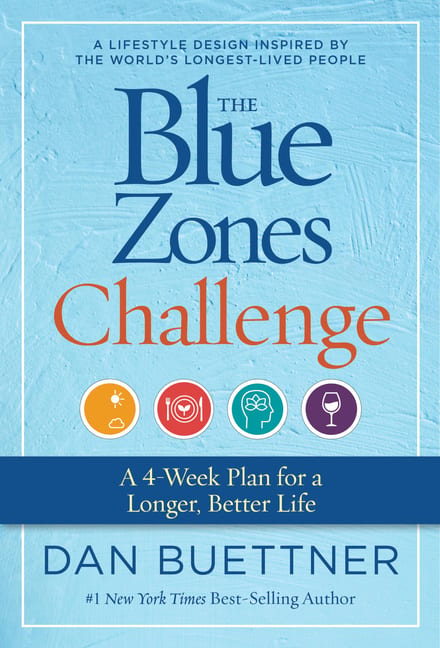
The Blue Zones
Lessons for Living Longer From the People Who've Lived the Longest
The full book runs ~320 pages — roughly 6 hours of reading. You get the key ideas here in 2 minutes.
The key ideas
- Genes set only 25 percent; daily lifestyle decides the rest
- Move naturally through daily work, not scheduled gym sessions
- Eat mostly plants, beans, and grains until 80 percent full
- Find purpose—ikigai—that gives you reason to wake up
- Surround yourself with a tribe reinforcing good habits
- Design your environment so healthy choices require no effort
The summary
The people who live longest don’t have more willpower than you. They live in places where the healthy choice is simply the easy one. They walk all day because walking is how you get anywhere. They eat plants because plants are what grow nearby. They stop eating before they’re full because their culture taught them to, and they’re surrounded, every day, by people doing the same things. Dan Buettner spent years studying these Blue Zones — pockets of the world where reaching 100 in good health is ordinary — and his central finding is a relief: longevity is mostly built, not inherited.
Only about 25 percent of how long you live is written in your genes. “The other 75 percent,” Buettner notes, “is determined by our lifestyles and the everyday choices we make.” No pill, surgery, supplement, or technique has been shown to slow aging itself. What you can do is stack your days with the right habits and add as much as a decade of good life. The trick the Blue Zones teach is to let your surroundings do that work, so you’re not deciding well over and over.
Movement you never have to schedule
In the Barbagia highlands of Sardinia, men are fourteen times more likely to reach 100 than the average American. The traditional shepherds there walk miles a day over hills — not to hit a step count, but because that’s the job. It’s exactly “the type of low-intensity exercise that yields all the cardiovascular benefits without the joint-pounding damage.” Nobody in these regions belongs to a gym. In Okinawa, elderly women keep tending their gardens into their nineties; on Costa Rica’s Nicoya Peninsula, centenarians spent their lives in hard physical labor. Movement is woven into the day, not carved out of it.
Eat mostly plants, and stop before you’re full
Okinawans live by hara hachi bu, a Confucian habit that means eating until you’re 80 percent full. Said before meals, it quietly cuts calories with no sense of deprivation. Their food is built around home-grown vegetables, tofu, and medicinal herbs like mugwort and turmeric, with meat as a rarity. Sardinians eat whole-grain bread, fava beans, and flavonoid-rich Cannonau wine, plus goat’s milk that may guard against inflammation. Nicoyans rely on the old Chorotega diet — fruit, beans, and maíz nixquezado, corn soaked in lime that raises its calcium and amino acids — and drink hard water heavy in calcium and magnesium that strengthens bones and hearts. The pattern never changes: plants first, especially beans and whole grains, a little red wine, and no calorie math, because the food that’s normal and available is already the right food.
A reason to get up in the morning
Okinawans call it ikigai, the reason you wake up. Nicoyans call it plan de vida. In both places, purpose isn’t a self-help slogan; it’s built into a life spent caring for family and community. Elders aren’t shipped off and forgotten. Sardinians celebrate their oldest members and keep them at the center of the household, and it pays off — seniors who stay home get better care and stay engaged. “They love, and they are loved.”
Purpose can also come through faith. In Loma Linda, California, a community of Seventh-day Adventists leads the entire United States in life expectancy. Their religion gives them built-in service and a hard weekly stop: a 24-hour Sabbath for rest, family, and worship that nobody is allowed to skip. The Adventist Health Study found that their habits — a vegetarian diet, nuts at least five times a week, five or six glasses of water a day — substantially lower heart-disease risk and add years to life.
Surround yourself with the right tribe
The people around you may matter most of all. Okinawans form moais, groups of lifelong friends who meet constantly; the women gather every afternoon at 3:30. These aren’t clubs, they’re decades-deep bonds that soak up stress and carry people through hard times. Adventists stay healthy partly because everyone in their community already avoids smoking, drinking, and junk food — good habits stick when they’re the norm. Buettner’s advice is to engineer the same thing for yourself: pick a “right tribe” whose values pull you the way you want to go.
Across all the regions, the same nine habits kept turning up:
- Move naturally through daily activity like walking or gardening
- Eat until you’re 80 percent full (hara hachi bu)
- Lean on plants — beans, whole grains, and nuts over meat
- Drink red wine in moderation
- Know your sense of purpose, your ikigai
- Build in ways to shed stress
- Belong to a spiritual community
- Put family first
- Keep the right people around you
The bottom line
You don’t out-discipline your way to a long life; you build an environment where the healthy choice happens on its own — walkable surroundings, mostly plants, real purpose, and people who reinforce all of it. Read this if you’re tired of relying on willpower and want to see how the world’s healthiest communities make it effortless.
Fact check
Popular books repeat findings that later research has complicated. Where The Blue Zones makes a testable claim, here's what the evidence actually shows.
Only about 25 percent of how long you live is set by your genes; the other 75 percent comes down to lifestyle and daily choices.
25 percent is a fair reading of the classic twin work — 2,872 Danish twin pairs born 1870-1900 yielded heritability of 0.26 for men and 0.23 for women — but the number is unsettled in both directions. A pedigree analysis built from 54 million public Ancestry family trees put heritability well below 10% once assortative mating was accounted for, since in-laws correlated on lifespan nearly as much as blood relatives did. A 2026 Science analysis pushed the opposite way: separating accidental and infectious deaths from intrinsic aging raised heritability above 50%. Lifestyle plainly matters a great deal; the tidy 25/75 split is the part without firm support.
- Herskind AM, McGue M, Holm NV, Sørensen TI, Harvald B, Vaupel JW. The heritability of human longevity: a population-based study of 2872 Danish twin pairs born 1870-1900. Hum Genet. 1996;97(3):319-23. PubMed
- Ruby JG, Wright KM, Rand KA, Kermany A, Noto K, Curtis D, Varner N, Garrigan D, Slinkov D, Dorfman I, Granka JM, Byrnes J, Myres N, Ball C. Estimates of the heritability of human longevity are substantially inflated due to assortative mating. Genetics. 2018;210(3):1109-1124. PubMed
- Shenhar B, Pridham G, Lopes De Oliveira T, Raz N, Yang Y, Deelen J, Hägg S, Alon U. Heritability of intrinsic human life span is about 50% when confounding factors are addressed. Science. 2026;391(6784):504-510. PubMed
Men in Sardinia's Barbagia highlands are fourteen times more likely to reach 100 than the average American.
A real, age-validated longevity cluster does sit there: the AKEA study identified a mountainous central-eastern zone of Sardinia where centenarians are close to evenly split by sex (a ratio of 1.35, against far more female-skewed ratios elsewhere), and unusual male survival is the distinctive feature. The fourteen-fold multiplier is not a figure from that research. Later auditing also cuts against high-end centenarian counts generally: a UCL demographer's Ig Nobel-winning work found that the highest rates of reaching 100 are predicted by poverty, absent birth certificates and fewer 90-year-olds, and that many Blue Zone centenarians were alive in government records but dead in reality.
- Poulain M, Pes GM, Grasland C, Carru C, Ferrucci L, Baggio G, Franceschi C, Deiana L. Identification of a geographic area characterized by extreme longevity in the Sardinia island: the AKEA study. Exp Gerontol. 2004;39(9):1423-9. PubMed
- UCL Institute of Education. UCL demographer's work debunking 'Blue Zone' regions of exceptional lifespans wins Ig Nobel prize. September 13, 2024. Source
The Adventist Health Study found that eating nuts at least five times a week substantially lowers heart-disease risk.
The study reported close to exactly this: people eating nuts more than four times a week had a relative risk of 0.52 for fatal coronary heart disease (95% CI 0.36-0.76) and 0.49 for nonfatal myocardial infarction (0.28-0.85) compared with those eating nuts less than once a week. That is roughly halved risk, which matches the summary's wording. It is observational, so confounding by the rest of the Adventist lifestyle cannot be excluded, and the effect size for any single food should be read as an association rather than a proven cause.
- Fraser GE, Sabaté J, Beeson WL, Strahan TM. A possible protective effect of nut consumption on risk of coronary heart disease. The Adventist Health Study. Arch Intern Med. 1992;152(7):1416-24. PubMed
The people you surround yourself with may matter more for how long you live than anything else you do.
Social ties predict survival about as strongly as conventional risk factors: a meta-analysis of 148 studies and 308,849 participants found a 50% greater likelihood of survival for people with stronger social relationships, holding across age, sex, baseline health and cause of death. The largest effects came from complex measures of social integration rather than simple headcounts, which fits Buettner's emphasis on decades-deep groups like the Okinawan moai. What the evidence does not establish is the ranking — that company beats diet or movement — because those comparisons have not been tested head to head.
- Holt-Lunstad J, Smith TB, Layton JB. Social relationships and mortality risk: a meta-analytic review. PLoS Med. 2010;7(7):e1000316. PubMed
Frequently asked questions
What is The Blue Zones about?
Dan Buettner studies the pockets of the world where reaching 100 in good health is ordinary, and finds that the people who live longest don't have more willpower, they live where the healthy choice is simply the easy one. They walk because walking is how you get anywhere, eat plants because plants grow nearby, and stop eating before they're full because their culture taught them to. His central, hopeful finding is that longevity is mostly built, not inherited.
What are the key takeaways from The Blue Zones?
Only about 25% of how long you live is genetic; the other 75% comes from lifestyle. The habits repeat across regions: natural movement woven into daily life rather than the gym, eating until 80% full (the Okinawan hara hachi bu), a plant-heavy diet built on beans and whole grains, a clear sense of purpose (ikigai or plan de vida), and a supportive social circle like the Okinawan moai. The practical move is to engineer your surroundings so the healthy choice happens on its own.
Who should read The Blue Zones?
Read it if you're tired of relying on willpower and want to see how the world's healthiest communities make longevity effortless. It's for anyone who'd rather change their environment than white-knuckle their way to better habits.
Is The Blue Zones worth reading?
Yes, for a practical, encouraging blueprint drawn from real long-lived communities in Sardinia, Okinawa, Nicoya, and Loma Linda, distilled into nine concrete habits. It's built on observation of these places rather than controlled trials, so if you want clinical proof of each claim you'll find it more inspirational than rigorous, but the advice is sound and easy to act on.