Book summary
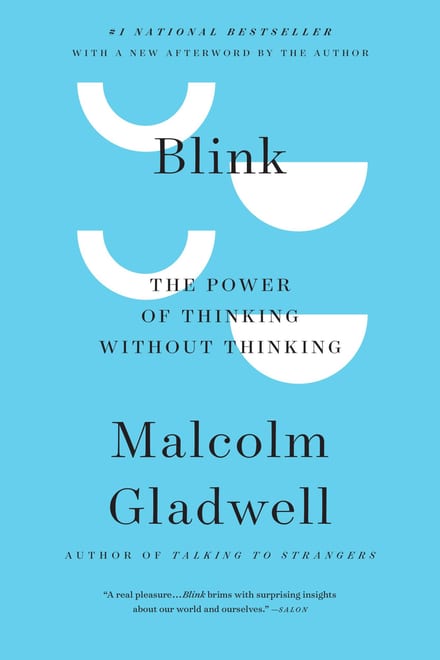
Blink: The Power of Thinking Without Thinking
The full book runs ~295 pages — roughly 5 hours of reading. You get the key ideas here in 2 minutes.
The key ideas
- Thin-slicing beats hours of deliberation on tiny evidence slices.
- More information often buries the signal and worsens decisions.
- Hidden stereotypes hijack snap judgments before reason kicks in.
- Stress narrows vision and shuts down social reading.
- Artificial testing conditions produce misleading answers.
- Strip away irrelevant cues to keep intuition clean.
The summary
Most of the decisions that shape a moment get made in about two seconds, well before you can explain them. That instant read — the sense that a painting is wrong, that a couple won’t last, that you like or distrust a stranger — isn’t a lazy guess. It’s your unconscious running a fast, parallel analysis, throwing out almost everything and locking onto the few details that matter. Malcolm Gladwell calls this thin-slicing, and the unsettling part is how often it beats careful deliberation. The same filter that makes it sharp, though, is exactly what lets bias slip through unseen. Whether a two-second judgment can be trusted comes down to two things: trained expertise and honest conditions.
Less information, better decisions
We assume more data means better choices. Often the reverse is true. When researchers built a stripped-down method for diagnosing heart attacks — tracking a handful of key signs instead of every available reading — it turned out faster and more accurate than the exhaustive standard. The extra information didn’t clarify; it buried the signal. Your unconscious is ruthlessly good at this kind of pruning. Art experts sense a forgery within seconds and can’t say why. Some tennis coaches call a double fault before the racket meets the ball. Researchers who watch a few seconds of a couple’s ordinary bickering can predict the marriage’s fate with startling accuracy. In each case the skill is knowing which slivers to keep and which to throw away.
Snap judgments run on hidden code
The catch is that the same automatic filter can make you blind. You think you’re reacting to what’s in front of you, but you’re often reacting to what your mind has quietly learned to associate with it. Psychologists call this priming, and it’s easy to trigger: people who spend a few minutes imagining themselves as a professor score higher on a trivia quiz than people who picture a football hooligan. Merely activating a stereotype shifts behavior.
The stakes climb when the associations are about people. Tall white men earn more and reach senior management more often — not because they’re more capable, but because we unconsciously link their appearance with authority. Warren Harding looked the part of a president, and that alone helped carry him into an office he handled badly enough to be ranked among the worst leaders in American history. Afterward we invent tidy reasons for these calls, but the verdict was already in within two seconds. The best defense isn’t trying harder to be fair; it’s exposure. Spend real time around people who don’t fit the stereotype, and the unconscious slowly retrains.
Stress makes you temporarily blind
Reading emotion off a face is one of the unconscious mind’s core talents — expressions are close to universal. But stress shuts that system down. Under enough pressure, your vision narrows, your ability to process social cues collapses, and you lose the very skill that makes thin-slicing work. Gladwell links this tunnel vision to police shootings of unarmed people: an innocent gesture gets misread as a threat because the officer’s flooded system can no longer read it correctly. A snap judgment is only as good as the state that produced it. Panicked, exhausted, or flooded with adrenaline, your intuition isn’t sharp. It’s just fast.
The test has to match reality
Coca-Cola learned this the hard way with New Coke. The reformulated drink tested beautifully in blind sips, so the company rolled it out — and set off a consumer revolt. The formula wasn’t the problem; the test was. A single sip at a tasting booth tells you nothing about how a full can feels at home. When the conditions are artificial, so is the answer. The same distortion shows up whenever people rate something new: they tend to reject the unfamiliar at first, because the unconscious needs time to adjust. If you want an accurate read, the test has to resemble real use as closely as possible.
Strip out what doesn’t matter
For decades orchestras auditioned musicians in full view and stayed overwhelmingly male. Then they put a screen between the panel and the player, and the number of women hired jumped. The screen didn’t improve anyone’s playing; it removed the irrelevant cue — appearance — that had been contaminating the judgment. That’s the practical fix. When professionals trust their gut well, from goalkeepers reading a penalty to investors sensing a bad deal, it’s because training taught them which signals to discard. Expertise isn’t seeing more. It’s seeing less, but seeing it clearly.
The bottom line
Your unconscious is fast, powerful, and frequently right — but only when it’s trained, the conditions are honest, and no bias has been smuggled into the signal. The goal isn’t to stop trusting your gut; it’s to tell when your gut is genuinely thinking and when it’s merely reacting. Read this if you hire people, make decisions under pressure, or want to understand why a first impression is so hard to shake.
Fact check
Popular books repeat findings that later research has complicated. Where Blink makes a testable claim, here's what the evidence actually shows.
Researchers who watch a few minutes of a couple's ordinary bickering can predict whether the marriage will last with startling accuracy.
The underlying study is real: Carrere and Gottman coded the first three minutes of a conflict discussion among 124 newlywed couples and predicted marital breakup over six years, with the opening three minutes doing as well for wives as the full fifteen. The problem is that the famous accuracy figures come from equations fitted to the same couples they were tested on. When Heyman and Smith Slep built a comparable equation, it classified 90% of the development sample correctly (92% sensitivity, 89% specificity), then fell apart on crossvalidation: positive predictive value dropped from 65% to 29%, and to 21% once adjusted for the real prevalence of divorce. Conflict patterns do carry signal about a marriage; near-oracle prediction from a thin slice does not survive testing on fresh couples.
Briefly priming a stereotype changes behavior — people who spend a few minutes imagining a professor score higher on a trivia quiz than people who imagine a football hooligan.
This is Dijksterhuis and van Knippenberg's 1998 experiment, which reported that the professor prime raised general-knowledge scores by about 13% relative to the hooligan prime. A registered replication designed with input from the original author, pooling 23 laboratories and 4,493 participants, found a difference of 0.14% — no effect, and no moderation by gender. The broader claim that snap judgments run on associations you cannot introspect still has support from other lines of work; this specific demonstration of it does not replicate.
- Dijksterhuis A, van Knippenberg A. The relation between perception and behavior, or how to win a game of trivial pursuit. J Pers Soc Psychol. 1998;74(4):865-77. PubMed
- O'Donnell M, Nelson LD, Ackermann E, et al. Registered Replication Report: Dijksterhuis and van Knippenberg (1998). Perspect Psychol Sci. 2018;13(2):268-294. PubMed
Tall men earn more and reach senior management more often not because they are more capable, but because we unconsciously read height as authority.
The correlation is well established. Judge and Cable's meta-analysis found height related to social esteem (ρ = .41), leader emergence (ρ = .24) and rated performance (ρ = .18), and across four samples totaling 8,590 people height predicted earnings (β = .26) after controlling for sex, age and weight. The contested half is the mechanism: Case and Paxson found that taller children score higher on cognitive tests well before they enter the labor market, and that those scores explain a large share of the adult height premium. Appearance bias is a plausible part of the story, but the data do not establish it as the whole of it.
Putting a screen between the audition panel and the musician sharply increased the number of women hired by orchestras.
Goldin and Rouse's study of actual audition records is the source of this story, and its headline estimate is that screens account for roughly 30-55% of the rise in the female share of new hires since 1970, when women held under 5% of seats in top US orchestras. The authors are more careful than the retelling: their own abstract notes that some estimates carry large standard errors and that one effect runs persistently in the opposite direction, with the screen appearing to help women in some rounds and not others. The direction of the evidence supports the point about removing irrelevant cues; the audition-level data are too noisy to carry the crisp before-and-after version.
- Goldin C, Rouse C. Orchestrating impartiality: the impact of "blind" auditions on female musicians. Am Econ Rev. 2000;90(4):715-741. Source
Frequently asked questions
What is Blink about?
Malcolm Gladwell explores the split-second judgments we make before we can explain them, the instant sense that a painting is off or a stranger can't be trusted. He calls it thin-slicing: your unconscious running a fast analysis that throws out almost everything and locks onto the few details that matter, often beating careful deliberation. The catch is that the same filter can let bias slip through unseen, so a two-second read is only trustworthy under the right conditions.
What are the key takeaways from Blink?
More information often clouds decisions rather than sharpening them, as a stripped-down heart-attack diagnosis proved. Snap judgments run on hidden code like priming and stereotypes, which is how a president who merely looked the part, Warren Harding, reached office. Stress narrows perception and shuts thin-slicing down, tests have to match real conditions or they mislead, as New Coke showed, and removing irrelevant cues, like the orchestra audition screen, fixes contaminated judgment. Expertise is seeing less, but seeing it clearly.
Who should read Blink?
Read it if you hire people, make decisions under pressure, or want to understand why a first impression is so hard to shake. It's for anyone who relies on gut instinct and wants to know when to trust it.
Is Blink worth reading?
Yes, for its memorable stories and the practical point that the goal isn't to stop trusting your gut but to tell when it's genuinely thinking versus merely reacting. It's more a collection of vivid cases than a step-by-step method, so readers wanting a rigorous decision-making system may find it thinner than they'd like.