Book summary
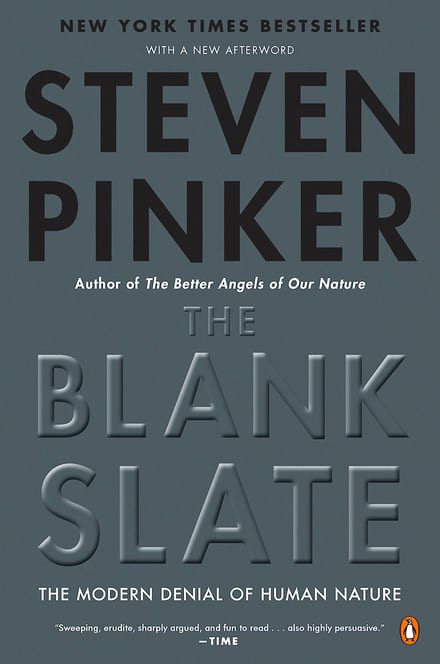
The Blank Slate: The Modern Denial of Human Nature
The full book runs ~528 pages — roughly 10 hours of reading. You get the key ideas here in 6 minutes.
The key ideas
- Reject three myths: blank slate, noble savage, ghost in machine
- Twin studies prove intelligence, personality, and politics are heritable
- Genetic differences run larger within groups than between them
- Distinguish explanation from exculpation to preserve moral responsibility
- Ground equality in principle, not in claims of biological sameness
- Embrace realistic humanism between blank slates and genetic determinism
The summary
The Blank Slate — the belief that the mind arrives empty and is shaped entirely by experience — has always looked like the safe, decent position. If nobody is born with fixed traits, then everybody starts equal and any inequality is society’s fault, fixable by reform. Steven Pinker’s argument is that this comfort is an illusion. Equality is a moral commitment about how we treat people, not a prediction about what biology will find. Confuse the two, and every discovery about genes or brains starts to feel like an attack on justice itself.
Three doctrines that shaped a century
For most of the twentieth century, three ideas governed how the West thought about human nature. The Blank Slate, from John Locke, held that the mind has no innate content. The Noble Savage, from Rousseau, held that people are naturally good and that civilization corrupts them. The Ghost in the Machine, from Descartes, split an immaterial mind from the physical body and put free will beyond the reach of biology. These took hold partly for moral reasons: early-century science had been full of racist and sexist theories used to justify hierarchy, eugenics, and worse, so a movement arose to sever any link between biology and behavior. Behaviorists like Watson and Skinner treated the mind as a slate written on by conditioning. Anthropologists like Franz Boas built a model in which culture, not nature, shaped everything.
The evidence refused to cooperate
Advances in cognitive science, genetics, and neuroscience dismantled all three. The mind is not a ghost — it’s the computational activity of the brain, which needs intricate built-in circuitry to work at all. Children don’t just record language; they generate sentences they’ve never heard, which means the machinery is there from the start. Twin studies show that psychological traits, from intelligence to political leanings, are substantially heritable. Evolutionary psychology explains why we carry motives for both cooperation and conflict, which is hard to square with a naturally peaceful Noble Savage.
Even gross brain anatomy tells the story. Einstein had unusually large inferior parietal lobules, regions tied to spatial and numerical reasoning. Gay men are likelier to have a smaller third interstitial nucleus in the anterior hypothalamus. Violent, antisocial people tend to have a smaller, less active prefrontal cortex, the part that governs decisions and restrains impulse. These features aren’t carved by incoming experience, which implies that differences in intelligence, sexual orientation, and impulsive violence aren’t entirely learned.
Why the resistance runs so hot
Inquiry into human nature keeps meeting hostility because the Blank Slate has hardened into sacred doctrine. Researchers like Napoleon Chagnon, who pursued biological explanations of behavior, were falsely accused of deliberately starting a measles epidemic. The fear is understandable: if traits are innate, won’t that license inequality? But the logic runs backward. Genetic variation is far greater within any group than between groups, which pulls the ground out from under racism. And equality was never supposed to rest on biological sameness. As Pinker puts it, equality is not the claim that all groups are interchangeable; it’s the moral principle that individuals shouldn’t be judged by the average properties of their group.
The Blank Slate has its own body count, too. Stalin, Mao, and Pol Pot all leaned on the idea of reshaping “human raw material” to justify total control and mass murder. If people are infinitely malleable, resistance is just bad conditioning to be corrected by force.
Three fears worth disarming
Pinker names three anxieties that drive the denial. The fear of imperfectibility says a flawed nature makes reform hopeless — but that commits the naturalistic fallacy (whatever is natural is good) and its mirror, the moralistic fallacy (whatever is good must be natural). Nature is often brutal, and moral progress happens because our minds are complex enough to override our baser impulses. The fear of determinism says biology erases responsibility — but responsibility is a tool for deterrence. We exempt children and the legally insane not because their acts are more “determined,” but because they can’t be deterred. The fear of nihilism says we’re reduced to gene-copying machines — but a gene’s ultimate goal (replication) is not the same as a person’s proximate motive (real love, genuine altruism), and either can produce the other.
The data itself is sober rather than scary. Eric Turkheimer’s three laws of behavioral genetics, replicated many times, hold that all behavioral traits are heritable, that shared family environment matters less than genes, and that a large share of variation comes from each person’s unique environment — peers, chance, neighborhood. Roughly: genes 40–50 percent, shared environment 0–10 percent, unique environment 50 percent. Identical twins are 50 percent similar whether they grow up together or apart.
The bottom line
Denying human nature doesn’t protect equality; it just turns evidence into a threat and leaves the moral case resting on a claim science keeps disproving. A realistic, biologically informed humanism accepts that we’re neither blank slates nor prisoners of our genes, and it anchors equality in principle rather than wishful biology. Read this if you want to think clearly about politics, education, and justice without flinching from what the science actually says.
Fact check
Popular books repeat findings that later research has complicated. Where The Blank Slate makes a testable claim, here's what the evidence actually shows.
Behavioral genetics finds roughly 40-50 percent of the variation in psychological traits traces to genes, 0-10 percent to the shared family environment, and about 50 percent to each person's unique environment.
The largest synthesis of the field — 17,804 traits from 2,748 twin studies covering 14.5 million twin pairs — puts average heritability at 49%, and for 69% of traits the correlations fit a model where resemblance is purely additive-genetic with essentially no shared-environment contribution. Turkheimer's own paper agrees that roughly 50% of the differences among siblings is left over as 'nonshared environment', but stresses that this is a residual rather than a set of identified causes: a review of 43 studies found objectively measured nonshared events accounted for a median of under 2% of outcome variance. He also cautions that the apparent win for nature in the first two laws is more methodological than substantive.
- Polderman TJ, Benyamin B, de Leeuw CA, Sullivan PF, van Bochoven A, Visscher PM, Posthuma D. Meta-analysis of the heritability of human traits based on fifty years of twin studies. Nat Genet. 2015;47(7):702-9. PubMed
- Turkheimer E. Three laws of behavior genetics and what they mean. Curr Dir Psychol Sci. 2000;9(5):160-164. Source
Identical twins are about 50 percent similar whether they grow up in the same house or apart.
The reared-apart half of this holds up well: the Minnesota Study of Twins Reared Apart found separated identical twins about as alike as identical twins raised together across personality, temperament, interests and social attitudes. The single 50 percent figure is a rough average rather than a constant — the same study attributed about 70% of IQ variance to genetic factors, and the 49% average heritability across 17,804 traits conceals wide variation by domain. Reared-apart samples are also small, and placements were not fully random, so individual correlations carry real uncertainty.
- Bouchard TJ Jr, Lykken DT, McGue M, Segal NL, Tellegen A. Sources of human psychological differences: the Minnesota Study of Twins Reared Apart. Science. 1990;250(4978):223-8. PubMed
- Polderman TJ, Benyamin B, de Leeuw CA, Sullivan PF, van Bochoven A, Visscher PM, Posthuma D. Meta-analysis of the heritability of human traits based on fifty years of twin studies. Nat Genet. 2015;47(7):702-9. PubMed
Genetic variation is far greater within any human group than between groups.
Genome-wide data bear this out: across 377 microsatellite loci in 1,056 people from 52 populations, differences among individuals within populations accounted for 93-95% of genetic variation, while differences among major geographic groups accounted for only 3-5%. The caveat is what follows from it. Edwards argued that small between-group variance at single loci does not make populations indistinguishable, because the distinguishing information sits in the correlation structure across many loci — the same Rosenberg dataset resolved six clusters largely matching geographic regions. Pinker's own conclusion survives that dispute, since he rests equality on a moral principle rather than on genetic sameness.
Gay men are likelier to have a smaller third interstitial nucleus of the anterior hypothalamus (INAH3).
LeVay's 1991 study did report INAH3 more than twice as large in heterosexual men as in homosexual men, but it rested on 41 postmortem brains, most from men who died of AIDS. The main follow-up, examining 27 homosexual and 22 heterosexual men, found only a nonsignificant trend toward smaller INAH3 volume in homosexual men and no difference at all in the number of neurons within the nucleus. The direction of the original finding has survived weakly; the twofold size gap and any straightforward causal reading have not.
- LeVay S. A difference in hypothalamic structure between heterosexual and homosexual men. Science. 1991;253(5023):1034-7. PubMed
- Byne W, Tobet S, Mattiace LA, Lasco MS, Kemether E, Edgar MA, Morgello S, Buchsbaum MS, Jones LB. The interstitial nuclei of the human anterior hypothalamus: an investigation of variation with sex, sexual orientation, and HIV status. Horm Behav. 2001;40(2):86-92. PubMed
Frequently asked questions
What is The Blank Slate about?
Steven Pinker takes on the popular belief that the mind arrives empty and is shaped entirely by experience, an idea that looks like the safe, decent position because it seems to guarantee equality. His argument is that this comfort is an illusion: equality is a moral commitment about how we treat people, not a prediction about what biology will find. Confuse the two and every discovery about genes or brains starts to feel like an attack on justice.
What are the key takeaways from The Blank Slate?
Three doctrines shaped a century of thinking, the Blank Slate, the Noble Savage, and the Ghost in the Machine, and cognitive science, genetics, and neuroscience dismantled all three. Children generate sentences they've never heard, twin studies show traits are substantially heritable, and equality should rest on principle rather than biological sameness, since variation within any group dwarfs the differences between groups. Pinker also disarms three fears, of imperfectibility, determinism, and nihilism, and cites Turkheimer's laws of behavioral genetics.
Who should read The Blank Slate?
Read it if you want to think clearly about politics, education, and justice without flinching from what the science actually says. It suits readers ready to separate the moral case for equality from claims about biology.
Is The Blank Slate worth reading?
Yes, if you want a rigorous, evidence-heavy reframing of the nature-versus-nurture debate that lands equality on firmer ground. It's dense and unafraid to state uncomfortable findings, so readers who want their politics undisturbed by biology, or who prefer a lighter read, may find it hard going.