Book summary
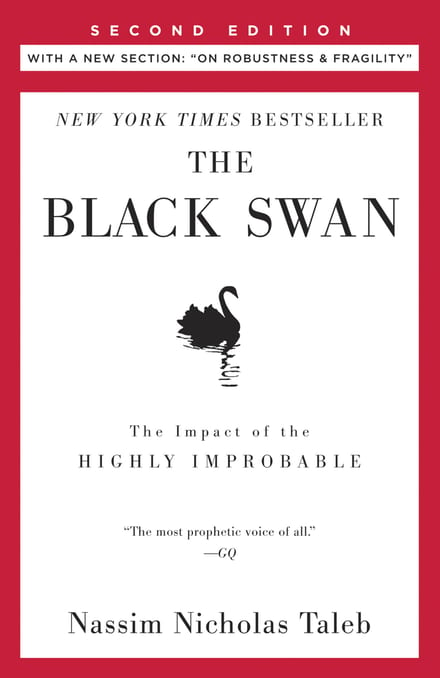
The Black Swan: The Impact of the Highly Improbable
The Impact of the Highly Improbable
The full book runs ~421 pages — roughly 8 hours of reading. You get the key ideas here in 5 minutes.
The key ideas
- Separate Mediocristan from Extremistan: one weighs people, the other counts fortunes.
- Remember the turkey: confidence peaks the day before the slaughter.
- Distrust tidy explanations — history rewrites itself the moment it's over.
- Count the cemetery: survivors look skilled only because failures stay silent.
- Judge experts by their error rate, not their fluency.
- Barbell your risk: 85–90% ultra-safe, the rest wildly speculative.
The summary
Before Australia was discovered, every swan anyone had seen was white — and one bird undid a belief built on millions of confirming sightings. Nassim Nicholas Taleb takes that as the shape of the events that actually run your life: rare, enormous in consequence, and declared obvious only after they land. A handful of them explain almost everything — the Great War, the collapse of the Soviet bloc, the spread of the Internet — while we spend our attention on the small repeatable things we can measure. The trouble isn’t that we fail to see them coming. It’s that we act as though they don’t exist.
Mediocristan and Extremistan
Line up a thousand random people in a stadium and add the heaviest human alive. He accounts for maybe 0.6 percent of the group’s total weight — a rounding error. That’s Mediocristan, where no single observation moves the aggregate: height, calorie intake, a dentist’s income. Now add the richest person on the planet, whose net worth Taleb puts near $80 billion: everyone else becomes a rounding error on his portfolio’s movement over the last second. For weight to do that, someone would have to weigh fifty million pounds. That’s Extremistan: wealth, book sales, city populations, market moves.
The dividing line is scalability. A dentist is paid by the hour and held down by gravity; a novelist writes the book once and sells it to one reader or three hundred million. In Mediocristan a hundred observations tell you most of what there is to know; in Extremistan your data will never be enough, because the observation that decides everything hasn’t shown up yet.
The turkey problem
Taleb’s version of a puzzle from Bertrand Russell: a turkey is fed every day by people who appear to have its interests at heart, and every feeding firms up the belief. On the Wednesday afternoon before Thanksgiving, the belief gets revised. The sharp part isn’t that the past misled the bird — it’s that its sense of safety peaked exactly when the risk was highest. Experience had negative value.
Generalize it to any situation where the same hand that feeds you can wring your neck. In the summer of 1982, large American banks lost roughly everything they had ever earned in the history of American banking, all at once, when the countries they had been lending to defaulted together. They had looked conservative right up to the end.
History hides the evidence
Psychologists once asked women to pick a favorite from twelve pairs of nylon stockings. The pairs were identical; the women confidently cited texture, feel, and color. Explanation isn’t something you do, it’s something that happens to you — and it works by compression. “The king died and the queen died” is two facts. “The king died, and then the queen died of grief” is one, lighter to carry and easier to pass on. Every satisfying story has thrown out the randomness, and the Black Swan is what got thrown out.
Then history deletes the evidence. Cicero tells of Diagoras, shown painted tablets of worshippers who prayed and survived a shipwreck; he asked where the pictures were of those who prayed and drowned. Studies of self-made millionaires find courage, optimism, and appetite for risk — so would a study of the graveyard of people who tried the same things and lost.
The scandal of prediction
Ask people for a range they are 98 percent confident contains some number. Two percent should fall outside it; when Albert and Raiffa first ran the test, on Harvard Business School students, 45 percent did. Taleb asked sixty Londoners to bracket the number of books in Umberto Eco’s library — thirty thousand — and not one range was wide enough. The problem isn’t how little you know, it’s the distance between that and how much you think you know. The Sydney Opera House was to open in early 1963 for AU$7 million; it opened a decade late, in a smaller form, for around AU$104 million.
Some experts really are experts: chess masters, physicists, test pilots. The list with no measurable edge is longer and better paid — stockbrokers, economists, clinical psychologists, risk experts. Things that move rarely have experts; things that sit still often do. Extra information only makes it worse: give bookmakers ten more variables per horse race and their accuracy stays flat while their confidence climbs. The casino Taleb visited spent hundreds of millions modeling gamblers, then took its four biggest hits from a tiger, a would-be bomber, a clerk hiding tax forms under his desk, and a kidnapping.
Be prepared instead of predictive
Since you can’t forecast these events, change your exposure. Decide by consequences, which you can picture, rather than probabilities, which you can’t compute. You don’t know the odds of an earthquake, but you know what one would do to San Francisco.
In practice that’s the barbell. Put 85 to 90 percent in the safest instruments you can find, Treasury bills, and the other 10 to 15 percent in extremely speculative bets. No broken risk model can reach your floor, and you keep the whole upside. Medium risk is the dangerous place, because “medium” was calculated by someone using a bell curve.
Then sort your surprises. Banking and catastrophe insurance carry only downside. Publishing, venture capital, and research have small losses and unbounded gains — there, not knowing is an asset, so make many small aggressive bets and stay in the path of accidents. Fleming found penicillin while cleaning his lab. Go to parties.
The bottom line
You will not see the big one coming, and neither will the person charging you for the forecast. Stop buying better predictions: cap the losses that could end you, stay exposed to the gains you can’t foresee, and treat any model that makes rare events look negligible as the one most likely to hurt you. Read it if you make decisions where the worst case matters more than the average.
Fact check
Popular books repeat findings that later research has complicated. Where The Black Swan makes a testable claim, here's what the evidence actually shows.
When people give a range they are 98 percent sure contains an unknown quantity, the true answer falls outside it far more than 2 percent of the time.
This is one of the sturdiest findings in judgment research. Soll and Klayman had people set high and low bounds they were X percent sure enclosed the answer, and found the intervals were systematically too narrow given how much the judges actually knew — sometimes only 40 percent as wide as calibration required. Moore and Healy's review separates three things people call overconfidence and concludes this one, excessive precision, is the most persistent of the three. The size of the miss does move with wording: asking for the two bounds in separate steps narrows the gap, so the exact hit rate varies between studies.
Well-paid forecasting professions — economists, clinical psychologists, market experts — have no measurable predictive edge.
On the two groups Taleb names, the record is close to what he says. A meta-analysis of clinical versus statistical prediction in health and behavior found simple mechanical rules were about 10 percent more accurate on average, substantially better in 33 to 47 percent of studies and substantially worse in only 6 to 16 percent — and the clinicians' years of experience made no difference. Economists fare no better on the events that matter: across 63 countries from 1992 to 2014 there were 153 recessions, and in April of the preceding year consensus forecasts called for output to fall in 5 of them. Where the blanket version breaks down is that forecasting skill turns out to be identifiable and trainable — in the IARPA tournaments the top 2 percent of forecasters held their accuracy across a second year rather than regressing to the mean.
- Grove WM, Zald DH, Lebow BS, Snitz BE, Nelson C. Clinical versus mechanical prediction: a meta-analysis. Psychol Assess. 2000;12(1):19-30. PubMed
- An Z, Jalles JT, Loungani P. How Well Do Economists Forecast Recessions? IMF Working Paper WP/18/39. International Monetary Fund, March 2018. Source
- Mellers B, Stone E, Murray T, et al. Identifying and cultivating superforecasters as a method of improving probabilistic predictions. Perspect Psychol Sci. 2015;10(3):267-81. PubMed
Financial returns are fat-tailed, so any model built on the bell curve makes extreme market moves look far rarer than they are.
Measured rather than assumed, the tails are power laws, not the fast-decaying tails of a normal distribution. An analysis of roughly 40 million trades across the NYSE, AMEX and NASDAQ found the cumulative distribution of price changes decays with an exponent near 3 — outside the Lévy range and far outside the Gaussian one, which is why a move a bell curve treats as effectively impossible shows up every few years. Later work found similar exponents across different market types, market sizes, countries and trend directions, so this is not an artifact of one dataset.
- Gopikrishnan P, Meyer M, Amaral LAN, Stanley HE. Inverse cubic law for the distribution of stock price variations. Eur Phys J B. 1998;3(2):139-140. Source
- Gabaix X, Gopikrishnan P, Plerou V, Stanley HE. A theory of power-law distributions in financial market fluctuations. Nature. 2003;423(6937):267-70. PubMed
Frequently asked questions
What is The Black Swan about?
It argues that history is driven by rare, enormous, unpredictable events — the Great War, the collapse of the Soviet bloc, the spread of the Internet — while we spend our attention on the small, measurable things instead. The name comes from the discovery of Australia, where a single bird undid a belief built on millions of confirming sightings of white swans. The problem isn't that we fail to forecast these events; it's that our models are built as though they don't exist.
What are the key takeaways from The Black Swan?
Separate Mediocristan, where no single observation moves the total, from Extremistan, where one does — add the heaviest person alive to a stadium of a thousand and he's a rounding error, but add the richest and everyone else becomes the rounding error. Remember the turkey fed every day until the Wednesday before Thanksgiving: its sense of safety peaked exactly when the risk was highest. Distrust tidy narratives and count the graveyard, since studies of self-made millionaires never interview the people who took the same risks and lost. And judge experts by their error rate: give bookmakers ten more variables per race and their accuracy stays flat while their confidence climbs.
Who should read The Black Swan?
Read it if you make decisions where the worst case matters more than the average — investors, risk managers, founders, anyone whose plan is quietly resting on a forecast.
Is The Black Swan worth reading?
It does one thing exceptionally well: it replaces prediction with exposure, giving you concrete moves like the barbell — 85 to 90 percent in the safest instruments you can find, the rest in wildly speculative bets, nothing in the dangerous middle. The evidence is memorable rather than systematic, built from stockings, shipwrecks, the Sydney Opera House and a casino's four biggest losses. If you want precise models or tidy step-by-step advice you'll find it frustrating; if you want to be shaken out of trusting them, that's the point.