Book summary
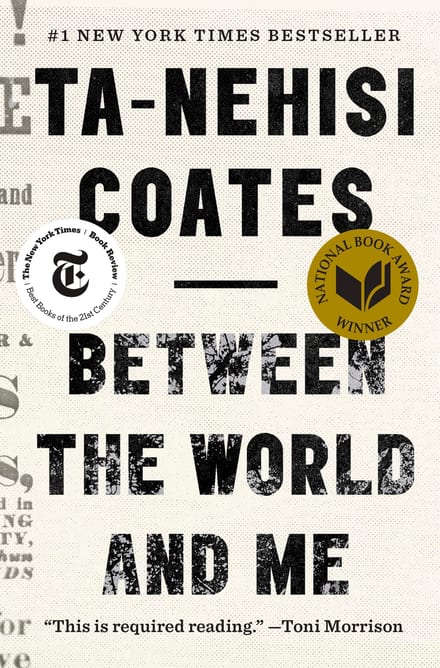
Between the World and Me
The full book runs ~155 pages — roughly 3 hours of reading. You get the key ideas here in 5 minutes.
The key ideas
- Race is the child of racism: hierarchy came first, hue and hair second.
- The Dream — lawns, cookouts, treehouses — rests on the plunder of black bodies.
- Streets and schools were two arms of one beast, both governed by fear.
- Howard replaced his heroic black history with a brawl of arguing ancestors.
- An officer killed his friend Prince Jones and was charged with nothing.
- He offers his son struggle, not hope: actions over states, verbs over nouns.
The summary
The night it was announced that Michael Brown’s killers would go free, Coates’s fifteen-year-old son said “I’ve got to go,” went into his room, and cried. His father came in five minutes later and did not hug him, did not tell him it would be okay, because he has never believed it would be. He said what his own parents had told him: this is your country, this is your body, find some way to live within it. The book is the long version of that answer.
Race is the child of racism
Americans treat race as a fact of nature, which lets them deplore the Middle Passage the way you’d deplore an earthquake. Coates reverses it. Difference in hue and hair is old; the belief that hue and hair can correctly organize a society is new, invented to justify a hierarchy that came first. This is why he never writes “white people” but “people who believe that they are white.” They were Catholic, Corsican, Welsh, Jewish before they were white, and the washing of those tribes white came through flayed backs and sold children, not wine tastings and ice cream socials.
The second insistence is physical. All the careful phrasing — race relations, racial profiling, white privilege — obscures that racism dislodges brains, blocks airways, cracks bones. “The sociology, the history, the economics, the graphs, the charts, the regressions all land, with great violence, upon the body.”
Fear was the weather of West Baltimore
Coates grew up among people who were dangerously afraid, though he didn’t recognize it as fear: it looked like big coats, medallions, a practiced bop, hard eyes. He was eleven, outside a 7-Eleven, when a boy with small eyes pulled a gun, tucked it, untucked it, and put it away. The boy didn’t need to shoot; he had made his point about how easily Coates could be selected.
His father beat him for letting another boy steal from him, and again for threatening a teacher. The logic fit in one sentence: “Either I can beat him, or the police.” A third of his brain went daily to who he walked to school with, how many times he smiled, who offered a pound. Streets and schools were two arms of the same beast: fail the streets and a crew takes your body now; fail the schools and you’re suspended back onto those streets, where the country can wash its hands — he should have stayed in school. Everyone told him to be twice as good, which he says only ever meant accept half as much.
The Mecca broke his myths too
Howard University — The Mecca — gave him the whole black diaspora inside a twenty-minute walk across the Yard, and the Moorland-Spingarn reading room, where he ordered books three call slips at a time. He arrived carrying a counter-myth: black kings in exile, Queen Nzinga as his answer to Saul Bellow’s sneer, “Who is the Tolstoy of the Zulus?”
His professors took it apart. Linda Heywood retold the Nzinga story without romance — the queen had an adviser get on all fours to serve as her chair — and it landed as a sucker punch: his breakable body was the adviser’s, not the queen’s. He’d come looking for a parade of champions and found a brawl of ancestors, Hurston battling Hughes, Du Bois warring with Garvey. Ralph Wiley had already answered Bellow — “Tolstoy is the Tolstoy of the Zulus” — and Coates saw that his error wasn’t adopting someone else’s dream but accepting the need for dreams at all.
Prince Jones, and what a body costs
Prince Jones was a Howard student, a doctor’s son, born-again, generous. A Prince George’s County officer in plain clothes followed him from Maryland through Washington into Virginia and shot him yards from his fiancée’s home, then said Prince had tried to run him over. The officer was a known liar whose earlier false arrest had forced prosecutors to drop every case he touched. He was hunting a man five foot four and 250 pounds; Prince was six three and 211. He was charged with nothing and put back on the street. At the funeral, mourners asked forgiveness for him. Coates, who believes the body is the whole of the self, could not: Prince was killed less by one officer than by his country.
Years later he visits Dr. Mable Jones, who integrated her Louisiana high school, went to med school at LSU, served in the Navy, became chief of radiology. Asked whether she regretted Prince choosing Howard over Harvard, she gasped: “No. I regret that he is dead.” She had bought him a jeep at twenty-three with a huge purple bow on it. “And that was the jeep he was killed in.”
Struggle instead of hope
The Dream is what he refuses to let his son enter: perfect houses, nice lawns, Memorial Day cookouts, treehouses, a country that “smells like peppermint but tastes like strawberry shortcake.” It runs on forgetting. At the onset of the Civil War, enslaved bodies were worth four billion dollars, more than all American industry and railroads combined. Later came redlining, ghettos planned as carefully as any subdivision, and the jargon of “black-on-black crime” — shooting a man, then shaming him for bleeding.
So he offers no rescue. What he hands his son is struggle — “verbs over nouns, actions over states, struggle over hope” — never pinned on the Dreamers converting, because the same appetite that stows bodies in prisons is now working on the planet.
The bottom line
American history isn’t background to racism, it’s the mechanism, and every abstraction about it eventually arrives as a hand on a body: his father’s belt, an officer’s gun, a jeep with a purple bow. Coates won’t console you, and he admits his own wisdom is partial. Read it if you want the case made without hedging, in prose specific enough to argue with.
Fact check
Popular books repeat findings that later research has complicated. Where Between the World and Me makes a testable claim, here's what the evidence actually shows.
At the onset of the Civil War, enslaved people in the United States were worth four billion dollars — more than all American industry and railroads combined.
Economic historians put the aggregate 1860 value of the roughly four million enslaved people at about $3 billion, a little under the four-billion figure, but the comparison Coates draws holds by a wide margin. That sum was around three times the value of US manufacturing and three times the value of the railroads, seven times the net worth of all banks, and forty-eight times federal government spending. Enslaved people were the single largest class of capital in the country, exceeding investment in manufacturing, railroads, banks, livestock and farm machinery in North and South together.
Frequently asked questions
What is Between the World and Me about?
It's a letter from Ta-Nehisi Coates to his fifteen-year-old son, written the year the boy watched Eric Garner choked to death and Michael Brown's killers go free. Coates argues that race is the child of racism rather than the other way around: the hierarchy came first, and hue and hair were recruited afterward to justify it. His insistence throughout is physical, that all the graphs and careful phrasing about racism finally arrive as a hand on somebody's body.
What are the key takeaways from Between the World and Me?
Four ideas carry the book. Race was invented to name a hierarchy, which is why Coates writes about "people who believe that they are white" rather than white people. The Dream — lawns, cookouts, treehouses — runs on forgetting how it was paid for, from four billion dollars of enslaved bodies at the start of the Civil War to redlined neighborhoods planned as carefully as any subdivision. Streets and schools were two arms of one beast in his Baltimore childhood, both governed by fear. And Howard University taught him that even his own counter-myth of black kings in exile was a dream: he found a brawl of arguing ancestors instead of a parade of champions.
Who should read Between the World and Me?
Anyone who wants American racism described at the level of the body rather than the level of policy language, and anyone raising or teaching a child they cannot fully protect. It also rewards readers who like watching a writer dismantle his own earlier beliefs in public.
Is Between the World and Me worth reading?
Yes, and it's short enough to read in a sitting. The prose is specific where most writing on race is abstract — Prince Jones shot by an officer who was charged with nothing, Dr. Mable Jones remembering the jeep with the purple bow she bought her son, the boy at the 7-Eleven who didn't need to fire. Readers looking for policy proposals or a hopeful ending should know that Coates refuses both on principle, and offers his son struggle instead.