Book summary
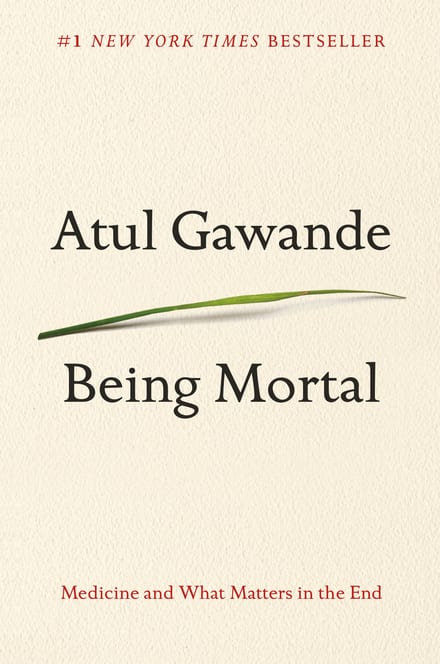
Being Mortal: Medicine and What Matters in the End
The full book runs ~283 pages — roughly 5 hours of reading. You get the key ideas here in 5 minutes.
The key ideas
- Reframe death as life's natural end, not medical failure
- Recognize independence eventually fails everyone who ages
- Fight nursing home plagues: boredom, loneliness, helplessness
- Give the elderly something to care for and live for
- Choose comfort over aggressive treatment—hospice patients lived 25% longer
- Ask patients what matters most before suggesting procedures
The summary
Doctors are trained to save lives, not to care for the dying. Gawande, a surgeon, names the painful paradox at the center of that training: medical professionals concentrate on the repair of health, not the sustenance of the soul, and yet we’ve handed them the job of defining how we live our final days. Death is normal. It is the natural order of things, not a failure. But medicine keeps treating it as one, trading away a dying person’s remaining autonomy for a few more weeks of survival, often causing enormous suffering in pursuit of treatments that barely help. The book asks a better question than “how do we keep this person alive?” It asks what someone wants their last chapter to hold.
Independence is a modern gift that eventually breaks
Aging changed shape in the 20th century. Gawande contrasts two elders in his own family. His grandfather Sitaram lived in India, cared for entirely by relatives, and kept authority over his farm and business into extreme old age, though that arrangement quietly chained his children’s freedom to his needs. His wife’s grandmother Alice lived on her own terms in America, supported by pensions, retirement programs, and elder services. When economic independence becomes possible, people tend to choose it, for both parents and children. In 1945 most Americans died at home; by the 1980s that had fallen to 17%, as adult children scattered and grew busy. As Gawande puts it, modernization didn’t demote the elderly, it demoted the family, replacing the veneration of elders with the veneration of the independent self.
The trouble is that independence always fails in the end. Normal aging brings shrinking lung capacity, hardening vessels, a shrinking brain, bad teeth, slower bowels, changes a doctor can manage but never reverse. Around 350,000 Americans break a hip in a fall every year. When falls finally forced Alice into a nursing home’s care wing, she felt imprisoned; the safety rules stripped away her privacy, her control, and with them her sense of meaning. She died after months of resistance, seeming to prefer death to mere custody. Harry Truman, the 83-year-old who refused to leave his home beneath Mount St. Helens in 1980 and died when it erupted, embodies the same fierce point: safety and longevity are bought with control over your own last days.
Institutions built for safety, not for living
Nursing homes were never designed for living. Better than the poorhouses they replaced, they were still an accident of history, invented to clear hospital beds and draw on Medicare, and they isolate people from whatever they still hold onto. Assisted living, founded as a humane alternative, has too often drifted into a halfway house to institutionalization, with rigid rules that soothe anxious children more than they please the parents living there.
The doctor Bill Thomas gave the problem a name: the three plagues of boredom, loneliness, and helplessness. At Chase Memorial Nursing Home he fought them by bringing in pets, plants, and children, and the results were measurable, with medication use and deaths both falling. Having something to care for gave residents a reason to keep going. The philosopher Josiah Royce argued that people need a cause beyond themselves, large or small, to find life meaningful, and the research on aging backs the instinct: as their horizons contract, older people shift from chasing new experiences to savoring present ones and close relationships, and they tend to be happier and more emotionally steady than the young. The models that work share a shape, with smaller units, personalized care, and real chances to connect. The only way death escapes meaninglessness is to see yourself as part of something larger, a family, a community, a society.
The conversation that changes the ending
The pivot Gawande argues for is a conversation most doctors never learn to have. Ask terminally ill patients what matters most to them, then recommend procedures with those priorities in mind, even when the honest choice might shorten life rather than stretch it. A good doctor, like a wise general, helps a patient win the battles still worth fighting, for pain relief, for time with family, for one last chocolate ice cream, while recognizing when the war against mortality is already lost.
The numbers reward that humility. Patients who saw a palliative care specialist stopped chemotherapy sooner, entered hospice earlier, suffered less at the end, and lived 25% longer. You live longer, it turns out, only when you stop trying to. Yet a quarter of US healthcare spending goes to people in their last year of life, who make up just 5% of patients. Gawande watched this play out with his own father, who faced a tumor and chose quality of life over aggressive treatment, using hospice and palliative care to manage pain and keep control of his remaining time. He helped his father die on his own terms, and when the family scattered his ashes in the Ganges, they felt him connected to something larger than himself. Peg, his daughter’s piano teacher, spent her final days with terminal cancer still teaching her students.
The bottom line
Our cruelest failure with the sick and the old is refusing to see that they have priorities beyond staying safe and living longer, and that the chance to shape one’s own story is what keeps a life meaningful to its final page. The remedy costs nothing but honesty: talk openly about aging, illness, and death before the choices are made for you. Anyone caring for a declining parent, or facing their own mortality, should read this.
Fact check
Popular books repeat findings that later research has complicated. Where Being Mortal makes a testable claim, here's what the evidence actually shows.
Patients who saw a palliative care specialist lived about 25% longer than those who received standard treatment.
The survival figure comes from a single 151-patient trial of early palliative care in metastatic non-small-cell lung cancer, where median survival was 11.6 months against 8.9 months for standard care. That trial also halved depressive symptoms (16% versus 38%) and cut aggressive end-of-life care (33% versus 54%), so its central point stands. The survival result has not generalized: a meta-analysis of 43 randomized trials covering 12,731 patients found no association between palliative care and survival (hazard ratio 0.90; 95% CI 0.69-1.17), while confirming the gains in quality of life, symptom burden, advance care planning and satisfaction.
- Temel JS, Greer JA, Muzikansky A, Gallagher ER, Admane S, Jackson VA, et al. Early palliative care for patients with metastatic non-small-cell lung cancer. N Engl J Med. 2010;363(8):733-42. PubMed
- Kavalieratos D, Corbelli J, Zhang D, Dionne-Odom JN, Ernecoff NC, Hanmer J, et al. Association between palliative care and patient and caregiver outcomes: a systematic review and meta-analysis. JAMA. 2016;316(20):2104-2114. PubMed
A quarter of US healthcare spending goes to people in their last year of life, who make up only about 5% of patients.
The one-quarter figure describes Medicare, not US healthcare as a whole. Measured across all ages and payers, spending in the last twelve months of life is roughly 8.5% of total US health spending, the lowest share among the countries compared, which ran up to 11.2% in Taiwan. The framing also implies the money is knowingly spent on the dying, which the Medicare data do not support: less than 5% of spending goes to people whose predicted one-year mortality exceeds 50%, so most of it treats seriously ill patients whose deaths were not foreseeable at the time of care.
- French EB, McCauley J, Aragon M, Bakx P, Chalkley M, Chen SH, et al. End-of-life medical spending in last twelve months of life is lower than previously reported. Health Aff (Millwood). 2017;36(7):1211-1217. PubMed
- Einav L, Finkelstein A, Mullainathan S, Obermeyer Z. Predictive modeling of U.S. health care spending in late life. Science. 2018;360(6396):1462-1465. PubMed
Bill Thomas's Eden Alternative at Chase Memorial, which brought in pets, plants and children, measurably cut both medication use and deaths.
The morale benefits hold up better than the medication and mortality ones. When researchers compared an Eden Alternative home against a matched control home run by the same organization, they found no benefit after a year in cognition, functional status, survival, infection rate or cost of care; the Eden site had more residents on hypnotics, more falls in the previous 30 days and more nutritional problems. A systematic review of person-centred care did credit the Eden Alternative with significant improvements in residents' boredom and helplessness, two of the three plagues Thomas named, while noting that two studies linked such programs to higher fall risk. The original Chase Memorial figures came from uncontrolled before-and-after reporting.
- Coleman MT, Looney S, O'Brien J, Ziegler C, Pastorino CA, Turner C. The Eden Alternative: findings after 1 year of implementation. J Gerontol A Biol Sci Med Sci. 2002;57(7):M422-7. PubMed
- Brownie S, Nancarrow S. Effects of person-centered care on residents and staff in aged-care facilities: a systematic review. Clin Interv Aging. 2013;8:1-10. PubMed
Frequently asked questions
What is Being Mortal about?
Surgeon Atul Gawande examines how modern medicine handles aging and dying, and names the flaw at its center: doctors are trained to repair health, not to sustain the soul, so they trade a dying person's autonomy for a few more weeks of survival. Death isn't a failure, it's the natural order, yet medicine keeps treating it as one. The book argues for a better question than 'how do we keep this person alive?' It asks what someone actually wants their last chapter to hold.
What are the key takeaways from Being Mortal?
Independence is a modern gift that always fails in the end, and safety bought at the cost of control can strip a life of meaning. Nursing homes were built to clear hospital beds, not for living, which is why Bill Thomas fought the 'three plagues' of boredom, loneliness, and helplessness with pets, plants, and children. Purpose, or ikigai, keeps people going, and the pivotal move is a conversation most doctors never learn: ask what matters most, then treat accordingly. Patients who chose palliative care suffered less and lived 25% longer.
Who should read Being Mortal?
Anyone caring for a declining parent, or facing their own mortality, should read it. It's for people who sense that safety and longevity aren't the only things worth protecting at the end of a life.
Is Being Mortal worth reading?
Yes. Gawande blends hard numbers with intimate stories, including his own father's choice to prize quality of life over aggressive treatment, and the honesty is what lands. It can be a heavy read if you're in the middle of a loss right now, but the remedy it offers, talking openly before the choices are made for you, costs nothing and changes everything.