Book summary
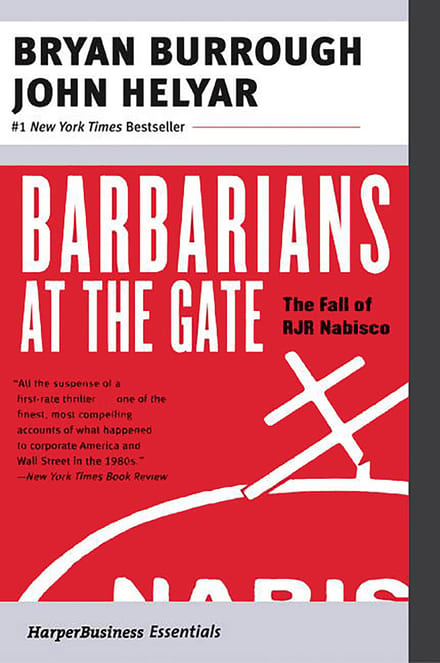
Barbarians at the Gate: The Fall of RJR Nabisco
The Fall of RJR Nabisco
The full book runs ~592 pages — roughly 11 hours of reading. You get the key ideas here in 5 minutes.
The key ideas
- Understand the buyout: the company borrows against itself to fund its own sale.
- Watch the ratio: KKR put up $2 billion and borrowed $21.7 billion.
- Spot the conflict: Ross Johnson bid for the company he already ran.
- Note the board took $109 over $112, preferring structure and employee protections.
- Follow the fees: hundreds of millions rode on the outcome for advisers.
- Recall almost nobody won — KKR later said it would not repeat the deal.
The summary
The RJR Nabisco takeover was not a crime, and that is what makes it useful. In Bryan Burrough and John Helyar’s account nobody breaks a law. The chief executive, the buyout firms, the investment banks and the directors all behave rationally given what each personally stood to gain — and the company still ends up sold at a record price paid with borrowed money, its chief executive gone, its new owners holding a deal they would later say they would not repeat. The argument underneath the storytelling is structural. When the people making a decision are paid on a different basis from the people who own the asset, the decision stops being about the asset.
Burrough and Helyar covered the fight as Wall Street Journal reporters and built the book out of that reporting; Harper & Row published it in 1990. Its publisher now describes it as “a book that created a genre of its own,” and the claim holds up — the fly-on-the-wall deal narrative, reconstructed from the participants themselves, starts here.
A leveraged buyout is a bet placed with the target’s own balance sheet
The mechanism at the centre of the story is simple enough to state in one sentence, which is why so few people notice how strange it is. In a leveraged buyout, an investor buys a company using debt secured against that company’s own assets and future profits. The company, in effect, pays for its own purchase.
The RJR numbers make this vivid. When KKR filed its financing plan with the SEC in December 1988, the documents showed a $24.8 billion purchase in which the firm would supply about $2 billion — $1.5 billion in cash from a pool bankrolled largely by institutional investors, the rest raised from debt securities — and borrow roughly 87 percent, some $21.7 billion, against RJR Nabisco itself. Of that, $16.7 billion was bank loans and $5 billion short-term subordinated loans destined to become junk bonds. A KKR spokeswoman told UPI at the time that this was “the most conservatively structured leveraged buyout Kohlberg Kravis has ever done.”
That was the conservative version. The ratio is the whole point: a thin slice of real equity controls an enormous asset, so modest gains multiply and modest losses are fatal. It also explains why so many people wanted in. Reviewing the book in 1990, the Christian Science Monitor noted that hundreds of millions of dollars in fees for investment bankers, lawyers and advisers rode on the outcome.
The trigger was a man bidding for his own company
The auction did not begin with a raider at the gate. It began inside. On 20 October 1988, RJR Nabisco president F. Ross Johnson and his management team offered to take the company private at $75 a share. A chief executive bidding for the company he runs sits on both sides of the table at once: he helps set the price he pays, and he owes a duty to the shareholders he pays it to.
The terms made the conflict concrete. Johnson’s original proposal, UPI reported, contained provisions to enrich him and other senior managers by as much as $100 million. On 5 December 1988, Time put Johnson on its cover under the headline “A Game of Greed.” Whatever else the coverage achieved, it hardened the board.
The board took the lower offer
Once the company was in play the directors ran an auction, and after six weeks it produced a result that only makes sense if you stop treating price as the only variable. On 30 November 1988 the board awarded RJR Nabisco to KKR at $109 a share, roughly $25 billion — UPI reported the winning bid at $25.07 billion — over a management bid of $112 a share, about $25.4 billion.
Time reported that the directors preferred KKR’s sounder financial structure, its plan to sell fewer businesses, and stronger protections for employees. Johnson left as agreed. “Ross will step down after the transaction is complete,” Kravis told the Winston-Salem Journal the following week. It is the book’s sharpest lesson in governance: a board is entitled to weigh what a bid does to the company rather than only what it pays per share — though this board began doing so only after the bidding had already run for six weeks.
Almost nobody won
The deal closed in 1989 and the debt arrived on schedule. RJR was soon swapping stock for debt with its bondholders, and a share issue in April 1991 raised $1.125 billion in fresh capital and brought a Standard & Poor’s upgrade. KKR started unwinding its stake in 1994 and sold the last of it in 1995.
Perry Golkin, a KKR partner, was later asked at Wharton whether the firm would buy RJR Nabisco again. He said no. The high-yield market shut down after Drexel Burnham Lambert collapsed, forcing quick sales of securities. Philip Morris cut Marlboro prices. Tobacco litigation, which the industry had been winning, turned against it. Parts of the plan worked — assets sold for more than expected, profitability improved — but the largest buyout in history was not, by its own buyer’s account, a good investment.
The bottom line
Structure beats character. The RJR Nabisco fight was settled by who got paid for what, not by who was clever or greedy, and the winning price reflected an auction’s momentum more than a business’s worth. That is why “barbarians at the gate” — a phrase Ted Forstmann aimed at Kravis’s junk-bond financing before it became this book’s title — has outlasted the deal itself.
Read it if you want private equity explained from the inside, or if you want the best argument in print that incentives, not villains, account for most corporate disasters.
Fact check
Popular books repeat findings that later research has complicated. Where Barbarians at the Gate makes a testable claim, here's what the evidence actually shows.
KKR bought RJR Nabisco almost entirely with money borrowed against RJR itself, putting up only a thin slice of equity.
KKR's own financing documents, filed with the SEC and reported in December 1988, show a $24.8 billion purchase in which KKR supplied about $2 billion — $1.5 billion in cash from a pool bankrolled largely by institutional investors, plus $500 million from debt securities — and borrowed $21.7 billion, roughly 87 percent, against the company's assets and future earnings. Of that, $16.7 billion was bank loans and $5 billion short-term subordinated loans headed for the junk market. The projected closing balance sheet was $7.4 billion of equity against $22.8 billion of debt, a ratio a KKR spokeswoman called the firm's most conservative buyout to date.
- Baker N. KKR reveals financing for RJR Nabisco deal. United Press International, 2 December 1988. Source
RJR Nabisco's board handed the company to KKR at $109 a share even though the management group had bid a higher $112.
On the night of 30 November 1988 the special committee unanimously chose KKR's $109 a share, about $25 billion, over the F. Ross Johnson management group's $112, about $25.4 billion. Time reported the directors judged KKR's financing sounder, its plan required selling fewer businesses, and its employee protections were stronger. The academic post-mortem in the Financial Analysts Journal reaches the same reading of the auction, noting that hitting the $109 valuation required cash flows growing at least 18 percent a year even on optimistic assumptions.
- 250,000,000,000 Buyout Barons: KKR outfox Ross Johnson's group. Time, 12 December 1988. Source
- Michel A, Shaked I. RJR Nabisco: A Case Study of a Complex Leveraged Buyout. Financial Analysts Journal. 1991;47(5). Source
- RJR Nabisco president expected to leave when takeover is completed. United Press International, 7 December 1988. Source
The RJR deal shows that leveraged buyouts of that era destroyed value, and that almost nobody came out of them ahead.
One group won decisively: RJR's public shareholders. Kaplan and Stromberg put KKR's premium to them at roughly $10 billion, and note that KKR's own investors then earned a low return — meaning KKR paid away most or all of the value the deal created. But the wider charge of value destruction does not hold. The same survey finds that US public-to-private buyouts of the 1980s raised operating income to sales by 10 to 20 percent, that 6 to 7 percent of all buyouts ended in bankruptcy or reorganization — an annual default rate near 1.2 percent against the 1.6 percent Moody's records for all US corporate bond issuers from 1980 to 2002 — and that buyout fund investors, net of fees, earned about 93 to 97 percent of the S&P 500.
- Kaplan SN, Stromberg P. Leveraged Buyouts and Private Equity. Journal of Economic Perspectives. 2009;23(1):121-46. Source
Frequently asked questions
What is Barbarians at the Gate about?
It's the story of the 1988 fight for RJR Nabisco, the largest leveraged buyout in history at the time, reconstructed by two Wall Street Journal reporters from the participants themselves. Nobody in it breaks a law: the chief executive, the buyout firms, the banks and the directors all behave rationally given what each personally stood to gain, and the company still ends up sold at a record price paid with borrowed money. The argument underneath is structural — when the people making a decision are paid on a different basis from the people who own the asset, the decision stops being about the asset.
What are the key takeaways from Barbarians at the Gate?
A leveraged buyout is a bet placed with the target's own balance sheet: the buyer borrows against the company's assets and future profits, so the company effectively pays for its own purchase. KKR's December 1988 filing showed a $24.8 billion deal in which the firm supplied about $2 billion and borrowed roughly 87 percent, some $21.7 billion, against RJR Nabisco itself — a thin slice of equity controlling an enormous asset, which multiplies modest gains and makes modest losses fatal. The auction started inside the company, with president F. Ross Johnson bidding $75 a share for the business he ran, on terms UPI reported would have enriched him and other senior managers by as much as $100 million. And the board's decision is the governance lesson: on 30 November 1988 it took KKR's $109 a share over management's $112, preferring the sounder structure, fewer business sales and stronger employee protections.
Who should read Barbarians at the Gate?
Read it if you want private equity explained from the inside — how debt, fees and management incentives actually decide a deal. It's also the best argument in print that incentives rather than villains account for most corporate disasters, which makes it useful well beyond finance.
Is Barbarians at the Gate worth reading?
It created the fly-on-the-wall deal narrative and still does it better than its imitators, partly because the reporting is close enough to show people making ordinary decisions that add up to a disaster. The ending is unusually honest for a business book: KKR partner Perry Golkin, later asked at Wharton whether the firm would buy RJR Nabisco again, said no. If you want a structured explanation of buyout mechanics rather than a long cast of bankers and boardroom scenes, a textbook will serve you faster.