Book summary
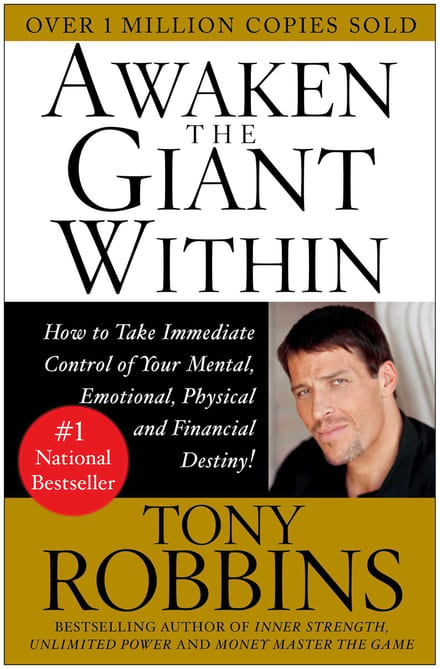
Awaken the Giant Within: How to Take Immediate Control of Your Mental, Emotional, Physical and Financial Destiny
How to Take Immediate Control of Your Mental, Emotional, Physical and Financial Destiny
The full book runs ~539 pages — roughly 10 hours of reading. You get the key ideas here in 5 minutes.
The key ideas
- Rewire the links instead of grinding through more willpower.
- Decide for real: a decision cuts off every other possibility.
- Build leverage — nothing moves until staying hurts more than changing.
- Interrupt the old pattern, then install a replacement that does its job.
- Change your habitual questions; they decide what occurs to you.
- Drop any rule that hands your happiness to something you don't control.
The summary
Everything you have ever done, and everything you keep failing to do, comes down to two sensations: what your nervous system has learned to link to pain, and what it links to pleasure. Tony Robbins builds the whole book on that claim. Procrastination isn’t laziness, it’s arithmetic — at some level you’ve decided acting now would hurt more than putting it off. Change what your body has linked to what, and behavior follows without the grind of willpower.
What you link pain to shapes your destiny
Robbins’s example of how personal those links get is a pairing readers resist: Donald Trump and Mother Teresa, driven by the identical force. Trump learned to equate being second-best with failure, and avoidance is the stronger engine of the two. Mother Teresa learned that wading through the muck of Calcutta to reach a sick child relieved her own pain by relieving someone else’s.
The wiring often goes in by accident. At eleven or twelve, Robbins wanted beer because his father drank it; his mother, rather than argue, made him drink a six-pack at the kitchen table until he threw up over himself and had to clean it up. He has never had a sip since. What keeps people stuck is that they haven’t hit what he calls threshold — where the pain of staying finally exceeds the fear of the unknown. Until then, “I’ve had it” is talk.
A decision cuts off the alternatives
“Decision” comes from the Latin de, from, and caedere, to cut: a real decision cuts off every other possibility. Most of what we call deciding is stating a preference — I’d like to make more money, I’d like to be closer to my kids — which he separates sharply from commitment. When you truly decide you’ll never smoke again, smoking stops being something you evaluate.
His answer to “but I don’t know how” is Ed Roberts, paralyzed from the neck down by polio at fourteen and spending every night in an iron lung. He became the first quadriplegic to graduate from UC Berkeley, later ran the California State Department of Rehabilitation, and pushed the country toward wheelchair ramps and grab bars. You don’t need the route in advance: decide, act, notice what’s working, change the approach.
Six steps to rewire an association
The engine of the book is Neuro-Associative Conditioning, or NAC — six steps for attaching unbearable pain to the old behavior and immediate pleasure to the new one:
- Decide what you really want, and what’s preventing you from having it now.
- Get what Robbins calls leverage: enormous pain linked to not changing now, enormous pleasure to changing now.
- Interrupt the limiting pattern.
- Create a new, empowering alternative.
- Condition the new pattern until it’s consistent.
- Test it.
Step two produces the book’s most memorable stunt: two women who kept breaking their weight-loss promises told friends that whoever slipped would eat a can of Alpo, kept the cans in plain view, and read the “horsemeat chunks” label whenever hunger hit. It worked.
Steps three and four are where most attempts die: motivation alone leaves you like a fly hurling itself at a windowpane, and a habit dropped without a replacement comes back, because nothing else is doing its job.
Questions are the answer
Thinking, Robbins argues, is nothing but asking and answering questions, so your habitual questions decide what occurs to you. His illustration is Stanislavsky Lech, who in a death camp in Krakow stopped asking why God had done this to him and started asking how he could use it to escape. Looking at a truck heaped with gassed bodies, he had his answer: he dove naked into the pile, was dumped in an open grave outside the camp, and ran twenty-five miles to freedom.
The daily version is his Morning Power Questions — what am I happy about in my life now, what am I excited about — with the instruction to add the word “could” if nothing comes. The companion tool is Transformational Vocabulary. Robbins once watched a CEO go beet-red calling himself furious and enraged while a friend with the same money at stake said he was a bit peeved. He tried the ridiculous word himself at a hotel desk after a night flight, telling a slow clerk he feared becoming “a bit peeved.” The clerk smiled, he smiled, and the anger drained out. The word fixes nothing on its own; it breaks the pattern before it builds.
Your rules decide when you’re allowed to feel good
Underneath sits what Robbins calls your Master System: your emotional state, habitual questions, values, beliefs, and references. Beliefs about identity sit at the top, which is why “I’m just not that kind of person” ends the conversation before capability is tested.
The most usable piece is rules — the conditions you’ve set for when you’re permitted to feel good. On the Big Island for a total eclipse, Robbins watched clouds roll in and thousands of people end up watching it on television. One man cursed the $4,000 he’d spent; a woman a few feet away said she felt lucky to be there. Most of the crowd left disgruntled, and twenty minutes later the trade winds cleared the sky. Robbins and his wife had one rule for the day: enjoy it no matter what happens. Any rule that hands your happiness to something you don’t control guarantees pain.
The bottom line
Your behavior sits downstream of what your nervous system codes as pain and pleasure, and that code is editable — by a decision that cuts off retreat, by conditioning rather than willpower, and by changing the questions, words, and rules you run on automatic. It’s a manual, not an argument, and it repays you only as far as you do the exercises. Read it if you know what you should be doing and can’t get yourself to do it.
Fact check
Popular books repeat findings that later research has complicated. Where Awaken the Giant Within makes a testable claim, here's what the evidence actually shows.
Avoiding loss is a stronger motivator than acquiring gain — people will work harder to keep $100,000 they already have than to earn another $100,000.
The asymmetry is one of the most-tested findings in behavioural economics, and the largest meta-analysis of it — 607 estimates drawn from 150 papers — puts the mean loss-aversion coefficient at 1.955, with a 95 percent interval of 1.820 to 2.102. That is close to the roughly 2-to-1 ratio Robbins describes. But a 2025 re-analysis of that same dataset found the number depends heavily on how the studies were built: where gains and losses were matched in size and the options were not presented in an ordered sequence, the coefficient fell to about 1.07, not significantly above 1.0. Losses do loom larger in most real-stakes settings, but the ratio behaves like a design-sensitive tendency rather than the fixed constant of human nature the book treats it as.
Deliberately loading enough pain onto not changing — a self-imposed penalty you would hate to pay — is what converts an intention into a behaviour change that lasts.
Self-imposed penalties do work, for the people who agree to them. In a randomised trial of 2,538 CVS Caremark employees, relatives and friends, programs that put $150 of the participant's own money at risk produced 13.2 percentage points more six-month abstinence than reward-only programs among the people who would have accepted either — but just 13.7 percent agreed to a deposit, against 90 percent who accepted rewards, so the gentler program ended up quitting more smokers overall. A Cochrane review of 33 trials covering more than 21,600 people found incentive schemes raised quit rates at six months or longer (RR 1.49, 95% CI 1.28 to 1.73), and that the advantage held after the incentives were withdrawn. The leverage mechanism is real and it outlasts the incentive; what the book skips is that most people will not volunteer for the pain in the first place.
- Halpern SD, French B, Small DS, Saulsgiver K, Harhay MO, Audrain-McGovern J, Loewenstein G, Brennan TA, Asch DA, Volpp KG. Randomized trial of four financial-incentive programs for smoking cessation. N Engl J Med. 2015;372(22):2108-17. PubMed
- Notley C, Gentry S, Livingstone-Banks J, Bauld L, Perera R, Hartmann-Boyce J. Incentives for smoking cessation. Cochrane Database Syst Rev. 2019;7(7):CD004307. PubMed
Changing the questions you habitually ask yourself, and the words you use for what you feel, changes your emotional state and what you do next.
Reframing does move emotion, though by less than the book's before-and-after stories suggest. A meta-analysis of 306 experimental comparisons found cognitive-change strategies produced a small-to-medium effect (d+ = 0.36), with perspective taking the strongest single tactic (d+ = 0.45) and attempts to suppress the feeling itself producing nothing (d+ = -0.04). Robbins's word-swapping sits on firmer ground than it looks: across seven studies with 585 participants, referring to yourself by name or as "you" rather than "I" during a stressful task lowered distress, improved observer-rated performance and led people to frame coming stressors as challenges rather than threats. The narrower claim that phrasing self-talk as a question beats phrasing it as a statement rests on a single 2010 paper of small lab experiments and has not been tested at scale.
- Webb TL, Miles E, Sheeran P. Dealing with feeling: a meta-analysis of the effectiveness of strategies derived from the process model of emotion regulation. Psychol Bull. 2012;138(4):775-808. PubMed
- Kross E, Bruehlman-Senecal E, Park J, Burson A, Dougherty A, Shablack H, Bremner R, Moser J, Ayduk O. Self-talk as a regulatory mechanism: how you do it matters. J Pers Soc Psychol. 2014;106(2):304-24. PubMed
- Senay I, Albarracin D, Noguchi K. Motivating goal-directed behavior through introspective self-talk: the role of the interrogative form of simple future tense. Psychol Sci. 2010;21(4):499-504. PubMed
Frequently asked questions
What is Awaken the Giant Within about?
Tony Robbins builds the book on one claim: everything you do and everything you keep failing to do comes down to what your nervous system has learned to link to pain and what it links to pleasure. Procrastination isn't laziness, it's arithmetic — somewhere you decided acting now would hurt more than putting it off. Change the links and behavior follows without the grind of willpower.
What are the key takeaways from Awaken the Giant Within?
A real decision cuts off every other possibility — the word comes from the Latin for "to cut from" — and most of what we call deciding is only stating a preference. Neuro-Associative Conditioning is the engine: decide what you want, get leverage by linking enormous pain to not changing, interrupt the limiting pattern, create an empowering alternative, condition it until it's consistent, then test it. Nothing moves before threshold, the point where the pain of staying exceeds the fear of the unknown. Your habitual questions decide what occurs to you, which is why Robbins runs Morning Power Questions and swaps loaded words for ridiculous ones — "a bit peeved" instead of enraged. Underneath sits your Master System, and its most usable piece is rules: any rule that hands your happiness to something you don't control guarantees pain.
Who should read Awaken the Giant Within?
Read it if you know what you should be doing and can't get yourself to do it. It's aimed at people who want a procedure for changing behavior rather than an explanation of why they haven't.
Is Awaken the Giant Within worth reading?
It's a manual, not an argument, and it repays you only as far as you actually do the exercises. The strength is the specificity — the six NAC steps, the Alpo stunt two women used to hold each other to a weight-loss promise, the eclipse rule about enjoying the day no matter what happens. If you want evidence and careful hedging rather than stories and instructions, this will frustrate you.