Book summary
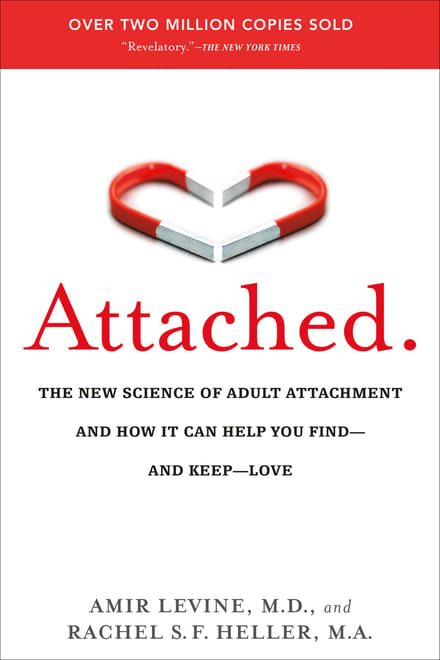
Attached
The New Science of Adult Attachment and How It Can Help You Find -- and Keep -- Love
The full book runs ~294 pages — roughly 5 hours of reading. You get the key ideas here in 5 minutes.
The key ideas
- Identify three attachment styles: secure, anxious, avoidant
- Recognize the anxious-avoidant trap that fuels romantic misery
- Choose secure partners who provide steady, consistent support
- Spot avoidant deactivating strategies early and walk away
- Break destructive cycles through open communication, no game-playing
- Change is possible—attachment styles shift over time
The summary
Your love life probably isn’t as unpredictable as it feels. According to Amir Levine and Rachel Heller, most romantic patterns follow a script set by attachment style—the wired way you handle closeness—and there are only three main scripts. Roughly half of adults are secure: comfortable with intimacy, steady when a partner needs space. About 20 percent are anxious: hungry for closeness but forever scanning for signs of abandonment. Around 25 percent are avoidant: they read intimacy as a threat to independence and keep partners at arm’s length. The single most common source of romantic misery is the collision between the last two, where one person’s reach for connection sets off the other’s retreat, again and again.
Three ways of needing people
The theory grew out of watching how babies reacted when their mothers left the room and came back. Secure babies were upset by the exit but settled fast on return. Anxious babies stayed distressed and even angry. Avoidant babies barely seemed to register the difference. Those early patterns don’t stay in the nursery. They shape how you fight, how you ask for what you need, how you read a partner’s silence, even your body. Studies show a supportive partner literally helps regulate your blood pressure, heart rate, and stress hormones; holding a loved one’s hand in a hard moment lowers your physiological stress in measurable ways.
That’s why the book pushes back hard on the idea that needing someone is weakness. Karen, a reality-show participant, scolded herself as “needy” for wanting her partner to hold her hand during stress—precisely the moment research says contact helps most. Dependency isn’t a character flaw. It’s biology. The trick is finding someone who can actually be depended on.
The anxious-avoidant trap
Anxious people come equipped with a hypersensitive alarm for relationship threats. Their attachment system activates fast, and they often mistake that activation—the racing thoughts, the preoccupation—for passion. Their brains react more strongly to the idea of loss and have a harder time switching the alarm off. The cruel twist is that anxious people are frequently drawn to avoidants, who confirm every fear. The avoidant’s hot-and-cold rhythm delivers brief highs followed by long stretches of doubt, an intense roller coaster that keeps the anxious partner destabilized and calls it love.
Avoidants, for their part, aren’t as self-contained as they look. Research shows they carry the same need for connection as everyone else; they just run “deactivating strategies” to keep it at bay—fixating on a partner’s flaws, withholding “I love you,” pulling back physically, pining after an unavailable ex. Even when a partner is warm and reliable, an avoidant tends to read it negatively, so both people end up feeling unmet. Chris McCandless, who walked away from everyone to live alone in the Alaskan wild, captured the cost in his last journal entry: “Happiness only real when shared.”
What secure looks like, and how to move toward it
Secure partners expect love to be available and responsive, and it shows. Time and again, the research finds that a secure attachment style is the best single predictor of relationship happiness. Secure people stay calm under relationship stress, say what they mean, and hold their composure in conflict. They give a partner a “secure base”—present without hovering, encouraging, consistent.
The hopeful part of the book is that none of this is fixed. Attachment styles come from a mix of genetics, early caregiving, and later relationships, and they shift over time. Anxious and avoidant partners can both build security by naming their triggers, learning from secure role models, and adopting a few concrete habits: communicate directly, drop the game-playing, and stay on the specific issue instead of spiraling into “you always” generalizations. Being honest and unapologetic about a need—“I feel devalued when you contradict me in front of your friends”—turns a vague grievance into something a partner can actually respond to.
When to leave
Sometimes the healthiest move is out. If two people can’t grow toward security together, someone ends up making lopsided compromises about closeness—usually the non-avoidant one—and in a newer relationship that’s a signal worth heeding. Breaking up is brutal by design: the same brain regions that fire when you break a leg light up when a relationship ends, because our attachment system evolved to keep us from being alone. Expect it to play tricks on you, flooding you with the handful of good memories while erasing the many bad ones. Levine and Heller’s steadying reminder is simple: however much it hurts right now, it will pass.
The bottom line
Most romantic suffering isn’t bad luck; it’s the predictable anxious-avoidant pairing, where one person’s pursuit triggers the other’s withdrawal. Learn to spot the pattern early—in yourself and in the people you date—so you can choose a partner who offers a steady base instead of a roller coaster. Read this if you keep landing in the same painful dynamic and want to understand why.
Fact check
Popular books repeat findings that later research has complicated. Where Attached makes a testable claim, here's what the evidence actually shows.
Adults divide into roughly 50% secure, 25% avoidant and 20% anxious.
The shape is right, the numbers drift. A nationally representative US sample found 59% secure, 25% avoidant and 11% anxious — avoidant matches the book, secure runs higher and anxious roughly half what the book states. The bigger caveat is the sorting itself: a taxometric analysis of 1,139 fifteen-month-olds found attachment varies continuously rather than falling into discrete types, so any three-bucket split is a convenience rather than a natural boundary.
- Mickelson KD, Kessler RC, Shaver PR. Adult attachment in a nationally representative sample. J Pers Soc Psychol. 1997;73(5):1092-106. PubMed
- Fraley RC, Spieker SJ. Are infant attachment patterns continuously or categorically distributed? A taxometric analysis of strange situation behavior. Dev Psychol. 2003;39(3):387-404. PubMed
Holding a loved one's hand measurably lowers physiological stress — blood pressure, heart rate and stress hormones.
The study behind this is real but narrower than the retelling. Sixteen married women facing the threat of electric shock showed broadly reduced activation in threat-related neural systems while holding their husband's hand, less so with a stranger's hand, and the buffering was strongest in the happiest marriages. That outcome was brain activation, not the cardiovascular measures the summary names — a 2025 meta-analysis found perceived social support was not significantly related to systolic blood pressure, diastolic blood pressure or heart-rate reactivity. Contact buffers threat; the blood-pressure-and-heart-rate version is the part the evidence does not carry.
- Coan JA, Schaefer HS, Davidson RJ. Lending a hand: social regulation of the neural response to threat. Psychol Sci. 2006;17(12):1032-9. PubMed
- Landvatter J, Uchino BN, Tacana T. Individual differences of perceived social support and cardiovascular reactivity: A meta-analysis. Health Psychol. 2025;44(5):537-548. PubMed
A secure attachment style is the best single predictor of relationship happiness.
Attachment matters, but it is not the top of the list. A machine-learning analysis pooling 43 longitudinal couples datasets from 29 labs ranked attachment avoidance and anxiety fourth and fifth among individual-difference predictors, behind life satisfaction, negative affect and depression. More to the point, what a person feels about their specific relationship — perceived partner commitment, appreciation, sexual satisfaction — predicted up to 45% of variance in relationship quality against 21% for all individual differences combined, and the individual differences added nothing once those relationship-specific reports were accounted for.
- Joel S, Eastwick PW, Allison CJ, et al. Machine learning uncovers the most robust self-report predictors of relationship quality across 43 longitudinal couples studies. Proc Natl Acad Sci U S A. 2020;117(32):19061-19071. PubMed
A breakup fires the same brain regions that fire when you break a leg.
There is overlap, but not identity. When people who had recently been through an unwanted breakup viewed a photo of their ex, secondary somatosensory cortex and dorsal posterior insula activated — regions whose activation is diagnostic of physical pain with positive predictive values up to 88%. A later study of 60 participants pushed further: multivariate classifiers told painful heat from social rejection with 92% and 80% accuracy, and each classifier performed at chance on the other condition. Same coarse anatomy, different fine-grained signatures.
- Kross E, Berman MG, Mischel W, Smith EE, Wager TD. Social rejection shares somatosensory representations with physical pain. Proc Natl Acad Sci U S A. 2011;108(15):6270-5. PubMed
- Woo CW, Koban L, Kross E, et al. Separate neural representations for physical pain and social rejection. Nat Commun. 2014;5:5380. PubMed
Frequently asked questions
What is Attached about?
It argues that your love life isn't as unpredictable as it feels, because most romantic patterns follow one of three attachment styles, the wired way you handle closeness. Secure, anxious, and avoidant styles shape how you love, and the single most common source of misery is the collision between anxious and avoidant partners.
What are the key takeaways from Attached?
About half of adults are secure, roughly 20 percent anxious, and around 25 percent avoidant, and these styles trace back to early caregiving but can shift over time. The anxious-avoidant trap pairs one person's reach for connection with the other's retreat, mistaking the roller coaster for passion. Needing people isn't weakness but biology, since a supportive partner literally regulates your stress. Secure attachment is the best single predictor of relationship happiness, and you can move toward it by naming triggers, communicating directly, dropping game-playing, and sometimes leaving.
Who should read Attached?
Anyone who keeps landing in the same painful romantic dynamic and wants to understand why.
Is Attached worth reading?
Yes, it gives a simple, memorable framework that helps you spot patterns early in yourself and the people you date, backed by attachment research. Readers who resist being sorted into three categories may find the model reductive, but its practical guidance on communication and partner choice is genuinely useful.