Book summary
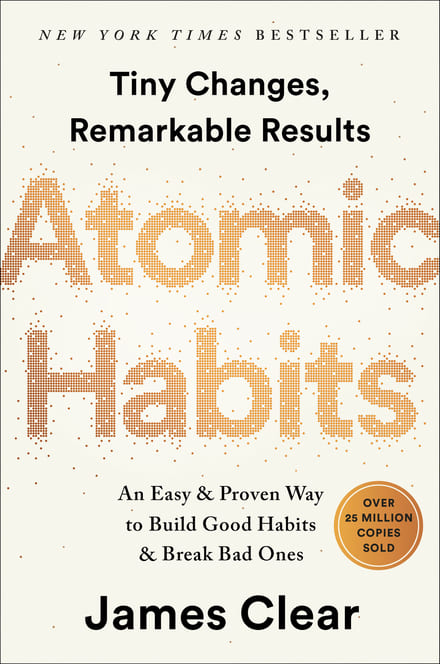
Atomic Habits: An Easy & Proven Way to Build Good Habits & Break Bad Ones
The full book runs ~322 pages — roughly 6 hours of reading. You get the key ideas here in 5 minutes.
The key ideas
- Compound tiny habits; small daily gains snowball into massive results.
- Follow the loop: cue, craving, response, reward.
- Make cues obvious by reshaping your environment and stacking habits.
- Reduce friction; the two-minute rule makes starting effortless.
- Attach immediate rewards, track streaks, and sign habit contracts.
- Distinguish motion from action; planning isn't doing.
The summary
Behavior change works far better when you redesign the conditions around you than when you try to summon willpower. That’s the core of James Clear’s argument: a habit is just a behavior repeated enough that it runs on autopilot, and you shape those behaviors by shaping your cues, cravings, and rewards. The stakes hide in how small the adjustments feel. A plane leaving Los Angeles for New York that shifts its heading just 3.5 degrees south lands in Washington, DC instead — and not one passenger notices mid-flight. Habits work the same way. Their effect on any given day is too small to see, which is exactly why they’re so easy to underestimate and so powerful over time.
Small changes are compound interest
Start jogging 15 minutes today and tomorrow your body looks identical; keep it up and in a few months you’re genuinely fitter. Clear calls habits “the compound interest of self-improvement” — a version of the Japanese principle of kaizen, continuous tiny improvement — and the lesson is to stop judging yourself by today’s results and start watching your trajectory. Where you’re headed matters more than where you are.
Underneath every habit runs the same four-stage loop: cue, craving, response, reward. Psychologist Edward Thorndike saw it a century ago when he shut cats in a black box. At first they scrambled around until they stumbled onto a lever that opened the door; after enough repetitions, they walked straight to the lever every time. Your morning coffee is the same loop — waking is the cue, wanting to feel alert is the craving, brewing and drinking is the response, and the jolt of energy is the reward that stamps the whole sequence in. Change a habit by working on those four parts, which map onto four levers: make the cue obvious, the craving attractive, the response easy, and the reward satisfying.
Make the cue obvious
Because cues trigger behavior, the fastest way to change a habit is to change what you see. A Boston doctor wanted her patients eating better, so she quietly restocked the hospital cafeteria’s refrigerators with more water near the registers. Soda sales fell 11% and water sales rose 25% — no lectures, just a rearranged room. You can borrow the trick anywhere: leave the instrument out where you’ll pass it, put the fruit on the counter and bury the chips in a cupboard.
Two techniques sharpen this further. The first is a specific plan. “I’m going to be fitter” is useless; “I’ll run two miles around the park at 8:30 AM on Mondays, Wednesdays, and Fridays when the alarm goes off” is a real cue, especially with your shoes left in plain sight. The second is habit stacking — anchoring a new habit to one you already do. If you already drink coffee each morning, read while you drink it. The old habit supplies the momentum until the new one runs on its own.
Make it easy, and don’t confuse motion with action
We drift to social media because it takes no effort and avoid studying Chinese because it takes plenty. So the goal is to strip friction out of the good behaviors and pile it onto the bad ones. Clear’s wife sends greeting cards reliably because she keeps a box pre-sorted by occasion; the task is nearly effortless, so it happens. Run it in reverse to break a habit: to watch less TV, unplug the cables and pull the batteries out of the remote.
Watch out for the trap of motion. Reading articles about healthy eating is motion; eating a healthy meal is action. Watching tutorials is motion; doing the work is action. Motion feels like progress, which is exactly why we hide in it — it’s procrastination dressed up as effort, usually because we’re afraid to fail. The cure is the two-minute rule: shrink any habit to a version you can finish in two minutes. Don’t vow to read 20 books this year; read two pages a day. Starting is the hard part, so make starting trivial and momentum tends to carry you well past two pages.
Make the reward immediate
We’re built for an immediate-return world — find food, eat, feel good — but we live in a delayed-return one, working all month before payday and training for weeks before the mirror changes. That mismatch is why bad habits win: a cigarette relieves nicotine withdrawal right now, and the lung cancer is decades away. The fix is to attach something satisfying to good habits today. A health researcher cut illness in a Pakistani neighborhood simply by handing out premium soap that smelled good and lathered well; handwashing became pleasant, and childhood diarrhea fell 52%, pneumonia 48%, and skin infections 35%.
Tracking supplies the same instant payoff. Mark each day you keep a habit or dodge a bad one, the way Benjamin Franklin logged his in a notebook — the act of recording is its own small reward and builds a streak you won’t want to break. And if you need extra teeth, write a habit contract with a real penalty: miss a gym day and your trainer collects $100. Telling other people about it works too, since we’ll go to surprising lengths to avoid letting them down.
The bottom line
Stop relying on willpower and start engineering the conditions: make good habits obvious, attractive, easy, and satisfying, and let repetition do the rest, because tiny changes compound into results that look dramatic only in hindsight. Read this if you want a concrete, mechanical system for changing behavior rather than another pep talk about discipline.
Fact check
Popular books repeat findings that later research has complicated. Where Atomic Habits makes a testable claim, here's what the evidence actually shows.
Rearranging a hospital cafeteria so water was easier to reach cut soda sales 11% and raised water sales 25%, with no persuasion involved.
The numbers are close to the published study: at Massachusetts General Hospital, sales of "red" (unhealthy) beverages fell a further 11.4% and bottled water rose 25.8% once staff made healthier drinks more visible and convenient. But that rearrangement was phase 2 of a two-part intervention whose phase 1 had already put red/yellow/green traffic-light labels on every item for three months, and red beverages had dropped 16.5% from the labels alone — so this was persuasion plus layout, not layout by itself. A follow-up by the same team found the shift held for two years, with red beverages going from 26% of beverage sales at baseline to 17%.
- Thorndike AN, Sonnenberg L, Riis J, Barraclough S, Levy DE. A 2-phase labeling and choice architecture intervention to improve healthy food and beverage choices. Am J Public Health. 2012;102(3):527-33. PubMed
- Thorndike AN, Riis J, Sonnenberg LM, Levy DE. Traffic-light labels and choice architecture: promoting healthy food choices. Am J Prev Med. 2014;46(2):143-9. PubMed
Giving out a soap that smelled good and lathered well made handwashing pleasant enough to cut childhood diarrhea 52%, pneumonia 48%, and skin infections 35% in a Pakistani neighborhood.
The reductions are real and close to what the trial reported: across 36 squatter-settlement neighbourhoods in Karachi, households given plain soap had 53% less diarrhoea, 50% less pneumonia, and 34% less impetigo than controls. What the trial cannot show is that the soap's sensory appeal did the work. Fieldworkers visited every soap household weekly for a full year to encourage handwashing, and the arm given antibacterial soap fared no better than the arm given plain soap — so the active ingredient looks more like a year of in-person prompting than the lather.
- Luby SP, Agboatwalla M, Feikin DR, Painter J, Billhimer W, Altaf A, Hoekstra RM. Effect of handwashing on child health: a randomised controlled trial. Lancet. 2005;366(9481):225-33. PubMed
Redesigning your surroundings changes behavior far more reliably than trying to summon willpower.
The largest meta-analysis of choice architecture interventions — over 200 studies and 2.1 million people — put the average effect at d = 0.45, with food choices the most responsive domain by up to a factor of 2.5. A reanalysis of the same dataset found the literature severely publication-biased, and after correction the pooled effect was no longer distinguishable from zero. The gap shows up outside the lab too: across 126 trials run by two large US nudge units and covering 23 million people, the average nudge moved take-up 1.4 percentage points, against 8.7 points in comparable published academic studies. Reshaping the environment does something, particularly around food, but much less than the published record implies.
- Mertens S, Herberz M, Hahnel UJJ, Brosch T. The effectiveness of nudging: a meta-analysis of choice architecture interventions across behavioral domains. Proc Natl Acad Sci U S A. 2022;119(1):e2107346118. PubMed
- Maier M, Bartoš F, Stanley TD, Shanks DR, Harris AJL, Wagenmakers EJ. No evidence for nudging after adjusting for publication bias. Proc Natl Acad Sci U S A. 2022;119(31):e2200300119. PubMed
- DellaVigna S, Linos E. RCTs to scale: comprehensive evidence from two nudge units. Econometrica. 2022;90(1):81-116. Source
Replacing a vague intention with a specific plan that names the time, place and trigger makes you much more likely to follow through.
This is one of the sturdier findings the book rests on. Gollwitzer and Sheeran's review of 94 independent tests found that if-then plans had a medium-to-large effect on goal attainment (d = .65). Field trials are more modest but consistently positive: a meta-analysis of 35 randomized trials of planning interventions for physical activity found SMD = 0.35, and a 2026 review of if-then plans for fruit and vegetable intake found participants ate about a quarter of a portion more per day than controls (MD = 0.29). Real effect, reliably in the direction the book describes, though closer to a nudge than a transformation.
- Gollwitzer PM, Sheeran P. Implementation Intentions. National Cancer Institute, Division of Cancer Control and Population Sciences. Accessed July 30, 2026. Source
- Peng S, Othman AT, Yuan F, Liang J. The effectiveness of planning interventions for improving physical activity in the general population: a systematic review and meta-analysis of randomized controlled trials. Int J Environ Res Public Health. 2022;19(12):7337. PubMed
- Melum SK, Martiny-Huenger T. A systematic review and meta-analysis on the effectiveness of if-then plans - in a strict sense - to facilitate fruit and vegetable consumption in adults. Int J Behav Nutr Phys Act. 2026;23(1):51. PubMed
Frequently asked questions
What is Atomic Habits about?
It argues that behavior change works far better when you redesign the conditions around you than when you try to summon willpower. A habit is a behavior repeated until it runs on autopilot, and you shape it through its cue, craving, response, and reward, so tiny changes compound into results that look dramatic only in hindsight.
What are the key takeaways from Atomic Habits?
Habits are "the compound interest of self-improvement," so watch your trajectory instead of today's results. Every habit runs a four-stage loop, cue, craving, response, reward, mapped to four levers: make it obvious, attractive, easy, and satisfying. Make cues obvious with specific plans and habit stacking, make behaviors easy by cutting friction and using the two-minute rule, don't confuse motion with action, and make rewards immediate through habit tracking and habit contracts.
Who should read Atomic Habits?
Anyone who wants a concrete, mechanical system for changing behavior rather than another pep talk about discipline.
Is Atomic Habits worth reading?
Yes, it turns habit change into a clear, repeatable system with memorable examples, from the rearranged hospital cafeteria to the airplane thrown off course by 3.5 degrees. The core ideas are simple enough that some readers may find parts familiar, but the four-law framework makes them easy to actually apply.