Book summary
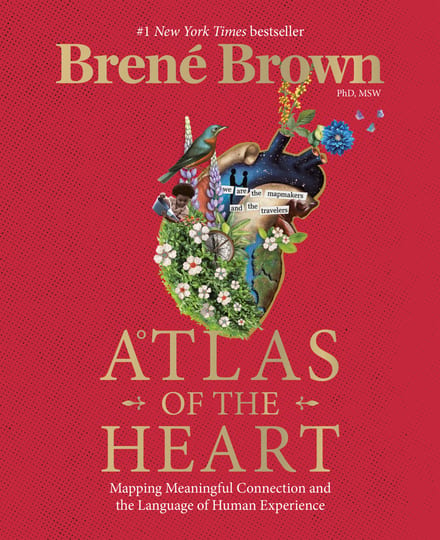
Atlas of the Heart: Mapping Meaningful Connection and the Language of Human Experience
The full book runs ~396 pages — roughly 7 hours of reading. You get the key ideas here in 3 minutes.
The key ideas
- Naming emotions turns overwhelming floods into workable, specific experiences
- Distinguish anguish, grief, hopelessness, and despair—they need different responses
- Build hope by setting realistic goals and meeting them
- Shrink negative feelings with the 3 Ps: personalization, permanence, pervasiveness
- Practice gratitude daily to fuel an upward spiral of joy
- Take a time-out to name emotion before your rational brain returns
The summary
When researchers asked 7,000 people to name every emotion they feel, the average answer was three: sad, mad, happy. That, in a sentence, is the problem Brené Brown set out to solve. Emotion doesn’t overwhelm us because we feel too much—it overwhelms us because we can’t tell one feeling from another, so it lands as a single undifferentiated flood. The fix isn’t to feel less. It’s to build the vocabulary that turns that flood into something you can name, locate, and respond to.
The doctor you can only point at
Picture going to a doctor for shoulder pain but being unable to speak—you can only wave and gesture. You’d leave frustrated and still hurting. That’s how most of us handle our inner lives: something big and formless shows up, we can’t put words to it, and we drown in it. The ability to name what you feel with precision is what Brown calls emotional granularity, and it’s less a nicety than a form of agency. When you can say exactly what you’re feeling, you can trace where it came from, spot your triggers, ask for the help that actually fits, and find the thing that soothes you. It also connects you to other people, who can only meet you where you can describe yourself.
Sadness is not one feeling
Take the word “sad.” It’s an umbrella stretched over states that are genuinely different and call for different responses. Anguish is sudden and traumatic; Brown says it “comes for the bones,” hitting you on a physical level. Grief is the deep sense of loss. Hopelessness is believing your goals are out of reach. Despair is darker still—the conviction that life itself is hopeless and nothing will ever change, which is why it can push people toward suicide as the only agency they feel they have left. Call all four “sad” and you blur exactly the distinctions that would tell you what you’re dealing with and what could help.
Where Brown learned to read emotion
Brown built this skill young, out of necessity. Her swim coach had an explosive temper that baffled the other kids, but she noticed the pattern: he blew up when he saw someone not trying hard enough. At home her parents were unpredictable and quick to anger, so she learned to map their soft spots—their “shame triggers”—to stay out of the blast radius. She also saw that outbursts are rarely about the thing in front of them; road rage isn’t really about traffic. There’s always something underneath.
That constant vigilance left her anxious and walking on eggshells, and for years she numbed it with smoking and drinking, which only made her feel worse. Therapy and sobriety turned it around. Once she stopped fleeing her feelings and started naming them, her life changed. The sensitivity that felt like a curse became a tool.
Hope, gratitude, and the shadow side of joy
Joy and happiness aren’t the same thing. Happiness is a longer, steadier state—a sense of being in control of your life. Joy is sudden, intense, and brief, a flash of the unexpected. And joy that strong can trigger what Brown calls foreboding joy: watching your child sleep, flooded with love, then instantly bracing for catastrophe. The move is to stay in the moment and not let dread rob you of what’s actually there.
Hope, meanwhile, is not a temperament but a skill. You grow it by setting realistic goals and hitting them, which builds a sense of agency, and it’s contagious—children of hopeful parents tend to be hopeful too. Gratitude runs on the same wiring: people who practice it feel more joy, and joy makes them more grateful, an upward spiral you can start with something as small as listing three things at the end of the day. When a hard feeling hits, Brown offers the 3 Ps—question its personalization (is this really about me?), its permanence (will it matter in a month?), and its pervasiveness (does it touch everything, or one corner?). Each question shrinks the emotion to its real size. Even sadness earns its keep here: sitting with it is how we learn vulnerability and empathy.
The bottom line
When emotion overwhelms you, the rational part of your brain goes quiet—so the worst moment to make a decision is mid-flood. Take the time-out, get enough distance to name what you’re feeling, and only then respond. Naming is the whole game: a feeling you can name is a feeling you can work with. Read this if you’re tired of being ambushed by your own inner life.
Fact check
Popular books repeat findings that later research has complicated. Where Atlas of the Heart makes a testable claim, here's what the evidence actually shows.
Naming a feeling precisely — emotional granularity — gives you more control over it and shrinks its intensity.
The effect is real but small, and conditional. A meta-analysis of 17 studies found people who differentiate their negative emotions more finely engage in fewer maladaptive coping behaviours, at r = -.15, and the association survived controlling for how much negative affect they felt. Labeling also damps the physiological response — an fMRI study found putting feelings into words reduced amygdala activity — but a 2022 experiment found labeling lowered distress for high-intensity aversive images while raising it for low-intensity ones. Naming appears to help most when the feeling is genuinely big.
- Seah THS, Coifman KG. Emotion differentiation and behavioral dysregulation in clinical and nonclinical samples: A meta-analysis. Emotion. 2022;22(7):1686-1697. PubMed
- Lieberman MD, Eisenberger NI, Crockett MJ, Tom SM, Pfeifer JH, Way BM. Putting feelings into words: affect labeling disrupts amygdala activity in response to affective stimuli. Psychol Sci. 2007;18(5):421-8. PubMed
- Levy-Gigi E, Shamay-Tsoory S. Affect labeling: The role of timing and intensity. PLoS One. 2022;17(12):e0279303. PubMed
A daily gratitude practice — listing three things at the end of the day — sets off an upward spiral of joy.
Gratitude exercises do lift wellbeing, but by a little. A preregistered meta-analysis of 145 papers, 727 effect sizes and 24,804 participants across 28 countries put the overall gain at Hedges' g = 0.19. An earlier meta-analysis found gratitude interventions beat a measurement-only control on psychological wellbeing (d = .31) but performed no better than any other psychologically active exercise (d = -.03). The benefit is genuine; the spiral is not.
- Choi H, Cha Y, McCullough ME, Coles NA, Oishi S. A meta-analysis of the effectiveness of gratitude interventions on well-being across cultures. Proc Natl Acad Sci U S A. 2025;122(28):e2425193122. PubMed
- Davis DE, Choe E, Meyers J, et al. Thankful for the little things: A meta-analysis of gratitude interventions. J Couns Psychol. 2016;63(1):20-31. PubMed
Questioning a hard feeling's personalization, permanence and pervasiveness — the 3 Ps — cuts it back to its real size.
The 3 Ps come out of Seligman's explanatory-style research, and the flagship program built on disputing those attributions — the Penn Resiliency Program — does reduce depressive symptoms, modestly. Across 17 controlled evaluations covering 2,498 young people, effects ranged from Glass's d = 0.11 to 0.21 against no-intervention controls and held at one-year follow-up, but showed no advantage over active control conditions. That sits in the same range as reappraisal generally: a meta-analysis of 306 experimental comparisons found cognitive-change strategies moved emotional outcomes by d = 0.36.
- Brunwasser SM, Gillham JE, Kim ES. A meta-analytic review of the Penn Resiliency Program's effect on depressive symptoms. J Consult Clin Psychol. 2009;77(6):1042-54. PubMed
- Webb TL, Miles E, Sheeran P. Dealing with feeling: a meta-analysis of the effectiveness of strategies derived from the process model of emotion regulation. Psychol Bull. 2012;138(4):775-808. PubMed
Frequently asked questions
What is Atlas of the Heart about?
It starts from a striking finding, that asked to name every emotion they feel, most people can name only three, and argues that emotion overwhelms us not because we feel too much but because we can't tell one feeling from another. The fix is to build the vocabulary that turns an undifferentiated flood into something you can name, locate, and respond to.
What are the key takeaways from Atlas of the Heart?
Emotional granularity, naming feelings precisely, is a form of agency that lets you trace a feeling's source, spot your triggers, and ask for the help that actually fits. Broad words like "sad" hide genuinely different states such as anguish, grief, hopelessness, and despair, each calling for a different response. Joy, happiness, hope, and gratitude aren't interchangeable, and intense joy can trigger "foreboding joy." Practical tools include the 3 Ps, questioning a feeling's personalization, permanence, and pervasiveness, and taking a time-out mid-flood before you respond.
Who should read Atlas of the Heart?
Anyone tired of being ambushed by their own inner life who wants a more precise language for what they feel.
Is Atlas of the Heart worth reading?
Yes, it works as a practical map of human emotions with clear distinctions and concrete tools, and the author's own story of learning to read emotion grounds it. Readers wanting a single linear argument rather than a reference-style tour of many feelings may find its structure sprawling, but that breadth is the point.