Book summary
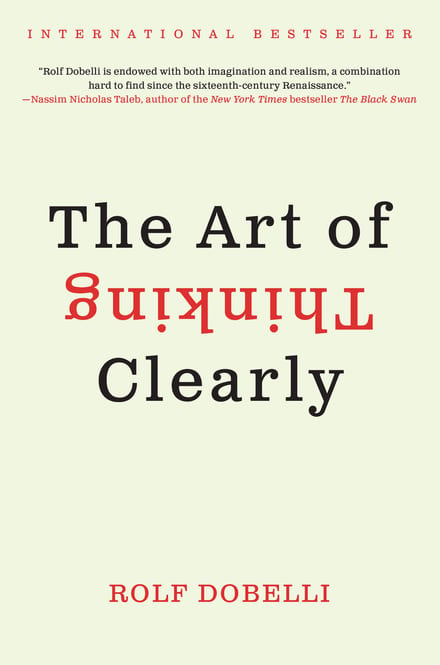
The Art of Thinking Clearly
The full book runs ~384 pages — roughly 7 hours of reading. You get the key ideas here in 5 minutes.
The key ideas
- Errors aren't random — they pile up in the overconfidence corner, never the underconfidence one.
- Survivorship bias: you see the rock stars, never the graveyard behind them.
- Tetlock graded 28,361 expert predictions; they barely beat a random forecast generator.
- Regression to the mean quietly funds chiropractors, golf pros and turnaround consultants.
- More than half of Milgram's subjects went to 450 volts on a professor's say-so.
- Via negativa: chisel away the errors and the upside takes care of itself.
The summary
In the fall of 2004, a European media mogul invited Rolf Dobelli to Munich and introduced him to the room as an authority on David Hume, which he was not. Nassim Taleb pulled over a free chair and patted the seat, and the evening became a catalogue of how badly CEOs and investors reason. Dobelli went home and started a private list of thinking errors, meant only to stop himself gambling away what he’d earned as a novelist.
That list is the argument. The errors aren’t noise; they pile up “in one specific, predictable corner like dirty laundry” while the other stays clean. We overestimate our knowledge far more often than we underestimate it. Mistakes that lean reliably one way can be named — and dodged.
You only ever meet the survivors
Rick sees rock stars everywhere, so he starts a band. The graveyard of failed musicians holds 10,000 times more people than the stage does, and no journalist digs there. The Dow Jones runs the same trick with money — an index of survivors, which is why it says little about a country’s economy.
Taleb, trying to lose weight, admired swimmers’ physiques and joined a pool, then realised swimmers don’t have those bodies because they swim. The physique is the selection criterion, not the result. Same with Harvard: fine school, or ruthless admissions? Same with cheerfulness, which the research suggests is largely a fixed trait — “trying to be happier is as futile as trying to be taller,” in Lykken and Tellegen’s phrase. The cheerful write the self-help books; the unhappy don’t publish their failures, so the sample is broken before page one.
The mind will not let randomness stay random
Diane Duyser saw the Virgin Mary in a slice of toast in 1994 and auctioned it for $28,000. Londoners mapped the V1 impact sites to find the safe districts; postwar analysis showed the distribution was random, the rocket’s navigation being that bad.
Randomness also gets mistaken for cause. On the Hebrides, head lice desert a man when he runs a fever, so the sick had lice put back in their hair and duly improved. German stork pairs and German births both fell from 1965 to 1987 along near-identical curves.
Regression to the mean quietly funds whole professions. Back pain bad enough to send you to a chiropractor would have eased anyway; a golfer books the pro after his worst round and plays better next time.
Nobody is standing in the underconfidence corner
Raiffa and Alpert asked people for estimate ranges wide enough to be wrong only 2% of the time. They were wrong 40% of the time. Expertise doesn’t help — an economics professor forecasting oil prices lands as wide of the mark as a zookeeper, only with more certitude. Philip Tetlock graded 28,361 predictions from 284 professionals over ten years and found they barely beat a random forecast generator, the media favourites worst of all.
Control is the same illusion, differently dressed. A man waves his red hat in the square each morning to keep the giraffes away, and the absence of giraffes proves he’s doing a good job. Elevator door-close buttons work on the same principle. And where luck decides the outcome, we reward it as though it were skill: a good managerial record, Buffett says, is “far more a function of what business boat you get into than it is of how effectively you row.”
Your thinking runs partly on other people
Solomon Asch sat a subject among five actors who confidently named the wrong line as the match; a third of the time, the subject agreed. In April 1961, Kennedy’s advisers sent 1,400 Cuban exiles to the Bay of Pigs, assuming they could retreat into mountains 100 miles away across an impassable swamp. Irving Janis called it the illusion of unanimity: if everyone else agrees, your objection must be the faulty one, and voicing it risks your place in the group.
Authority finishes the job. More than half of Milgram’s subjects went to 450 volts because a professor kept saying the experiment depended on it. Airlines answered with Crew Resource Management, training crews to contradict the captain — worth more to flight safety, Dobelli reckons, than any technical advance. Max Planck’s chauffeur, who had heard the quantum lecture often enough to deliver it, handled a physicist’s question by calling it too simple and passing it to “my chauffeur.” Real experts say “I don’t know” without apologising.
The fix is subtraction, not addition
Asked the secret of the David, Michelangelo said he removed everything that was not David. That is Dobelli’s method, and why there are no seven steps here. We don’t know what makes people successful or happy; we know fairly precisely what destroys both, and that negative knowledge is the sturdier kind — via negativa, the path of taking away. Buffett: “Charlie and I have not learned how to solve difficult business problems. What we have learned is to avoid them.”
The errors persist because we’re built for a vanished world: hunter-gatherers in Hugo Boss, wired for groups of about fifty, when fifteen minutes in a shopping mall now takes you past more faces than an ancestor saw in a lifetime. Dobelli doesn’t claim to have escaped. When the stakes are large he works through his list like a pilot with a checklist; otherwise he lets intuition run, as he does inside his circle of competence — which, he warns, is smaller than you think.
The bottom line
Awareness alone won’t save you — Dobelli notes that people who know about hindsight bias fall for it just as hard. What you can do is spot the two or three errors that would be expensive in the decision actually in front of you, and chisel those away. Read it if you make consequential calls about money, hiring or strategy and want a checklist rather than a worldview — but don’t expect a system. It’s ninety-nine warnings, deliberately.
Fact check
Popular books repeat findings that later research has complicated. Where The Art of Thinking Clearly makes a testable claim, here's what the evidence actually shows.
Philip Tetlock graded 28,361 predictions from 284 professional forecasters over ten years and found they barely beat a random forecast generator.
The headline result holds: Tetlock's experts made probability judgements that were, in his publisher's summary, "not very much better than making predictions by chance," and only slightly better than a casually informed layperson. The timescale in the summary is off — the forecast collection ran for more than twenty years, not ten. Tetlock's own later work also cuts against the fatalistic reading: in a two-year geopolitical forecasting tournament, probability training, working in teams, and promoting the top 2% of first-year forecasters into elite teams each produced measurable gains in calibration and resolution.
More than half of Milgram's subjects went all the way to 450 volts because an authority figure told them the experiment required it.
In the baseline experiment 65% did go to 450 volts, so the summary's figure is right for the study everyone remembers. Across Milgram's roughly 30 variants, though, the rate ranged from 0% to nearly 100%, and taking the programme as a whole a majority of participants stopped short — obedience was highly sensitive to how the situation was set up, not a constant. The effect itself is durable: a modern partial replication found obedience rates only slightly below Milgram's, against the 79% of his original participants who continued to the end once they had passed 150 volts.
- Milgram S. Behavioral study of obedience. J Abnorm Psychol. 1963;67:371-8. PubMed
- Haslam SA, Reicher SD. Contesting the "nature" of conformity: what Milgram and Zimbardo's studies really show. PLoS Biol. 2012;10(11):e1001426. PubMed
- Burger JM. Replicating Milgram: would people still obey today? Am Psychol. 2009;64(1):1-11. PubMed
In Asch's line-judgement experiment, people sided with a confident but obviously wrong majority about a third of the time.
Asch's own data give roughly that rate — participants endorsed the majority's wrong answer on about a third of the critical trials, while a substantial minority never went along at all. But the figure is not a fixed property of human nature. A meta-analysis of 133 studies using Asch's task across 17 countries found conformity in US samples has declined steadily since the 1950s, and that collectivist countries produce markedly higher conformity than individualist ones.
- Asch SE. Studies of independence and conformity: I. A minority of one against a unanimous majority. Psychol Monogr Gen Appl. 1956;70(9):1-70. Source
- Bond R, Smith PB. Culture and conformity: a meta-analysis of studies using Asch's (1952b, 1956) line judgment task. Psychol Bull. 1996;119(1):111-137. Source
Cheerfulness is essentially a fixed trait, so trying to become happier is as futile as trying to become taller.
Lykken and Tellegen's twin data put the heritability of well-being at 44-52%, rising to roughly 80% for the stable component that persists across 4-, 5- and 10-year follow-ups, while socioeconomic status, education, income, marital status and religious commitment together explained only about 3% of the variance. That stable component is not the whole of happiness, and set points do move: 15 years of German panel data on more than 24,000 people showed life satisfaction did not return to its earlier level after a spell of unemployment, even once people were back in work. The heritable baseline is real; the "as futile as trying to be taller" framing goes further than the evidence.
Frequently asked questions
What is The Art of Thinking Clearly about?
It's a catalogue of ninety-nine cognitive errors that Rolf Dobelli started keeping for himself after an evening in Munich with Nassim Taleb, to stop himself making expensive mistakes with money he'd earned writing novels. The point isn't that we think badly at random. The errors lean reliably in one direction — they pile up in the overconfidence corner, never the underconfidence one — which is exactly what makes them nameable, and therefore avoidable.
What are the key takeaways from The Art of Thinking Clearly?
Four families of error do most of the damage. You only meet the survivors: the graveyard of failed musicians holds 10,000 times more people than the stage, and the Dow Jones is an index of survivors, so success looks far likelier than it is. Your mind refuses to let randomness stay random, which is how head lice cured fevers on the Hebrides and how chiropractors take credit for regression to the mean. Nobody stands in the underconfidence corner: Tetlock graded 28,361 expert predictions and found they barely beat a random generator. And other people are load-bearing in your thinking — Asch's line test, the Bay of Pigs, Milgram's 450 volts. The remedy is via negativa: like Michelangelo, remove what isn't David.
Who should read The Art of Thinking Clearly?
Anyone who makes consequential calls about money, hiring or strategy and wants a checklist to run them past. It suits people who'd rather have ninety-nine specific warnings than one grand theory of the mind.
Is The Art of Thinking Clearly worth reading?
Yes, if you treat it as a reference rather than a cure. The chapters are short, concrete and genuinely useful — the examples stick, and the closing argument that negative knowledge beats positive knowledge is worth the price on its own. But the book admits its own limit: people who know about hindsight bias fall for it just as hard, so don't expect awareness alone to change how you decide.