Book summary
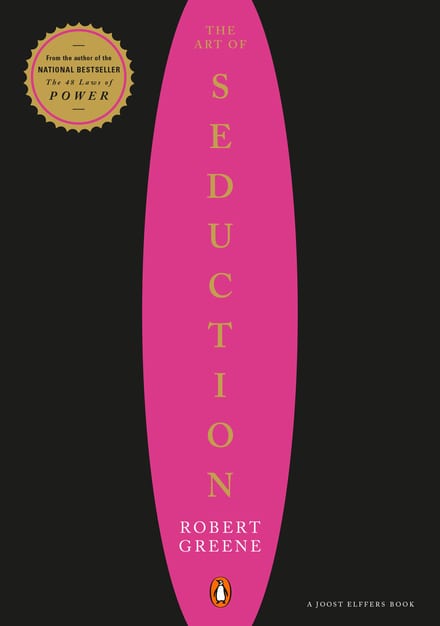
The Art of Seduction
The full book runs ~512 pages — roughly 9 hours of reading. You get the key ideas here in 5 minutes.
The key ideas
- Profiles nine seducer types, each built from historical case studies
- Calls the other person the victim, and sorts them into eighteen kinds
- Borrows crystallization from Stendhal: an enchanted image built from little evidence
- Maps twenty-four maneuvers in phases, ending on the aftereffects
- Widens the frame to selling anything to the masses
- Offers historical anecdote rather than evidence, and stays amoral on purpose
The summary
Seduction, on Robert Greene’s premise, is a branch of power rather than a branch of romance — the indirect kind that works on someone’s imagination instead of their reasoning. The publisher’s own copy states the ambition without blushing: raised to the level of art, seduction is “an indirect and subtle form of power” that “has toppled empires, won elections and enslaved great minds.” That claim explains the book’s unusual shape. Half of it is a gallery of historical characters, half an operations manual. Greene’s argument is that seduction is something you become before it is anything you do.
The seducer is a character before it’s a technique
Part One profiles nine seducer types — the Siren, the Rake, the Ideal Lover, the Dandy, the Natural, the Coquette, the Charmer, the Charismatic and the Star — each built out of historical case studies. Cleopatra anchors the Siren. Casanova serves as the Ideal Lover, the seducer who studies what is missing in someone’s life and supplies exactly that. Benjamin Disraeli, in his handling of Queen Victoria, is the Charmer.
The Coquette chapter is where the frame widens. Its two cases are Joséphine Bonaparte and Andy Warhol — Warhol’s studied blankness treated as an instrument aimed at a public rather than a person. Withholding, in Greene’s reading, is not the absence of a move. It is the move.
A tenth chapter breaks the pattern: the Anti-Seducer, the negative image, the person whose self-absorption and impatience repel without them ever noticing. It works as the section’s diagnostic. The point of Part One is not to pick a type off a shelf but to find the one your temperament already leans toward and build it out on purpose.
What gets seduced is the other person’s fantasy
Greene’s word for the person on the receiving end is victim, and a full chapter sorts them into eighteen types. The vocabulary is deliberate. He is describing a campaign, and campaigns have targets.
The psychology underneath comes from a nineteenth-century source. On his own blog, Greene traces the book to two starting points: Bronisław Malinowski’s anthropology, and his own experience of the type he calls the classical Rake — a figure he says is badly misread, since rakes tend to be highly emotional and genuinely fall for the women they pursue. The organizing idea he borrows from Stendhal’s On Love is crystallization: the way someone in love assembles an enchanted, fantasy-heavy image of another person out of very little actual evidence.
Greene’s move is to treat that as something a seducer can invite rather than wait for. Supply the raw material — mystery, absence, a hint of depth — and let the other person do the idealizing themselves. He has written that his aim was to drag a mostly unconscious process into the open so people could see it happening, including when it happens to them.
The process has a shape
Part Two is the manual: twenty-four numbered maneuvers, grouped into phases of a campaign. The first phase is titled “Separation: Stirring Interest and Desire”; a later one, “Lead Astray: Creating Pleasure and Confusion.” The individual strategies read exactly like what they are — Choose the Right Victim, Send Mixed Signals, Appear to Be an Object of Desire, Master the Art of Insinuation, Poeticize Your Presence, Isolate the Victim, Stir Up the Transgressive and Taboo, Master the Art of the Bold Move.
The sequence ends on “Beware the Aftereffects,” which is the tell. Greene treats the aftermath as part of the operation rather than the end of it. Two appendices then push the whole frame outward: “Seductive Environment: Seductive Time,” and “Soft Seduction: How to Sell Anything to the Masses.” The second is where the book stops pretending to be about dating at all.
It is amoral on purpose
Greene does not soften this and it would be strange to pretend otherwise. Answering readers on his blog about a seduction scenario, he wrote that he falls into the camp of all is fair in love and war, with a few limits he would personally observe — marriage, children being involved — and that without a feeling of transgression there would be no seduction at all. In a separate post he draws the line he cares about more: on one side the pickup-artist gimmicks aimed at a quick hook and then moving on, which he calls sad and mechanical; on the other a deep seduction in which emotions are engaged on a strong level. He also argues against opening with a bold, direct move, which he reads as the mark of someone insecure and afraid of failure rather than confident.
What you will not find is evidence in the modern sense. The method is historical anecdote sorted into patterns — the same method as The 48 Laws of Power, and a looser version of what he later does in Mastery and The Laws of Human Nature. Whether Cleopatra’s court really operated the way the chapter says is not a question the book invites. People magazine’s line, which Penguin still prints, is a fair summary of who it serves: a wry primer for people who desperately want to be on top.
The bottom line
Greene’s case is that desire is a form of power, that it can be studied and worked on like any other, and that the people history remembers as irresistible were running a process rather than radiating a gift. Whether you use it or only learn to see it used on you is left entirely to you — the book takes no position on that, which is precisely the thing readers argue about.
Read it if you want a serious anatomy of influence and can hold an author’s argument at arm’s length. Skip it if you are looking for relationship advice; that is not what this is.
Fact check
Popular books repeat findings that later research has complicated. Where The Art of Seduction makes a testable claim, here's what the evidence actually shows.
Falling for someone means assembling an idealized, fantasy-heavy image of them out of very little real evidence — the crystallization Greene borrows from Stendhal, and the mechanism a seducer is supposed to work on.
Idealization of a partner is real and measurable. Murray, Holmes and Griffin tracked both members of dating couples three times over a year and found people consistently saw partners more positively than the partners saw themselves; the relationships most likely to survive conflicts and doubts were the ones where idealization ran highest. A later study followed newlyweds across their first three years: satisfaction declined markedly overall, but the people who idealized their partner most at the time of marriage showed no decline at all. Where the research parts company with Stendhal is the ending — these illusions tend to be self-fulfilling rather than a bubble that bursts, which is why the 1996 authors called love "not blind, but prescient."
- Murray SL, Holmes JG, Griffin DW. The self-fulfilling nature of positive illusions in romantic relationships: love is not blind, but prescient. J Pers Soc Psychol. 1996;71(6):1155-80. PubMed
- Murray SL, Griffin DW, Derrick JL, Harris B, Aloni M, Leder S. Tempting fate or inviting happiness?: unrealistic idealization prevents the decline of marital satisfaction. Psychol Sci. 2011;22(5):619-26. PubMed
Cleopatra is the founding case of the book's Siren type — a woman whose hold on Caesar and Antony rested on a cultivated erotic presence.
The cultivation half survives better than the erotic half. Plutarch, the main ancient narrative source, wrote that her beauty "was in itself not altogether incomparable, nor such as to strike those who saw her," and put her force in her voice and her conversation — she could turn her tongue to whatever language she pleased and seldom needed an interpreter. The seductress image descends in large part from Octavian's propaganda war against Antony, which magnified Cleopatra to magnify his own victory. Stacy Schiff's account of the same evidence describes a monarch fluent in nine languages, incomparably richer than anyone else in the Mediterranean, and the only woman of her world to rule alone.
Frequently asked questions
What is The Art of Seduction about?
It treats seduction as a branch of power rather than romance — the indirect kind that works on someone's imagination instead of their reasoning. Half the book is a gallery of historical seducers, half an operations manual of numbered maneuvers. Greene's premise is that seduction is something you become before it is anything you do.
What are the key takeaways from The Art of Seduction?
Part One profiles nine seducer types — Siren, Rake, Ideal Lover, Dandy, Natural, Coquette, Charmer, Charismatic, Star — plus the Anti-Seducer as a diagnostic, with the advice being to build out the type your temperament already leans toward. A chapter sorts the people on the receiving end into eighteen kinds, and the psychology comes from Stendhal's idea of crystallization: someone in love assembles an enchanted image of another person out of very little evidence. Part Two is twenty-four maneuvers grouped into phases of a campaign, ending on "Beware the Aftereffects." Two appendices push the frame outward to environments, timing, and selling to the masses.
Who should read The Art of Seduction?
Anyone who wants a serious anatomy of influence and can hold an author's argument at arm's length — whether to use it or just to recognise it being used on them. It is not relationship advice, and readers looking for that should skip it.
Is The Art of Seduction worth reading?
It is genuinely good at making an unconscious process visible, and the historical case studies are the most readable part. What you will not find is evidence in the modern sense: the method is historical anecdote sorted into patterns, and whether Cleopatra's court really worked the way the chapter says is not a question the book invites. It is also amoral on purpose — Greene takes no position on how you use it, which is precisely the thing readers argue about.