
Book summary
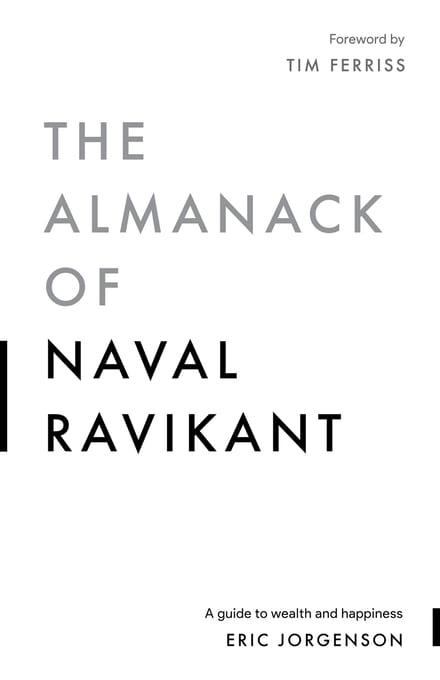
The Almanack of Naval Ravikant
A Guide to Wealth and Happiness
The full book runs ~242 pages — roughly 4 hours of reading. You get the key ideas here in 4 minutes.
The key ideas
- Distinguish wealth from money and status.
- Pursue specific knowledge that training can't replicate.
- Use code and media as permissionless, scalable leverage.
- Own equity; you won't get rich renting time.
- Remove the sense something's missing to find happiness.
- Change it, accept it, or leave it—never struggle.
The summary
Naval Ravikant’s advice fits on a napkin, but it all rests on one distinction most people blur. Wealth is not money, and it is not status. Wealth is having assets that earn while you sleep. Money is only how we transfer time and value. Status is your place in the social hierarchy. Chase the wrong one and you spend your life climbing a ladder that leads nowhere. The Almanack treats getting rich and being happy as two separate skills, each with its own methods, and it refuses to pretend the first one buys the second.
Seek wealth, not money or status
You get rich by giving society what it wants but doesn’t yet know how to get — at scale. Renting out your time will never do it, because paid hours don’t compound and they stop the moment you do. What compounds is equity. You have to own a piece of a business to reach financial freedom. Every real return in life — in money, relationships, or knowledge — comes from compound interest, which is why the direction you’re heading matters far more than how fast you move.
Specific knowledge is what you can’t be trained for
The knowledge that makes you rich is the knowledge nobody can hand you. “If society can train you, it can train someone else and replace you.” Specific knowledge shows up when you follow genuine curiosity instead of whatever’s hot, and it usually feels like play to you and work to everyone watching. Refine what you do until you’re the best at it, and opportunity starts seeking you out — luck becomes your destiny. None of it arrives without hard work, though. Hard work is the soil that both judgment and any real multiplier grow from.
A multiplier that needs nobody’s permission
Fortunes require a force multiplier, and the best kind asks no one for permission. Labor and capital both need a boss or an investor to say yes first. Code and media don’t. They are the multipliers behind the newly rich — software and content that keep working while you sleep and scale without adding a single employee. Sitting on top of that multiplier is judgment, which is the thing you actually want to be paid for. Naval’s illustration is blunt: someone whose judgment is right 85 percent of the time instead of 75 gets paid $50 million, $100 million, whatever it takes, because ten percent better judgment steering a $100 billion ship is worth a fortune. Judgment comes from clear thinking, and clear thinkers understand the basics at a fundamental level — they reason from principles and mental models, not from “X happened before, so X will happen again.” Meanwhile, value your time at a fixed hourly rate and defend it: if fixing a problem saves less than that rate, ignore it; if outsourcing a task costs less, outsource it.
Happiness is the absence of wanting
Wealth won’t hand you contentment, because contentment is a different skill entirely. Happiness, Ravikant says, is what’s there when you remove the sense that something is missing. The more present you are, the more of it you have — and there is nothing but this moment anyway, since no one has visited the past or reliably predicted the future. The obstacle is desire, which he defines as a contract you make with yourself to be unhappy until you get what you want. Status games make it worse because they’re zero-sum: to win one, you have to put someone else down.
His practical tool for suffering is a three-way fork. In any situation you can change it, accept it, or leave it. What ruins people is the fourth path — sitting there wishing they’d change it without changing it, wishing they’d leave without leaving, refusing to accept it. That struggle produces most of our misery, which is why the single word he repeats to himself most is “accept.”
Freedom from, not freedom to
Ravikant reframes the whole goal as internal freedom. His old idea of freedom was “freedom to” — do whatever he wanted, whenever. The freedom he wants now is “freedom from”: from reaction, from anger, from sadness, from being forced into things. The tool for that is habit, because you become your habits, and at any moment he’s either building a good one or shedding a bad one. Meditation he calls intermittent fasting for the mind — a way to make the mind a servant rather than a master and break the habit of uncontrolled thinking. Above happiness, family, and work, he ranks his own health, because in the end doctors won’t make you healthy and nutritionists won’t make you slim. You have to save yourself. And since the universe hands you no built-in meaning, you’re left to create your own.
The bottom line
Getting rich and being happy are two skills, not one. Build wealth by owning equity and applying knowledge only you have through tools that need no one’s permission; build contentment by wanting less, staying present, and accepting what you won’t change. Read this if you want a compact, first-principles framework for both money and peace of mind that cuts against most conventional career advice.
Frequently asked questions
What is The Almanack of Naval Ravikant about?
It collects Naval Ravikant's thinking on two separate skills, getting rich and being happy, and refuses to pretend the first one buys the second. The core distinction is that wealth means owning assets that earn while you sleep, not money or status, and contentment is a different discipline entirely.
What are the key takeaways from The Almanack of Naval Ravikant?
Seek wealth by owning equity, since rented time never compounds, and build "specific knowledge" that society can't train into you by following genuine curiosity. Use force multipliers that need no permission, like code and media, and get paid for judgment, which comes from clear, first-principles thinking. On happiness, it's the absence of wanting, desire is "a contract you make with yourself to be unhappy until you get what you want," and in any situation you can change it, accept it, or leave it, but never sit there wishing. The goal becomes "freedom from" reaction and anger, built through habit and meditation.
Who should read The Almanack of Naval Ravikant?
Anyone who wants a compact, first-principles framework for both money and peace of mind that cuts against most conventional career advice.
Is The Almanack of Naval Ravikant worth reading?
Yes, it distills a coherent philosophy into quotable, memorable principles and treats wealth and happiness as learnable skills rather than luck. Readers wanting step-by-step tactics or case studies may find it abstract, since its strength is framing and mindset over detailed how-to.