Book summary
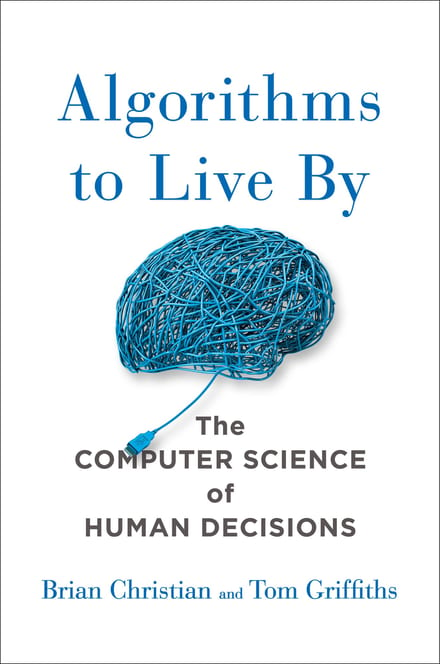
Algorithms to Live By: The Computer Science of Human Decisions
The full book runs ~359 pages — roughly 7 hours of reading. You get the key ideas here in 3 minutes.
The key ideas
- Reject the first 37%, then pick the next best option
- Explore widely early, exploit proven winners later
- Cache what you use most within easy reach
- Schedule by earliest due date, drop the longest task
- Accept good-enough answers over overfit perfect ones
- State your preferences to reduce others' cognitive load
The summary
Most of life’s hardest decisions aren’t hard because you’re bad at thinking. They’re hard because you’re solving problems that have no perfect answer: too many options, too little information, too little time. Computer scientists have spent decades on exactly these problems, and the strategies they worked out for machines turn out to be good advice for people. An algorithm is just a finite sequence of steps for solving a problem. Following a recipe is one, and so is making a pros-and-cons list, only less precise. The trick is knowing which algorithm fits which decision.
Know when to stop looking
When you evaluate options one at a time—apartments, job candidates, people to date—the agony is committing before you’ve seen enough, or waiting so long the good ones are gone. The optimal stopping rule settles it: look at the first 37% of your options without choosing any, just to learn what “good” looks like, then take the next one that beats everything you’ve seen so far. You won’t always land the single best option, but no strategy does better on average. The point is to stop agonizing and let a rule carry the decision.
Explore, then exploit
The multi-armed bandit problem—named for a gambler facing a row of slot machines—asks whether to keep pulling the arm that’s paid off or gamble on an untested one. The Upper Confidence Bound approach says start with the option that looks best, track what actually happens, and move on when reality falls short of what you expected. Medicine runs a version of this with adaptive clinical trials, adjusting the study as data comes in rather than following a fixed plan to the bitter end. The broader lesson is about timing. When you’re new to a city or early in life, explore: try the untested restaurant, meet new people. When your time is short or you’re passing through once, exploit what you already know is good.
Keep what you use within reach
Computers store the data they touch most often in a small, fast cache near the processor and dump the rest in slow, cheap storage. Your desk, your closet, and your brain all work better on the same principle. Keep what you use frequently and recently close at hand; when space runs out, evict whatever you won’t need for the longest time. This is why reading your notes right before bed loads them into easy reach for a morning exam, and why forgetting a name isn’t a character flaw but, as the authors put it, a “cache miss.” One caveat on tidiness: “Sorting something that you will never search is a complete waste; searching something you never sorted is merely inefficient.” Don’t organize what you’ll never look for.
Do the urgent thing, and only that thing
For deadlines, the Earliest Due Date rule is hard to beat: work on whatever’s due soonest. If you can’t finish everything, Moore’s Algorithm minimizes how many tasks come in late—follow earliest due date, then drop the single longest task when you fall behind. Better to blow one big deadline than three small ones. Watch for priority inversion, the trap where a trivial task blocks an important one, like answering email while the report your boss needs sits untouched. And resist the urge to multitask. Every switch forces your mind to reload its working memory, so the fastest route through a pile of work is one task at a time, finished before you move on.
Good enough beats perfect
The most complex model isn’t the best one. Pile in enough variables and you get overfitting: a solution so tuned to the data you have that it fails on anything new. Real decisions are the same—optimize too hard for one situation and you’ll be wrong about the next. So accept effective over ideal. “Don’t always consider all your options… Make a mess on occasion. Travel light. Let things wait. Trust your instincts and don’t think too long. Relax. Toss a coin.” This extends to how you treat people, through what the authors call computational kindness. Saying “Oh, I’m flexible, what do you want to do tonight?” feels generous, but it hands someone else the whole problem and forces them to guess your preferences, one of the hardest things a mind can do. Just say what you want.
The bottom line
The deepest idea here is that perfect information is a fantasy, and simple rules of thumb often beat exhaustive analysis. Sample about a third of your options before committing, keep what matters close, do one thing at a time, and let good enough be good enough. Read this if you’ve ever been paralyzed by too many choices and suspected there was a smarter way to decide than sheer force of will.
Fact check
Popular books repeat findings that later research has complicated. Where Algorithms to Live By makes a testable claim, here's what the evidence actually shows.
Rejecting the first 37% of your options and then taking the next one that beats them all is the optimal way to choose an apartment, a hire or a partner, and no strategy does better on average.
The 1/e cutoff is genuinely optimal, but only for a tightly defined problem: you know in advance how many options there are, they arrive in random order, you see nothing but relative rankings, a rejected option can never be recalled, and winning means landing the single best one — anything else scores zero. Under those rules the strategy succeeds about 36.8% of the time, so it misses roughly two-thirds of the time. Change the goal from 'the very best' to 'something good' and the optimal rule changes shape: the minimum-expected-rank version starts accepting after 25.8% of options, loosens its standard as it goes, and lands an average rank of about 3.9. Apartments and job candidates also come with visible rents and scores rather than bare rankings, and with that extra information the chance of picking the true best rises to about 58%.
Multitasking is slower than working through tasks one at a time, because every switch forces the mind to reload what it was doing.
Switch costs are among the more reliable findings in cognitive psychology. Rubinstein, Meyer and Evans had participants either alternate between tasks or repeat one, using geometric classification and arithmetic problems, and alternating was consistently slower; the penalty grew with the complexity of the rules and shrank when a visual cue signalled which task was coming. Reviews of the literature attribute the cost to reconfiguring the mental task set plus lingering activation and inhibition carried over from the previous task, rather than to a literal working-memory reload, and responses after a switch are usually more error-prone as well. Lab switch costs run in the hundreds of milliseconds, so the practical toll depends on how often you switch rather than on any fixed productivity percentage.
Frequently asked questions
What is Algorithms to Live By about?
It shows that many of life's hardest decisions are hard not because you think poorly but because they have no perfect answer: too many options, too little information, too little time. The book translates the strategies computer scientists worked out for machines into practical advice for people.
What are the key takeaways from Algorithms to Live By?
Concrete frameworks include the optimal stopping rule, where you look at the first 37% of options to learn what "good" is and then take the next one that beats them; explore-then-exploit for when to try new things versus stick with what works; caching, keeping what you use most within reach; and Earliest Due Date and Moore's Algorithm for scheduling. It also warns against overfitting, urging good enough over perfect, and offers "computational kindness": just say what you want instead of forcing others to guess.
Who should read Algorithms to Live By?
Anyone who has been paralyzed by too many choices and suspected there was a smarter way to decide than sheer force of will.
Is Algorithms to Live By worth reading?
Yes, it makes computer science genuinely useful for everyday decisions and reassures you that simple rules of thumb often beat exhaustive analysis. Readers who dislike math or want purely emotional guidance may find the analytical framing less appealing, but the ideas are practical and memorable.