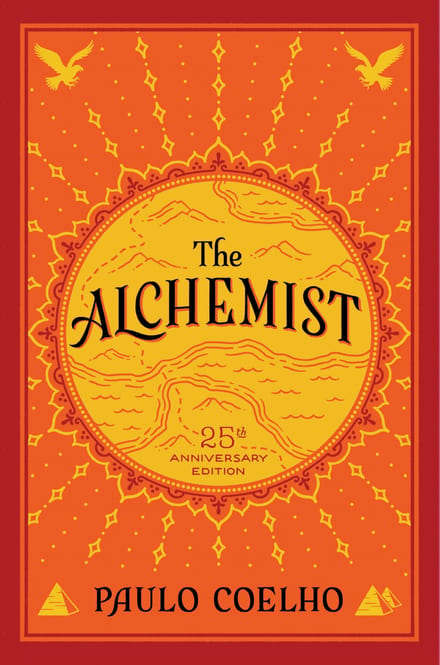
Book summary
The Alchemist
The full book runs ~197 pages — roughly 4 hours of reading. You get the key ideas here in 5 minutes.
The key ideas
- Melchizedek names the world's greatest lie: that fate eventually takes the controls.
- Santiago loses everything on his first day in Africa, then keeps going.
- The crystal merchant keeps Mecca a dream because arriving might end him.
- Fatima sends him on: love that holds you back was never love.
- Fear of failure, not the desert, is what stops almost everyone.
- The chest lay under the sycamore in the ruined church where he first dreamed.
The summary
Santiago, a shepherd in Andalusia, has twice dreamed the same dream: a child takes his hands, carries him to the Egyptian Pyramids, and is about to point out a hidden treasure when he wakes. An old man on a bench in Tarifa explains it. He calls the dream a Personal Legend — the thing you wanted when you were young and everything still looked possible — then names the belief that kills it in most people: that at some point we lose control of what’s happening to us and our lives get run by fate. That, he says, is the world’s greatest lie.
The world’s greatest lie
The old man is Melchizedek, king of Salem, and he charges for his help: one-tenth of the flock, six sheep, paid up front. What he gives back is two stones prised from a gold breastplate, Urim and Thummim, plus the book’s most quoted promise — when you want something, all the universe conspires in helping you to achieve it. Melchizedek also points out a baker who wanted to travel, decided to buy the bakery first, and now plans a month in Africa for when he’s old. What people think about shepherds and bakers ends up mattering more to them than their own Personal Legends. Santiago sells the rest of his sheep and sails for Tangier.
Losing everything is part of the route
Within a day he loses all of it. A young man offers to guide him across the Sahara, takes his money, and vanishes in the market while Santiago is admiring a sword. He weeps in the emptied plaza, then makes the choice the rest of the book turns on: the same facts make him either a robbery victim or an adventurer looking for treasure, and he picks the second.
He takes work cleaning glassware for a crystal merchant at the top of a hill nobody climbs, and stays eleven months and nine days — building a display case for the street, talking the merchant into serving mint tea in crystal glasses, until the shop needs two more employees. The merchant is the novel’s most affecting figure precisely because he never moves. A pilgrimage to Mecca is the fifth obligation of his faith, he has the money, and he will never go. “It’s the thought of Mecca that keeps me alive,” he says. “I’m afraid that if my dream is realized, I’ll have no reason to go on living.” When Santiago leaves with enough to buy a hundred and twenty sheep, the merchant blesses him and tells him flatly he won’t buy them. Maktub — it is written.
The Englishman reads, the boy watches
The caravan east carries an Englishman with suitcases of alchemy books, hunting an alchemist said to be two hundred years old. He and Santiago trade: the boy reads the books, the Englishman watches the caravan. Neither is converted. From the library Santiago takes one thing: the whole Master Work was once written on a single emerald. The desert teaches faster: a camel driver who lost his orchard to a flood and now refuses to live anywhere but the present moment, a tribal war he can’t see but can hear in how quietly people eat.
At the Al-Fayoum oasis, fifty thousand palms and three hundred wells, he meets Fatima at a well and proposes two days later. She accepts, then sends him on — the dunes are changed by the wind, she says, but the desert never changes, and that’s how their love will be. When he tries to stay anyway, the alchemist lays out the next four years: counselor of the oasis, married and happy; then the omens start mentioning the treasure; then Fatima miserable because she thinks she cost him the quest; and by year four the omens gone and a rich merchant who knows what he didn’t do.
Fear of failure is the only real obstacle
Santiago reads a fight between two hawks as a vision of an army attacking the oasis, warns the chieftains, and is told he’ll be executed if he’s wrong. He isn’t. On the road to the Pyramids, tribesmen seize the pair and take his gold, and the alchemist calmly informs the chief that the boy will turn himself into the wind in three days. Santiago has no idea how. There is only one thing, the alchemist tells him, that makes a dream impossible: the fear of failure. He spends those three days talking to his own heart, which admits that hearts go quiet on purpose — people stop wanting to hear about treasures they’ve given up on — and that the fear of suffering is worse than the suffering itself.
He reaches the Pyramids, falls to his knees, and digs where his tears landed. Nothing. Refugees from the war beat him bloody, and their leader, walking off, mentions his own recurring dream: a ruined church in Spain with a sycamore growing out of the sacristy, treasure buried at its roots — though he isn’t fool enough to cross a desert for a dream. Santiago laughs, because he has slept in that church. The chest of Spanish gold is under the sycamore where the whole thing started. Everything in between is what made the last line of the dream readable.
The bottom line
The obstacle here is never the desert. It’s the quiet bargain people make to keep a dream safely unrealized — the merchant’s Mecca on a shelf — and the fear of looking foolish for wanting something out loud. Coelho makes that case in parables rather than arguments, so the wisdom arrives as proverbs you can’t test; read as philosophy the book is thin, and “the universe conspires” is a promise nobody can keep. Read as a fable about setting out anyway, it earns the three hundred–plus weeks it spent on the bestseller list. Worth two hours if you’re stalled at the edge of something; skip it if you want reasons instead of omens.
Frequently asked questions
What is The Alchemist about?
Santiago, a shepherd in Andalusia, dreams twice of treasure hidden at the Egyptian Pyramids and sells his flock to go find it. An old man who calls himself the king of Salem tells him the dream is his Personal Legend — the thing he wanted before he learned to talk himself out of it — and that the world's greatest lie is believing fate takes the controls at some point. The rest is the journey: robbed in Tangier, a year behind a crystal counter, a Sahara crossing, a woman at an oasis well, and a treasure that turns out to be buried where he started.
What are the key takeaways from The Alchemist?
Four ideas carry the book. A Personal Legend is what you wanted when everything still looked possible, and most people trade it for what the neighbors think — the baker who'll travel when he's old, the crystal merchant who keeps Mecca as a dream because arriving might disappoint him. Omens are a language you learn by watching rather than reading, which is why Santiago outpaces the Englishman and his suitcase of alchemy books. Love that asks you to stay isn't love: Fatima sends him on. And the only thing that makes a dream impossible is the fear of failure, which the alchemist forces Santiago to face when he has three days to turn himself into the wind or die.
Who should read The Alchemist?
Anyone stalled at the edge of a decision they keep postponing — a move, a career change, a thing they wanted at twenty and stopped mentioning. It reads in about two hours and works best as a nudge rather than a plan.
Is The Alchemist worth reading?
As a fable it's beautifully built: the crystal merchant and his unvisited Mecca land harder than most self-help chapters, and the ending pays off the whole route. But it argues in proverbs rather than reasons, and "the universe conspires" is a promise nobody can keep — read as philosophy it's thin, and it says nothing about the people whose dreams simply don't work out. Skip it if you want evidence instead of omens.