Book summary
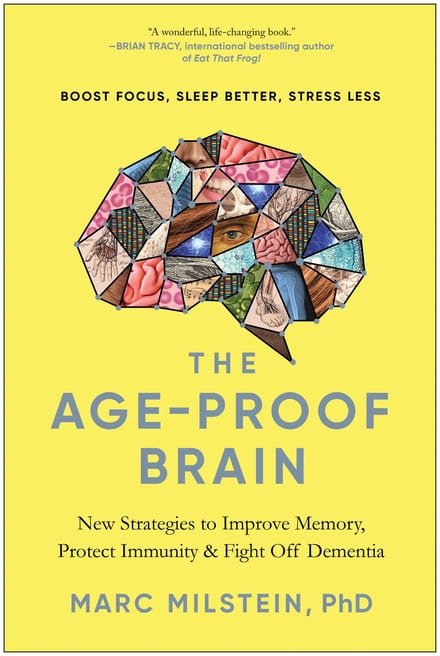
The Age-Proof Brain
New strategies to improve memory, protect immunity & fight off dementia.
The key ideas
- Sleep deeply so your brain flushes toxic waste nightly
- Fight chronic inflammation through stress, diet, and even laughter
- Protect your heart to protect your oxygen-hungry brain
- Feed your gut microbiome with Mediterranean and fermented foods
- Move regularly to grow your memory-storing hippocampus
- Stay connected and keep learning to rewire aging cells
The summary
The age of your brain and the number on your birth certificate are two different things. The proof is a group Milstein calls SuperAgers: people past 80 whose minds work like someone decades younger. Significant cognitive decline, it turns out, is not a normal part of getting old. An estimated third of current dementia cases could have been prevented by changes in how people live. That’s the whole premise here. Your sleep, your meals, your movement, and your relationships are quietly voting, every day, on whether your brain stays sharp.
Sleep is when the brain takes out the trash
During deep sleep your brain physically shrinks to about 65% of its normal size. That isn’t harm, it’s housekeeping. The compression lets the glymphatic system, a cleaning network wired to your immune system, wash spinal fluid through the tissue and flush out the waste and toxins that pile up between brain cells while you’re awake. Skimp on deep sleep and that garbage stays put, which is one reason poor sleep tracks with Alzheimer’s. What matters is not just the hours but how effective they are. Light and darkness set the internal clock, so get real sunlight in the morning and keep nights dark. A consistent routine helps, a warm bath about 90 minutes before bed helps, and if anxious thoughts keep circling, writing your worries down gets them out of your head.
Inflammation is the slow burn behind brain aging
A healthy immune system balances “killer” cells that attack invaders against “peacekeeper” cells that calm things down. Tip that balance and you get chronic inflammation, which Milstein treats as a central engine of aging. It frays telomeres, the protective caps on your chromosomes, and it can turn the immune system against your own brain tissue or stop it from clearing waste, feeding conditions from Alzheimer’s to depression. “If you manage the immune system, you de-age the brain.” Chronic, unmanaged stress pours cortisol on the fire, while short bursts of stress actually sharpen focus and switch on cellular cleanup. The counterweights are within reach: mindfulness strengthens the prefrontal cortex that governs your stress response, and practicing gratitude literally rehearses the pathways for positive moods. Even laughter counts. In one study, watching comedies 30 minutes a day cut inflammatory markers by 66%.
The heart, the gut, and your blood sugar all feed the brain
Your brain is greedy. It consumes roughly 20% of the oxygen your heart pumps, which is why a youthful brain is nearly impossible without a healthy heart. Coronary heart disease is tied to a 40% higher risk of dementia, and a resting heart rate of 80 beats a minute or more correlates with 55% greater risk. Seven numbers move both organs at once: cholesterol, blood pressure, heart rate, blood sugar, homocysteine, smoking, and weight. Optimists, interestingly, tend to have healthier hearts and a 50 to 70% better shot at reaching 85.
Below that sits your gut, a “second brain” in constant conversation with your head. The trillions of bacteria living there regulate immunity, make vitamins, shape your cravings, and produce the vast majority of your serotonin. When researchers swapped gut bacteria between mice, shy mice turned adventurous and bold ones turned timid. Let that microbiome go bad and toxins leak into the bloodstream, driving the same inflammation linked to Alzheimer’s, Parkinson’s, and depression. A Mediterranean diet, rich in vegetables, fish, healthy fats, and whole grains, feeds the good bacteria. Fermented foods like yogurt and kimchi work where probiotic pills for healthy people mostly don’t. The thing to fear on a label is added sugar, especially high-fructose corn syrup. Untreated diabetes raises Alzheimer’s risk by 65%, and more than 90% of people with prediabetes have no idea they have it.
Movement, connection, and learning keep the wiring alive
Exercise may be the single most powerful lever. It steadies the immune system, protects the heart, and can grow brain volume outright. Women who were highly fit at 50 were 90% less likely to develop dementia later, and plain walking has been shown to enlarge the hippocampus, the seat of memory. You don’t need heroics, just about 120 minutes of moderate movement a week. To make it stick, Milstein suggests CARS: a Cue like shoes by the door, an Action kept simple like walking in place during ads, a Reward that makes it fun, and Support from a workout buddy.
Connection matters just as much. Loneliness raises dementia risk by 40% and carries the mortality weight of smoking fifteen cigarettes a day, and it’s about the quality of closeness, not the size of the crowd. Untreated hearing loss is a quiet accelerant here, doubling dementia risk by pulling people out of conversation and starving the brain of stimulation. Learning does the opposite. Every new thing you master builds a fresh connection between cells and releases norepinephrine, a chemical that helps clear brain trash. To convert a short-term memory, which lasts only 7 to 20 seconds, into a lasting one, you have to convince the brain it matters through focused attention. Picture writing a new acquaintance’s name on their forehead, or say facts aloud to store them in both the speech and hearing centers, because the more places a memory lives, the more doors you have to reach it. Deep focus is the price of admission, and even a phone sitting nearby shrinks your capacity to pay it.
The bottom line
How you live shapes your brain’s age far more than your birthday does: sleep deeply, keep inflammation down, protect the heart and gut, move often, stay genuinely connected, and never stop learning. Only 1 to 5% of Alzheimer’s cases come from deterministic genes, which means for almost everyone the daily choices are the real lever. Read this if you want a concrete, science-backed plan to guard your memory and lower your odds of dementia.
Fact check
Popular books repeat findings that later research has complicated. Where The Age-Proof Brain makes a testable claim, here's what the evidence actually shows.
During deep sleep the brain physically shrinks to about 65% of its normal size so the glymphatic system can flush out waste.
The number has the underlying finding inverted. Xie and colleagues reported that in sleeping mice the interstitial space between brain cells expanded by roughly 60% — the cells shrink a little so the gaps between them widen — and that this sped up clearance of beta-amyloid. The brain does not lose a third of its volume overnight. The wider glymphatic story is also less settled than the summary implies: a 2024 study tracking fluorescent molecules through mouse brains found clearance was markedly reduced during sleep and anesthesia rather than increased.
About a third of dementia cases could have been prevented by changes in how people live.
If anything the book is conservative. The Lancet standing Commission attributed 40% of dementia worldwide to 12 modifiable risk factors in its 2020 report, and raised that to 45% across 14 factors in 2024 after adding high midlife LDL cholesterol (7%) and untreated vision loss (2%). The list runs from low education and hearing loss in early and mid-life to social isolation and air pollution later on. These are population attributable fractions: they assume the associations are causal and describe eliminating a risk factor across an entire population, so they set an upper bound rather than a personal guarantee.
- Livingston G, Huntley J, Liu KY, et al. Dementia prevention, intervention, and care: 2024 report of the Lancet standing Commission. Lancet. 2024;404(10452):572-628. PubMed
- Livingston G, Huntley J, Sommerlad A, et al. Dementia prevention, intervention, and care: 2020 report of the Lancet Commission. Lancet. 2020;396(10248):413-446. PubMed
Loneliness raises dementia risk by 40% and carries the mortality weight of smoking fifteen cigarettes a day.
The 40% comes from a real study: Sutin and colleagues followed 12,030 US adults for 10 years and found lonely people had a 40% higher risk of dementia, an association that held after adjusting for social isolation, depression and genetic risk. A 2024 meta-analysis pooling more than 600,000 people put the figure lower, at a 31% increase for all-cause dementia (HR 1.31, 95% CI 1.20-1.43). The cigarette comparison is a different measure attached to a different outcome — it traces back to a meta-analysis of 148 studies in which people with stronger social relationships had a 50% better chance of surviving follow-up, an effect the authors described as comparable to quitting smoking. That is an illustrative benchmark for mortality, not a measured dose equivalence for loneliness.
- Sutin AR, Stephan Y, Luchetti M, Terracciano A. Loneliness and risk of dementia. J Gerontol B Psychol Sci Soc Sci. 2020;75(7):1414-1422. PubMed
- Luchetti M, Aschwanden D, Sesker AA, et al. A meta-analysis of loneliness and risk of dementia using longitudinal data from >600,000 individuals. Nat Ment Health. 2024;2(11):1350-1361. PubMed
- Holt-Lunstad J, Smith TB, Layton JB. Social relationships and mortality risk: a meta-analytic review. PLoS Med. 2010;7(7):e1000316. PubMed
Untreated hearing loss doubles the risk of dementia.
Doubling is a fair reading of the observational data. Lin and colleagues followed 639 dementia-free adults for a median of 11.9 years and found mild hearing loss carried a hazard ratio of 1.89 for all-cause dementia, rising to 3.00 for moderate and 4.94 for severe loss, though the mild-loss confidence interval reached down to 1.00. Whether treating the hearing loss changes the outcome is a separate question, and the answer so far is unclear: the ACHIEVE trial randomised 977 older adults to hearing aids plus audiological counselling or to health education, and found no difference in three-year cognitive change (-0.200 vs -0.202 SD units). A prespecified analysis did find a benefit in the subgroup already at higher risk of cognitive decline.
- Lin FR, Metter EJ, O'Brien RJ, Resnick SM, Zonderman AB, Ferrucci L. Hearing loss and incident dementia. Arch Neurol. 2011;68(2):214-220. PubMed
- Lin FR, Pike JR, Albert MS, et al. Hearing intervention versus health education control to reduce cognitive decline in older adults with hearing loss in the USA (ACHIEVE): a multicentre, randomised controlled trial. Lancet. 2023;402(10404):786-797. PubMed
Frequently asked questions
What is The Age-Proof Brain about?
It argues that the age of your brain and the number on your birthday are two different things, and that significant cognitive decline is not a normal part of getting old. An estimated third of dementia cases could be prevented by how people live, so the book lays out how sleep, diet, movement, and relationships quietly decide whether your brain stays sharp.
What are the key takeaways from The Age-Proof Brain?
Deep sleep lets the glymphatic system flush waste from the brain, so protect it with morning sunlight and dark nights. Chronic inflammation is a central engine of brain aging, countered by mindfulness, gratitude, and even laughter. The heart, gut, and blood sugar all feed the brain, so a Mediterranean diet and fermented foods help while added sugar hurts. Exercise, about 120 minutes a week, may be the most powerful lever, and connection, constant learning, and treating hearing loss all guard memory, since loneliness alone raises dementia risk by 40%.
Who should read The Age-Proof Brain?
Anyone who wants a concrete, science-backed plan to guard their memory and lower their odds of dementia.
Is The Age-Proof Brain worth reading?
Yes, it's packed with specific, actionable levers, from the CARS habit method to the seven heart numbers to a warm bath 90 minutes before bed, all backed by research. Its core message that only 1 to 5% of Alzheimer's comes from deterministic genes is genuinely empowering, though readers already steeped in health advice may find some recommendations familiar.