Book summary
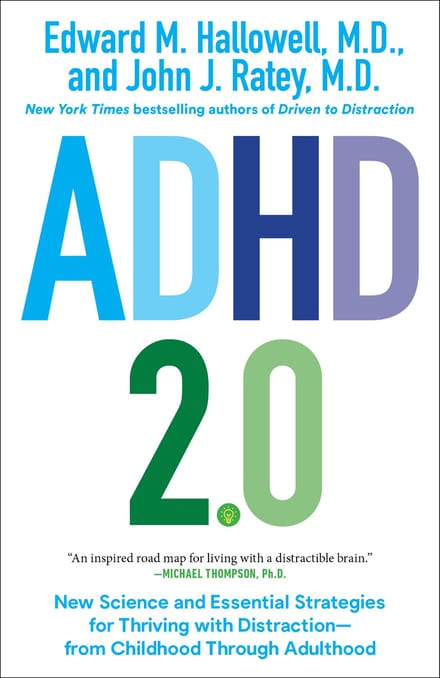
ADHD 2.0: New Science and Essential Strategies for Thriving with Distraction
The key ideas
- Escape negative mental loops by moving from thought to physical action
- Train the smaller cerebellum with balance exercises and daily movement
- Treat with connection and warmth, never punishment
- Build life and work around genuine obsessions, not forced compliance
- Protect sleep, clean up diet, and start with minimal structure
- Exercise releases dopamine that sharpens focus and thickens the brain
The summary
An ADHD brain isn’t defective; it’s a racecar with a pushcart’s brakes. The distractibility, impulsivity, and restlessness come bundled with energy, creativity, and drive, and the right strategies turn that combination into a genuine advantage. Recent fMRI research points to why the wiring feels the way it does. Two networks handle your thinking: the task-positive network, which fires when you’re focused and in the zone, and the default-mode network, which runs imagination, memory, and planning for the future. Everyone toggles between them, but with ADHD the switch is stubborn. You might lock onto one task and forget every other responsibility, or your imagination might latch onto shame and disappointment and loop. When you’re stuck spinning in negative thoughts, you’re trapped in the default-mode network. The exit is physical: take a walk, do a puzzle, wash the dishes — anything that gets you out of your head.
The cerebellum is small but trainable
Researchers recently found that a strip down the center of the cerebellum runs smaller in ADHD brains. The cerebellum does far more than coordinate movement; it shapes learning, quick decisions, emotional regulation, and balance. It’s also the most elastic part of the brain, which means you can strengthen it.
Dr. Hallowell treated a seven-year-old named Samuel, a remote patient attending school in Shanghai who couldn’t focus, struggled to follow instructions, and had grown depressed, with no local doctor able to prescribe medication. The plan was unconventional. Hallowell asked Samuel’s mother to hug him often and pour on affection, warmth, and encouragement to counteract his hard days at school. He also prescribed 30 minutes of daily balance work — standing on one leg with his eyes closed, taking his socks off without sitting down. Within weeks Samuel was more focused and less disruptive. The exercises were thickening that smaller part of his cerebellum while the affection rebuilt him.
Connection is the medicine
The heart of Samuel’s recovery was connection, and that’s the critical ingredient in any strength-based approach. People with ADHD often feel disconnected, which makes sense when your brain works differently from 90% of the population. Punishment only deepens the isolation, and that disconnection breeds low self-esteem, anxiety, depression, poor performance, relationship trouble, and acting out. The authors call human connection “the other vitamin C,” and it can even soften childhood pain. Share your worries with people you trust. Connect over meals. Talk to a friend at least once a week. If your child has ADHD, set aside 30 minutes each week for a one-on-one activity of their choosing. Even a pet counts as a daily source.
Build life around obsession, not compliance
The potential in people with ADHD tends to sit dormant, ignored. Most are exceptional or passionate about one or two things, and when those things get nourished, the wiring becomes a superpower. If a child is obsessed with science, video games, or the violin, tell the teacher, because a lesson that folds in that interest holds attention and lifts motivation. The same rule governs adults: a job aligned with what genuinely fascinates you is essential to managing ADHD. To find that thread, write down the achievements you’re proud of and the things you love, find easy, are good at, or want to get better at. Creativity is innate to ADHD — writing, drawing, carpentry, making things of any kind — and honing it is what makes the superpower shine.
Minimal structure, steady movement
Your environment is more than the room you’re in; it includes your routine and your diet. ADHD brains are hardwired to resist structure, so start absurdly small, with a daily to-do list of just two items you actually finish. If home, school, or work is full of shame or fear and you can’t fix it, it may be time to find a new environment. Diet matters too: cut processed foods, additives, coloring, sugar, and preservatives, and lean on whole grains, unprocessed meats, fish, nuts, fruit, and vegetables. Limit coffee and swap sugary soda for water or tea.
Sleep is a priority, not a luxury, because quality rest lowers the risk of the low mood and anxiety the default-mode network can generate. Turn off devices an hour before bed and keep the room cool. Exercise, meanwhile, releases dopamine that sharpens concentration. Martial arts and yoga suit ADHD especially well because they cultivate focus and balance, much like Samuel’s routine; 20 to 30 minutes a day can lower your stress within eight weeks while it thickens that undersized part of your cerebellum. Movement also works as a short-term boost — some schools now send restless kids to jump on a trampoline instead of into a time-out.
The bottom line
ADHD is a racecar with weak brakes, and connection, movement, sleep, and work built around your real obsessions are how you strengthen them. Read this if you have ADHD, or love someone who does, and want to stop fighting the wiring and start using it.
Fact check
Popular books repeat findings that later research has complicated. Where ADHD 2.0 makes a testable claim, here's what the evidence actually shows.
A strip down the centre of the cerebellum runs smaller in ADHD brains.
Cerebellar reductions are among the more reliable structural findings in ADHD. Valera's meta-analysis of structural MRI studies found global volume reductions in ADHD relative to controls (standardized mean difference 0.41), with cerebellar regions showing the largest and most frequently replicated differences. Stoodley's voxel-based meta-analysis of 10 ADHD studies localized the reduction to lobule IX bilaterally, in the inferior vermis, and found no cerebellar region enlarged. These are group averages with wide overlap between individuals, so they describe a population difference rather than anything visible on one person's scan.
- Valera EM, Faraone SV, Murray KE, Seidman LJ. Meta-analysis of structural imaging findings in attention-deficit/hyperactivity disorder. Biol Psychiatry. 2007;61(12):1361-9. PubMed
- Stoodley CJ. Distinct regions of the cerebellum show gray matter decreases in autism, ADHD, and developmental dyslexia. Front Syst Neurosci. 2014;8:92. PubMed
Thirty minutes a day of balance exercises thickens the undersized part of the cerebellum and reduces ADHD symptoms.
No controlled trial has tested balance training as an ADHD treatment or shown that exercise of any kind changes cerebellar volume in children with ADHD; the book's evidence for it is a single case. The longitudinal imaging data point the other way for the exact region targeted: Mackie and colleagues scanned 36 children with ADHD and 36 matched controls repeatedly over years and found the superior vermis deficit was fixed and nonprogressive, unchanged whether a child's symptoms improved or worsened. Only the cerebellar hemispheres tracked clinical course closely enough that the authors flagged them as a plausible intervention target.
- Mackie S, Shaw P, Lenroot R, et al. Cerebellar development and clinical outcome in attention deficit hyperactivity disorder. Am J Psychiatry. 2007;164(4):647-55. PubMed
Twenty to thirty minutes of daily exercise sharpens concentration in people with ADHD.
Exercise helps, but the symptom-level payoff is smaller than the book implies. Huang's meta-analysis of 22 randomized trials found sustained exercise produced only a small improvement in core ADHD symptoms (SMD -0.39) and in inattention specifically (SMD -0.32), with a moderate effect on executive function (SMD -0.68). An earlier, much smaller pooling of 8 trials and 249 children reported a far larger attention effect (SMD 0.84) — the sort of figure that typically shrinks as trial counts grow, as it did here. The realistic framing is a useful adjunct, not a substitute for treatment.
- Huang H, Jin Z, He C, Guo S, Zhang Y, Quan M. Chronic Exercise for Core Symptoms and Executive Functions in ADHD: A Meta-analysis. Pediatrics. 2023;151(1):e2022057745. PubMed
- Cerrillo-Urbina AJ, García-Hermoso A, Sánchez-López M, Pardo-Guijarro MJ, Santos Gómez JL, Martínez-Vizcaíno V. The effects of physical exercise in children with attention deficit hyperactivity disorder: a systematic review and meta-analysis of randomized control trials. Child Care Health Dev. 2015;41(6):779-88. PubMed
Cutting processed food, additives, colouring and sugar improves ADHD symptoms.
Diet does something for some children, but the effects are small and uneven across the claim. Nigg's meta-analysis put restriction diets at g = 0.29 and synthetic food colours at g = 0.18 by parent report, dropping to 0.12 after correcting for publication bias and to a nonsignificant 0.07 when teachers rather than parents rated the children; the authors estimated roughly 8% of children with ADHD have symptoms linked to food colours. Sonuga-Barke's meta-analysis found restricted elimination diets lost significance entirely under blinded assessment, while artificial food colour exclusion survived it (SMD 0.42), usually in children pre-selected for food sensitivity. Sugar is the weakest part: 23 blinded within-subject studies found no effect on behaviour or cognition at all.
- Nigg JT, Lewis K, Edinger T, Falk M. Meta-analysis of attention-deficit/hyperactivity disorder or attention-deficit/hyperactivity disorder symptoms, restriction diet, and synthetic food color additives. J Am Acad Child Adolesc Psychiatry. 2012;51(1):86-97.e8. PubMed
- Sonuga-Barke EJ, Brandeis D, Cortese S, et al. Nonpharmacological interventions for ADHD: systematic review and meta-analyses of randomized controlled trials of dietary and psychological treatments. Am J Psychiatry. 2013;170(3):275-89. PubMed
- Wolraich ML, Wilson DB, White JW. The effect of sugar on behavior or cognition in children. A meta-analysis. JAMA. 1995;274(20):1617-21. PubMed
Frequently asked questions
What is ADHD 2.0 about?
It reframes ADHD not as a defect but as a racecar with a pushcart's brakes, where the distractibility and impulsivity come bundled with energy, creativity, and drive. Drawing on recent brain research, the book lays out practical ways to strengthen focus and work with the wiring instead of fighting it.
What are the key takeaways from ADHD 2.0?
The ADHD brain gets stuck toggling between the task-positive and default-mode networks, and the way out of negative loops is physical, like a walk, a puzzle, or washing the dishes. The cerebellum runs smaller in ADHD brains but is trainable through balance work, and connection is "the other vitamin C," the core medicine. Build life around genuine obsessions rather than compliance, start with absurdly small structure like a two-item to-do list, and prioritize sleep, a clean diet, and 20 to 30 minutes of daily exercise.
Who should read ADHD 2.0?
Anyone who has ADHD, or loves someone who does, and wants to stop fighting the wiring and start using it.
Is ADHD 2.0 worth reading?
Yes, it pairs new science on the cerebellum and brain networks with concrete, doable strategies, and the strength-based framing is encouraging rather than clinical. Readers wanting a deep medical or medication-focused guide may find it light there, since the emphasis is on connection, movement, and lifestyle.