Book summary
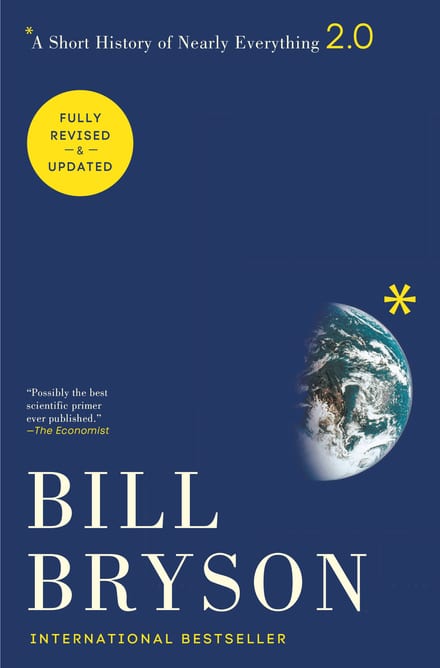
A Short History of Nearly Everything
The full book runs ~592 pages — roughly 11 hours of reading. You get the key ideas here in 5 minutes.
The key ideas
- Survive: your unbroken ancestral line never once failed to reproduce.
- Marvel: the universe's conditions are impossibly fine-tuned for life.
- Measure: radioactivity dated Earth at 4.54 billion years old.
- Understand: relativity, quantum theory, and atoms cracked reality's code.
- Evolve: every living thing elaborates on one shared genetic plan.
- Protect: extinction threats loom from asteroids, volcanoes, and human pollution.
The summary
You are the end of an unbroken streak of luck that is almost too long to believe. The right orbit around the sun, a collision that gave Earth a moon of exactly the right size, and a line of ancestors stretching back billions of years in which not one link ever failed. As Bill Bryson puts it, not one of them was “squashed, devoured, drowned, starved, stranded, stuck fast, untimely wounded, or otherwise deflected from its life’s quest of delivering a tiny charge of genetic material to the right partner at the right moment” — the only possible sequence of combinations that could result, eventually and all too briefly, in you. Against that, 99.99% of all species that ever lived are extinct. Bryson’s project is to tell the story of how we came to know all this, and to make science, so often written dryly, feel like the adventure it actually is.
A universe that had every reason not to exist
In the 20th century scientists worked out that all matter expanded from a tiny, dimensionless point roughly 13.8 billion years ago. The proof arrived almost by accident. In 1965, radio astronomers Arno Penzias and Robert Wilson kept picking up a faint interference on a large antenna in New Jersey; the hiss turned out to be cosmic background radiation left over from the birth of the universe, the first hard evidence for the Big Bang. About 1% of the static on an old television is a remnant of that first moment. And the whole thing is finely balanced on a knife’s edge: had any condition been even slightly different, a cosmos capable of supporting life would never have formed.
Then there is the sheer scale. Pluto sits inside our own solar system and is still billions of miles away and unreachable; the Milky Way alone holds hundreds of billions of stars, and their light is so old that we see them as they were years ago. In 1961 Frank Drake estimated there could be millions of advanced civilizations in our galaxy, yet with average distances of more than 200 light years between them, catching a signal is nearly hopeless. Space is vast enough to make company probable and contact almost impossible.
Learning to weigh and date the Earth
Our solar system improbably coalesced from an enormous cloud of gas and dust more than four billion years ago, and 500 million years later, carbon dioxide warmed the young planet enough for life to take hold. Figuring out the Earth itself took centuries of stubborn, sometimes absurd effort. One of the first great surveys, the French Geodesic Mission to the Equator, grew out of a bet over whether the planet bulged more at the equator or the poles. Newton’s laws of motion and gravity spurred the expeditions that followed, and we eventually learned that Earth weighs almost 6 billion trillion metric tons and, thanks to its spin, is an oblate spheroid rather than a perfect sphere.
Understanding deep time came harder. James Hutton wrote opaquely but presciently about mountains raised by colliding land, and Charles Lyell popularized uniformitarianism, the idea that the same slow processes at work today shaped the Earth across unimaginable spans. Even so, it took a long while for people to accept what dinosaur bones implied — that entire species can simply vanish. The key to the planet’s real age was radioactivity, discovered by Marie and Pierre Curie in 1896 when they found that certain rocks release energy without changing. It let Clair Cameron Patterson finally pin Earth’s age at 4.54 billion years. Curie herself became the first woman to win a Nobel Prize, the first person to win twice, and the only one to win in two different sciences.
The misfits who cracked reality
The people who explained the universe were rarely tidy geniuses. Einstein failed exams and struggled to find academic work before publishing relativity, which showed that space and time bend to the observer and that gravity curves spacetime itself. His E=mc² revealed that mass and energy are interchangeable — the matter in your body holds enough latent energy to rival 30 large hydrogen bombs. Max Planck’s quantum theory showed light behaving as both particle and wave; Bohr and Rutherford mapped the atom; Henrietta Swan Leavitt, working against the barriers of her time, devised a way to measure cosmic distances, and Edwin Hubble used it to discover the universe is expanding. Dmitri Mendeleev gave us the periodic table.
A foothold worth defending
Life clings to a narrow ledge. The precise distance from the sun, a molten core generating a protective atmosphere, a stabilizing moon, an intricately timed chain of events — all of it had to line up. It stays precarious. A cataclysmic asteroid finished the dinosaurs 66 million years ago, and by some estimates civilization-ending near-misses cross our path two or three times a week, while Yellowstone’s supervolcano could erupt at any time. Life began as simple microbes around four billion years ago, then became plants, sea creatures, and land life, and microbes still make up at least 80% of all biomass. Darwin explained the engine — natural selection — but hid his theory for nearly 15 years, fearing the backlash. Modern genetics later confirmed how deep the kinship runs: every living thing is an elaboration on a single original plan, and about half the chemical functions in a banana are fundamentally the same as those in you. As much as 97% of species may still await discovery, even as human activity drives extinctions and thins the ozone that shields us.
The bottom line
Existence is a run of cosmic near-misses too improbable to squander, and almost everything we know about that run was learned only in the last century. Life of any kind is so lucky and so precious that protecting it is the one obvious response. Read this if you want the whole sweep of science explained with wit and wonder instead of jargon.
Fact check
Popular books repeat findings that later research has complicated. Where A Short History of Nearly Everything makes a testable claim, here's what the evidence actually shows.
Microbes make up at least 80 percent of all biomass on Earth.
A 2018 census of global biomass put the planetary total at roughly 550 gigatons of carbon, of which plants hold about 450 Gt C — some 82 percent. Bacteria account for about 70 Gt C and archaea about 7 Gt C, putting microbes nearer 15 percent of the total than 80. Microbes do dominate on other measures, including cell count and share of the deep subsurface, which is probably where the larger figure comes from.
- Bar-On YM, Phillips R, Milo R. The biomass distribution on Earth. Proc Natl Acad Sci U S A. 2018;115(25):6506-6511. PubMed
Objects big enough to end civilization make near-misses past Earth two or three times a week.
The cadence is right and the size is not. NASA's close-approach database records 1,241 passes inside the Moon's orbit between January 2016 and July 2026 — about two or three a week — but every one of them was an object fainter than absolute magnitude 22, meaning under roughly 140 metres across. Query the same database for the entire 1900-2100 span and only one such pass involves an object bright enough to be about a kilometre wide, the scale associated with civilization-level damage.
- NASA Jet Propulsion Laboratory, Center for Near Earth Object Studies. Close-Approach Data API: objects passing within one lunar distance, January 1, 2016 to July 30, 2026. Accessed July 30, 2026. Source
- NASA Jet Propulsion Laboratory, Center for Near Earth Object Studies. Close-Approach Data API: objects with absolute magnitude H 18 or brighter (roughly 1 km and larger) passing within one lunar distance, 1900-2100. Accessed July 30, 2026. Source
As much as 97 percent of the species alive today still await discovery.
The best global estimate puts about 8.7 million eukaryotic species on Earth, of which some 86 percent on land and 91 percent in the ocean have never been described — high, but short of 97 percent. The share climbs once microbes are added, since bacterial and archaeal diversity is much less catalogued and its true size is still argued over. The direction of the claim holds; the specific figure is not something anyone can currently pin down.
- Mora C, Tittensor DP, Adl S, Simpson AG, Worm B. How many species are there on Earth and in the ocean? PLoS Biol. 2011;9(8):e1001127. PubMed
An asteroid impact killed off the dinosaurs 66 million years ago.
A review by more than 40 researchers synthesising the global stratigraphy concluded that the Chicxulub impact triggered the end-Cretaceous extinction. The ejecta layer chemically tied to Chicxulub appears worldwide at the boundary, it coincides in time with the onset of the extinctions, and the pattern of which groups died matches modelled impact effects such as darkness and cooling. Deccan flood-basalt volcanism was under way at the same time and some researchers still argue it contributed, so the live debate is over how much the volcanism added, not whether the impact did the killing.
- Schulte P, Alegret L, Arenillas I, et al. The Chicxulub asteroid impact and mass extinction at the Cretaceous-Paleogene boundary. Science. 2010;327(5970):1214-1218. PubMed
Frequently asked questions
What is A Short History of Nearly Everything about?
It tells the story of how humans came to know nearly everything we know about the universe, the Earth, and life itself, from the Big Bang to atoms to evolution. The aim is to make science feel like the adventure it actually is rather than a dry textbook, tracing the discoveries and the often eccentric people behind them.
What are the key takeaways from A Short History of Nearly Everything?
Your existence rests on an almost unbelievable run of luck, since 99.99% of all species that ever lived are extinct and not one of your ancestors failed to reproduce. The universe is finely balanced on a knife's edge: cosmic background radiation confirmed the Big Bang, radioactivity let scientists date Earth at 4.54 billion years, and Einstein's relativity showed space and time bend to the observer. Life clings to a narrow ledge kept safe by Earth's distance from the sun, its molten core, and a stabilizing moon, and every living thing is an elaboration on a single original plan.
Who should read A Short History of Nearly Everything?
Anyone who wants the whole sweep of science explained with wit and wonder instead of jargon, especially readers who found science dry in school and want to feel the adventure in it.
Is A Short History of Nearly Everything worth reading?
Yes, it covers an enormous range, from cosmology to geology to genetics, and does it with humor and a real sense of awe rather than dense technical detail. Readers wanting deep expertise in a single field might look elsewhere, but for a curious, entertaining tour of how we came to know all this, it delivers.