Book summary
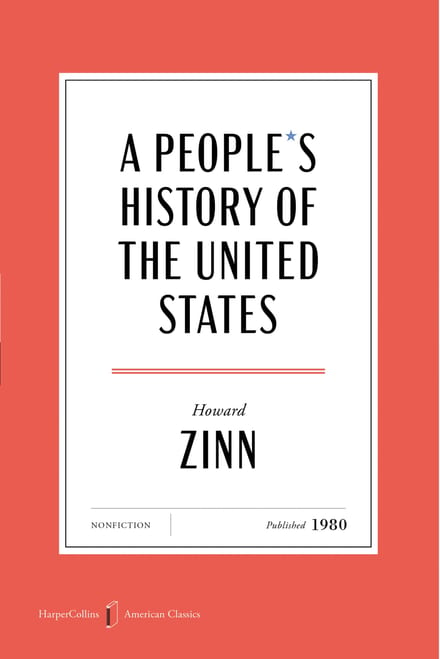
A People's History of the United States
The full book runs ~688 pages — roughly 13 hours of reading. You get the key ideas here in 8 minutes.
The key ideas
- Conquest and genocide erased Native peoples to build the nation
- Elites deliberately split poor whites from enslaved blacks
- Founders designed government to protect property, not people
- Wars served profit and distraction, not stated ideals
- Movements for justice always faced brutal suppression
- Ordinary people, not leaders, drove every real advance
The summary
American history is usually told as a widening circle of freedom. Howard Zinn tells it from the other side—from the perspective the privileged left out of the records, the view of the conquered, enslaved, and exploited. Seen that way, the country was not born free. It was born slave and free, servant and master, tenant and landlord, poor and rich. And the same machinery that held that arrangement together in 1676—war, race, and the fanfare of patriotism—is still running.
The conquest was not a discovery
Columbus is taught as the explorer who found America. What he found was the Arawak, whom he treated as subjects to be broken. Europeans forced them to mine gold, raped women, killed children, and shipped the able-bodied back to Spain as slaves. By 1515 more than 83 percent of the Arawak—250,000 people—were dead; by 1650 they were gone entirely. The English used a colder method: feign peace, let a tribe plant its corn, then fall on them just before harvest, killing as many as possible and burning the fields. The Powhatan and Pequot were destroyed this way. The Iroquois, who lived communally with women holding real power, held out longer, so colonists handed them smallpox-infected blankets—one community dropped from 3,000 to 313. Even treaties were temporary. The Cherokee named Alabama, perhaps “here we may rest,” after two forced relocations; in 1831 they were expelled again, and roughly one in four died walking west through winter.
Race was built to divide the poor
By 1800, 10 to 15 million Africans had been captured and shipped to America in conditions that killed a third en route; by 1763 half of Virginia was enslaved. They resisted immediately—in 1712, twenty-one people were executed in New York after a revolt that killed nine whites. The detail schools skip is that early uprisings often joined black slaves with poor white servants. In 1676 Nathaniel Bacon’s rebellion of disgruntled frontiersmen burned Jamestown; after it was crushed, planters hardened slavery and class lines to prevent the next alliance, and laws were passed forbidding black and white people from mixing. Division was policy. The Founding Fathers were wealthy landowners who wrote a government to protect property, not slaves, women, or the poor—some states required 5,000 pounds of property just to run for governor. By 1770 the top 1 percent held 44 percent of the wealth. The Constitution, Zinn argues, gave small farmers and mechanics just enough to make them a buffer against the very poor, the enslaved, and the natives—control kept with a minimum of coercion and a maximum of law, all dressed up as unity.
War as distraction and profit
Leaders learned early that war diverts attention from inequality at home. In 1846 President Polk baited Mexico into firing first, then sold the war as self-defense; poorly equipped immigrants were sent to die of disease while drunk soldiers terrorized villages, and the U.S. took California and New Mexico for $15 million. The Civil War grew as much from a clash between Northern industrialists and Southern planters as from slavery, and Lincoln’s Emancipation Proclamation was partly a war tactic to drain the South of labor. When it ended, Sherman’s promise of forty acres and a mule was rescinded by Andrew Johnson, and the land went back to its former white owners. World War I let American monopolies—U.S. Steel, Standard Oil, Morgan’s banks—plant footholds abroad; Wilson entered after the Lusitania sank without mentioning it also carried munitions, then jailed anti-war speech under the Espionage Act. World War II was about oil and markets as much as Pearl Harbor, and it birthed a “permanent war economy,” in the words of GM’s Charles Wilson. In 1990 Bush’s Gulf War secured Middle East oil under the banner of liberating Kuwait, and after 9/11 the budget soared again into the accounts of contractors.
Every gain came from below—and met force
Nothing was granted from above. In the 1800s workers discovered that striking together gave them power; in 1877 a hundred died in a railroad strike after the National Guard was called, and radical unions like the Industrial Workers of the World organized over 150 strikes, with co-founder Eugene Debs running again and again for president as a socialist. The civil rights movement won real ground through nonviolence—Rosa Parks’s arrest launched a 381-day bus boycott, and 250,000 gathered for King’s “I Have a Dream”—but even there, organizers quietly censored more militant voices like John Lewis after talks with the Kennedy administration. Six years of official inaction and continued lynchings followed, until riots and the 1968 Civil Rights Act. Vietnam was sold as defending independence from communism while the government eyed the country’s resources; Lyndon Johnson lied about an attack on U.S. ships, the My Lai massacre killed up to 500 civilians, and two million Americans joined the 1969 Moratorium against a war most of them already opposed.
The bottom line
Told from below, American history is less a story of expanding liberty than a long contest between a wealthy few and the many they keep divided—by race, by war, by the pledge and the flag. Yet the memory of the oppressed can’t be confiscated, and Zinn insists revolt always sits an inch below the surface. Read this if you want the version of the past that the official records were written to leave out.
Fact check
Popular books repeat findings that later research has complicated. Where A People's History of the United States makes a testable claim, here's what the evidence actually shows.
More than 83 percent of the Arawak — some 250,000 people — were dead by 1515, and by 1650 the population was gone entirely.
The collapse is not in dispute; the arithmetic and the ending are. The figures descend from Bartolome de las Casas, and modern estimates of Hispaniola's pre-contact population still span two orders of magnitude, so no percentage of it can be stated with confidence. Taino people also did not vanish: the genome of a 1,000-year-old Lucayan woman from Preacher's Cave in the Bahamas is closely related to the Native American ancestry carried by present-day Caribbean populations, which is evidence of continuity across the conquest rather than extinction.
- Schroeder H, Sikora M, Gopalakrishnan S, et al. Origins and genetic legacies of the Caribbean Taino. Proc Natl Acad Sci U S A. 2018;115(10):2341-2346. PubMed
Colonists deliberately infected the Iroquois with smallpox blankets, dropping one community from 3,000 people to 313.
Deliberate infection was attempted and is documented, but not against the Iroquois. The clear case is Fort Pitt in June 1763, where blankets and a handkerchief from the smallpox ward were passed to Delaware emissaries, with Amherst endorsing the tactic in writing weeks later; Fenn's study argues the idea circulated beyond that single Amherst episode. Whether the blankets caused the outbreak that followed is unresolved — smallpox was already moving through the Ohio Valley — and the epidemics that emptied Native communities were overwhelmingly an unintended consequence of contact rather than a weapon.
- Fenn EA. Biological warfare in eighteenth-century North America: beyond Jeffery Amherst. J Am Hist. 2000;86(4):1552-1580. Source
Roughly one in four Cherokee died during the forced march west.
One in four is the top of a range historians have never settled. The National Park Service puts deaths during the journey itself at more than a thousand out of the 16,000-plus Cherokee removed, with perhaps several thousand more dying from the consequences of the removal; the Oklahoma Historical Society gives the higher "as many as one out of four" figure, which counts deaths caused by removal rather than deaths on the road. One date worth correcting: the Cherokee removal began in May 1838, not 1831.
By 1770 the richest 1 percent of colonists held 44 percent of the wealth.
Colony-wide the concentration was nowhere near that. Lindert and Williamson's reconstruction of American incomes finds that in 1774 the colonies were far more equal than England and Wales, with New England and the Middle Colonies apparently more egalitarian than anywhere else then measurable, and inequality rising sharply only after 1774. Their measure is income rather than wealth, which is always the more concentrated of the two, but the 44 percent figure describes the wealthiest property owners in a single colonial port town, not colonists in general.
- Lindert PH, Williamson JG. American Incomes 1774-1860. NBER Working Paper 18396. Cambridge, MA: National Bureau of Economic Research; 2012. Source
Frequently asked questions
What is A People's History of the United States about?
It retells American history from the perspective the privileged left out of the records, the conquered, enslaved, and exploited, arguing the country was born not free but divided into servant and master, poor and rich. Howard Zinn's claim is that the machinery holding that arrangement together, war, race, and patriotism, has kept running ever since.
What are the key takeaways from A People's History of the United States?
The conquest of the Americas was a brutal dispossession, not a discovery, from the destruction of the Arawak to the forced removal of the Cherokee. Race was built as a tool to divide poor Black and white people after alliances like Bacon's Rebellion frightened the wealthy. War repeatedly served as distraction and profit, from the Mexican War to the "permanent war economy" after World War II. And every real gain, from labor strikes to the civil rights movement, came from ordinary people organizing below and was met with force from above.
Who should read A People's History of the United States?
It's for anyone who wants the version of the past that the official records were written to leave out, told from the viewpoint of the many rather than the powerful few.
Is A People's History of the United States worth reading?
Its power is the deliberate shift in perspective, surfacing figures and events, mass movements, massacres, and strikes, that traditional textbooks skip, backed by pointed detail. Because it argues so consistently from below, it reads as a corrective rather than a balanced overview, so readers should pair it with other accounts rather than take it as the whole story.