Book summary
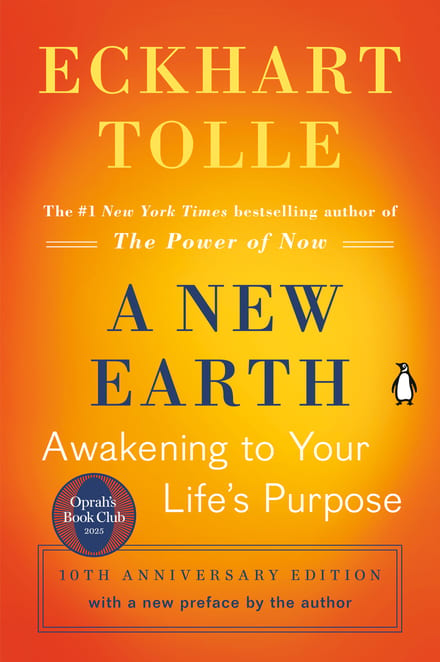
A New Earth: Awakening to Your Life's Purpose
The full book runs ~316 pages — roughly 6 hours of reading. You get the key ideas here in 5 minutes.
The key ideas
- The ego is identification with thought, possessions, and roles — a mental self that is not who you are.
- The pain-body is accumulated emotional pain that feeds on negative thinking and drama; being present starves it.
- Peace exists only in the present moment; complaining, grievances, and resentment keep you tied to the past.
- You can't fight the ego and win — calmly observing it is itself the awakening.
- Bring acceptance, enjoyment, or enthusiasm to whatever you do; how you act matters more than what you do.
The summary
You suffer because you have mistaken a bundle of thoughts for yourself. Tolle’s whole argument rests on that one claim. The “I” you defend all day — your name, your story, your opinions, the things you own — is a mental construct he calls the ego, and it is not who you are. It is a voice in the head that never stops talking, and most people never hear it as separate from themselves. Awakening, in this book, is not mystical: it is the moment you notice the voice and recognize yourself as the awareness that hears it, not the noise.
The ego is a case of mistaken identity
Watch how a child builds a self. First a name, then the magic word “I,” then a widening pile of “me” and “mine” — my toy, my body, my nationality, my beliefs, the things that happened to me. Each attachment gets invested with a sense of self, and the whole precarious stack becomes what you point to when you say “I.” Tolle names the core mechanism identification, from the Latin for “to make the same.” You make a thing the same as you, so losing it feels like losing yourself.
That is why the ego is bottomless. Trying to find yourself in possessions never works, so you keep buying — which is exactly what keeps the consumer machine running. Advertisers understand this perfectly; they don’t sell you a product but an “identity enhancer.” Change the content and the structure survives. So the point is not to fix or fight the ego. “You cannot fight against the ego and win,” Tolle writes, “just as you cannot fight against darkness.” You only need to see it, and the seeing is already the light.
The pain-body feeds on your unhappiness
Beneath the thinking mind sits something heavier: an accumulation of old emotional pain Tolle calls the pain-body. Every strong negative emotion you didn’t fully face left a residue, and over a lifetime those residues fuse into an energy field that lives in you — part personal, part inherited from the long human history of cruelty. It is, he says plainly, “an addiction to unhappiness.” It lies dormant, then wakes hungry and goes looking for a meal, and its food is negative thought and drama. It will provoke the people around you and turn the voice in your head bitter, because to the pain-body pain is pleasure.
The way out is not to analyze it or push it down but to be present with it. When you feel the emotion directly without letting it think through you, without the story it wants to tell, your conscious attention stops feeding it. The pain that fed on your unconsciousness becomes fuel for consciousness instead.
Complaining, grievances, and the roles you hide behind
The ego keeps itself solid through small, constant strategies. Complaining is a favorite: every complaint is a little story that makes you right and someone else wrong, and resentment is the emotion that rides along with it. Let a resentment harden over time and it becomes a grievance — a permanent state of “against” that quietly poisons the present with the past.
Roles do similar work. The functions you perform — parent, professional, expert — turn into identities you disappear into. A doctor fully identified with the role stops seeing a person and sees a case history. Tolle’s odd advice is to welcome the confusion when you no longer know who you are. “I don’t know” is not a problem; it’s an opening. Stop demanding that thought hand you an identity, and a quieter clarity appears that was always closer to you than any label.
Presence is the doorway, and it only opens now
The alternative to living as ego is presence: awareness without thought, attention resting in the present moment. Tolle is blunt about where peace lives — “your only opportunity for being at peace is now.” He points to the gaps between thoughts, to seeing a thing without instantly naming it, to the stillness under the mental noise, as small doorways into what he calls inner space. Make peace with this moment — with its “suchness,” as the Buddha called it — and you stop resenting reality. “Life is the dancer, and you are the dance.”
This is why surrender, for Tolle, is strength, not defeat: yielding to what is means acting from acceptance instead of inner resistance, so your action lines up with life rather than fighting it.
Awakened doing: acceptance, enjoyment, enthusiasm
None of this requires leaving your job or your life. What matters is not what you do but the state you do it from. Tolle offers three ways to carry awareness into ordinary action:
- Acceptance is for the flat tire in the rain at midnight. You can’t enjoy it, but you can do it at peace instead of at war.
- Enjoyment is the aliveness that flows into a task when you’re fully present in it — and the joy doesn’t come from the activity, it flows into it from within you, which is why chasing the world for happiness keeps failing.
- Enthusiasm is enjoyment joined to a goal — creative energy that carries you forward without the grasping of ego.
If you can bring none of the three to what you’re doing, he says, stop — because the one thing you are truly responsible for is your own state of consciousness.
The bottom line
You are not the anxious, opinionated voice in your head, and the instant you can observe that voice you have already stepped partway out of it. The shift Tolle asks for is presence, not self-improvement. Read this if your own mental churn wears you out and you want a calm, practical account of how to loosen its grip; skip it if you need argument and evidence, because Tolle asks you to verify his claims in your own experience rather than convincing you of them.
Frequently asked questions
What is A New Earth about?
The book argues that most human suffering comes from over-identifying with the ego — a false self built from thought, memory, and old emotional pain that Tolle calls the pain-body. It maps how the ego works in you and in the world, and then points to the way out: present-moment awareness, in which you recognize yourself as the consciousness behind your thinking rather than the thinking itself.
What are the main lessons in A New Earth?
A few ideas carry the whole book. The ego is identification with form — possessions, roles, opinions, your story — and it can never be satisfied. The pain-body is stored emotional pain that feeds on negativity and drama, and presence is what starves it. Peace is only ever available now, so complaining and grievances just keep you stuck in the past. And in daily life, what matters is the state you act from: acceptance, enjoyment, or enthusiasm.
Who should read A New Earth?
It's for anyone worn down by their own mental noise, anxiety, or reactivity who wants a calm, non-religious framework for stepping back from it. Readers open to contemplative, experiential spirituality will get the most out of it.
Is A New Earth worth reading?
If its central idea lands for you, the book can genuinely change how you relate to your own mind, and its plain examples make abstract points usable. It is repetitive and asks you to take insight on trust rather than proof, so readers who want argument and evidence may lose patience. Worth reading for the shift in perspective, not for rigor.