Book summary
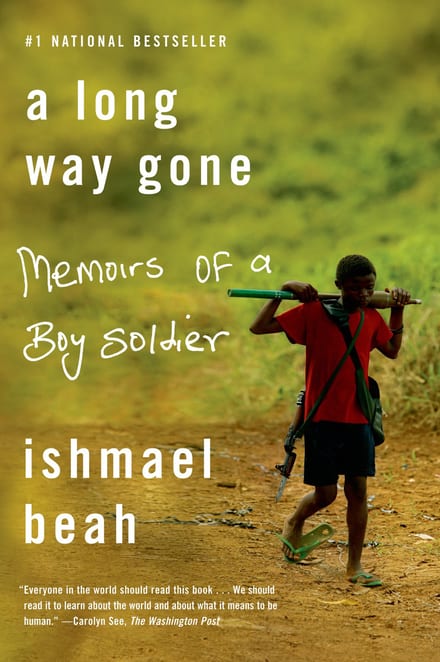
A Long Way Gone: Memoirs of a Boy Soldier
Memoirs of a Boy Soldier
The full book runs ~240 pages — roughly 4 hours of reading. You get the key ideas here in 5 minutes.
The key ideas
- Bereavement, hunger, stimulants, a squad, a named enemy — the inputs listed plainly
- Flat reporting is the technique; Beah declines to interpret or absolve
- Withdrawal at Benin Home is the second war, fought with patience
- "This isn't your fault" is the sentence he can't stand to hear
- A 2008 investigation disputed his dates; he conceded nothing
The summary
A Long Way Gone treats a child soldier as something assembled, and gives most of its length to the assembly. Ishmael Beah’s memoir, published in February 2007 by Sarah Crichton Books at Farrar, Straus and Giroux, carries one boy from twelve, running from an attack on his town in southern Sierra Leone, through the national army to a rehabilitation centre in Freetown at fifteen. The machinery is the subject: what, in Beah’s account, an army does to a grieving child to make him usable, and what reversing it costs. He writes both halves at the same flat pitch, and the evenness is the argument — on his telling neither process was mysterious, and only one was fast.
The army assembles a soldier out of grief
Beah never describes choosing to fight. He runs for months down roads littered with bodies, learns his parents and two brothers are dead, and reaches an army base in the southeast. Everything after is incremental: a lieutenant’s speeches about defending the country, a gun held for comfort, white capsules issued before battle whose contents he says he never learned, marijuana and “brown brown” — cocaine mixed with gunpowder — on a table by the ammunition hut. At night they run Rambo off a generator or a car battery and want to be him.
In the excerpt he published in The New York Times Magazine in January 2007, he compresses that stretch into one sentence: “My squad was my family, my gun was my provider and protector and my rule was to kill or be killed.” “The idea of death didn’t cross my mind,” he writes, “and killing had become as easy as drinking water.” You’re never invited to read this as possession by evil. It reads as a list of inputs — bereavement, hunger, stimulants, a peer group, an enemy with a name — that came together inside a week: after that first week of raids, he writes, “our initiation was complete.” And these boys wear government uniform: UNICEF’s own record of the conflict notes that in 1994 Sierra Leone’s head of state, Valentine Strasser, raised army recruitment to 12,000, some recruits street children as young as twelve.
The flatness is the technique
Beah rarely stops to explain and almost never to absolve. His friend Josiah, eleven, is thrown onto a tree stump by a grenade in Beah’s first firefight; Beah covers the boy’s eyes, lifts him off, finds his backbone shattered, lays him down and picks up his gun. No comment follows. Beah wrote most of the book as an Oberlin undergraduate, working through some four hundred pages with the novelist Dan Chaon. What survived is a narrator who reports and declines to interpret.
Withdrawal is the second war
Beah lands at Benin Home in Freetown’s Kissy neighbourhood, run by a local NGO, Children Associated With the War. The boys wreck the furniture, throw food at the staff, and hold a bucket over the cook’s head until he puts more milk in the tea. Coming off the drugs, Beah rolls a plain sheet of paper and smokes it. Boys bolt from the hall screaming that the rebels are coming; younger ones weep at rocks they say are their families.
The staff repeat one line and he hates it. “This isn’t your fault, you know,” a staff member says, wrapping a blanket around him after a nightmare. “It really isn’t.” A nurse called Esther gives him a Walkman and a Run-DMC tape, draws out the story of his bullet wounds, and says the same thing. He throws the Walkman at her and leaves with his fingers in his ears. Months later — a Bob Marley tape, a lyrics notebook, a dream of dinner with his dead family — he writes that he began to believe it, without becoming immune to the guilt. Nobody is repaired here; someone is made able to think.
The dates are contested, and this page can’t settle them
Early in the book Beah writes: “The first time that I was touched by war I was twelve. It was in January of 1993.” On 19 January 2008 The Australian ran an investigation by Peter Wilson, David Nason and Shelley Gare, followed by about a dozen further articles, arguing that the attacks Beah describes on his home town and region came in January 1995, not January 1993. If so, he was in the army for months, not the roughly two years the book covers before UNICEF removed him in January 1996. The paper also reported that aid workers and journalists in Freetown then could recall no trace of the fight Beah describes between army and rebel boys at the centre they were taken to — six dead, in his account — and that no official record of it turned up.
Beah conceded nothing. In a written statement three days later, quoted in Slate, he wrote: “I am right about my story. This is not something one gets wrong.” He told the Associated Press his memory gave him 1993, and that was what he stood by. His editor Sarah Crichton and FSG backed the book, and she ruled out a disclaimer for the paperback. Slate reported that March that FSG had produced witnesses who met Beah at the centre, but that no former child soldier who served with him had come forward to back the story. The Australian said former teachers produced documents placing him in school in March 1993; the Associated Press reported that most such records were destroyed in the war.
The surrounding history is not contested. Foday Sankoh’s Revolutionary United Front invaded from Liberia in March 1991, backed by fighters loyal to Charles Taylor, and children ended up armed on both sides. When formal demobilisation closed in January 2002, UNICEF counted 6,845 children among 72,500 demobilised combatants — and noted that many recruited as children were adults by then.
The bottom line
The book’s strongest claim is that turning a child into a killer took ordinary ingredients and about a week, while turning him back took months, a stranger’s patience and a sentence he couldn’t at first stand to hear. Read it for those mechanics, not a verdict, and read the 2008 dispute alongside it. Hand it to anyone who has only met the child-soldier question as a statistic.
Fact check
Popular books repeat findings that later research has complicated. Where A Long Way Gone makes a testable claim, here's what the evidence actually shows.
Events lived through between twelve and fifteen, under extreme stress and heavy drug use, can be recalled a decade later precisely enough to date them — the book puts the attack that started everything in January 1993 and gives Beah roughly two years in the army.
Research on refugees finds that the core of a traumatic memory holds up better than its dates and surrounding detail. In repeated interviews with 27 Kosovan and 12 Bosnian refugees, discrepancies between a person's own two accounts of the same event were common, fell more often on details the interviewee rated peripheral than on central ones, and grew with the gap between interviews for those scoring high on post-traumatic stress. A 12-month follow-up of unaccompanied refugee minors aged 12 to 18 (920 recruited, 63% retained) found inconsistency widespread as well, and its authors concluded it is not a usable test of credibility. Dating is the softest part of recall: when 11 diarists were retested ten years on, their estimates of how long events had lasted stayed stable while their date estimates drifted, mostly placing events earlier than they had happened.
- Herlihy J, Scragg P, Turner S. Discrepancies in autobiographical memories--implications for the assessment of asylum seekers: repeated interviews study. BMJ. 2002;324(7333):324-7. PubMed
- Spinhoven P, Bean T, Eurelings-Bontekoe L. Inconsistencies in the self-report of traumatic experiences by unaccompanied refugee minors. J Trauma Stress. 2006;19(5):663-73. PubMed
- Burt CD, Kemp S, Conway M. What happens if you retest autobiographical memory 10 years on? Mem Cognit. 2001;29(1):127-36. PubMed
Boys fighting in Sierra Leone's war were routinely given drugs before combat — marijuana, cocaine, cocaine mixed with gunpowder ('brown brown') and unidentified pills or capsules.
UNICEF's own review of the Sierra Leone child-demobilisation programme, covering 1998 to 2002, records that many of the children who came through the interim care centres spoke of being forced to take drugs before combat. Human Rights Watch's July 1999 investigation of the Freetown offensive documents the practice in detail: witnesses describe a brown or white powder that the rebels called cocaine being pushed into small incisions cut around fighters' temples and cheeks and taped over, along with forced injections, food and drink laced with drugs, marijuana, and 'small blue pills'. A sixteen-year-old abductee told HRW that the powder put in her food was called 'brown-brown'. The best-documented cases in that record are rebel RUF units rather than the government army Beah served in.
- Brooks A. The Disarmament, Demobilisation and Reintegration of Children Associated with the Fighting Forces: Lessons Learned in Sierra Leone 1998-2002. Dakar: UNICEF West and Central Africa Regional Office; June 2005. Source
- Human Rights Watch. Sierra Leone: Getting Away with Murder, Mutilation, Rape - New Testimony from Sierra Leone. Vol. 11, No. 3(A), July 1999, section 'The Use of Drugs by the RUF and Forced Drugging of Civilians'. Source
Frequently asked questions
What is A Long Way Gone about?
Ishmael Beah's memoir of Sierra Leone's civil war: separated from his family at twelve, taken into the national army, drugged and fighting, then removed to a rehabilitation centre in Freetown at fifteen. It treats a child soldier as something assembled, and gives most of its length to the assembly — what an army does to a grieving child to make him usable, and what reversing it costs.
What are the key takeaways from A Long Way Gone?
Beah never describes choosing to fight; he lists inputs — bereavement, hunger, stimulants, a squad, an enemy with a name — and writes that after the first week of raids the initiation was complete. The flatness is the technique: he reports and declines to interpret or absolve. Withdrawal is the second war, fought at Benin Home with a staff who repeat one sentence he can't stand to hear. And a 2008 investigation by The Australian disputed his dates, arguing he fought for months rather than roughly two years; Beah conceded nothing and his publisher backed him.
Who should read A Long Way Gone?
Anyone who has only met the child-soldier question as a statistic, and anyone who wants to understand the mechanics of how an ordinary child is made into a fighter and then unmade.
Is A Long Way Gone worth reading?
Yes, for the mechanics — it is unusually clear about the specific ingredients that produce a child soldier, and unusually restrained about the horror. Read it knowing the timeline is contested and that the dispute was never resolved either way; the book is testimony, not a verdict. Readers who want a settled historical account rather than one boy's memory should pair it with the UN and NGO records of the conflict.