Book summary
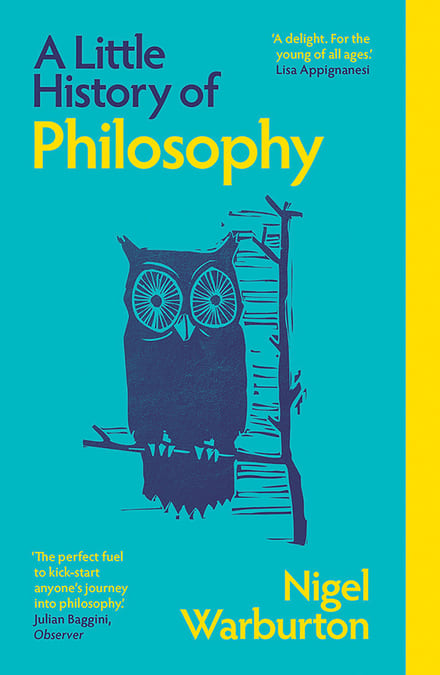
A Little History of Philosophy
The full book runs ~272 pages — roughly 5 hours of reading. You get the key ideas here in 8 minutes.
The key ideas
- Question relentlessly: Socrates proved the examined life alone is worth living.
- Control your reactions; Stoics and Epicurus tamed fear, death, and fate.
- Doubt everything, then rebuild: Descartes' thinking self resists all deception.
- Perception shapes reality; Kant and Berkeley limit what minds can know.
- Maximize happiness or forge your own values, from Bentham to Nietzsche.
- Test ethics with hard cases: trolleys, veils, drowning children, thinking machines.
The summary
Philosophy’s real achievement isn’t a stack of settled answers. It’s a relay of sharper questions, handed down. Every thinker since Socrates took something that looked obvious — about God, knowledge, the self, justice — and pushed until the certainty cracked. What you inherit from 2,500 years of argument is a set of tools for examining your own life, not a doctrine to memorize.
The examined life
Socrates made enemies in ancient Athens by asking questions that exposed how little people actually knew, and he was executed for it. His method survived through Plato: “An unexamined existence is all right for cattle, but not for human beings.” His student Aristotle argued that real happiness — eudaimonia — is the work of a whole life lived virtuously and rationally, not a single hit of pleasure. Ironically, later generations treated Aristotle’s conclusions as gospel, which strangled the very questioning he prized.
The skeptics pushed harder. Pyrrho held that since certainty is impossible, you should drop all belief and find peace in detachment; during a storm at sea he stayed perfectly calm, refusing to assume the danger was real. Centuries later Descartes chased the opposite goal — the one thing he couldn’t doubt. A false awakening, living a normal day only to wake and find it was a dream, drove him to reject anything with the slightest chance of being false. What survived was the thinker himself: I think, therefore I am. Even a deceiving demon can’t fake the fact that you’re thinking.
Living with death and fate
Epicurus offered a logical cure for the fear of death: you never experience it, so dread your non-existence afterward no more than the non-existence before your birth. The Stoics drew a sharper line — between what you control, your reactions, and what you don’t, like aging and loss. The US fighter pilot James Stockdale survived years of torture and solitary confinement in Vietnam by living Epictetus’s teaching and guarding only his own mind. Boethius, writing The Consolation of Philosophy while awaiting execution, reached the same place from a Christian angle: happiness is a state of mind, not of the world. Machiavelli, less consoling, told his prince to forget virtue — power held through deceit and force is the power that lasts.
Does God exist, and does the mind reach reality?
Medieval philosophers tried to prove God by reason alone. Anselm argued that the greatest conceivable being must exist by definition; Aquinas said every chain of causes needs an uncaused first cause. Pascal skipped the proof and made a bet: believe, because the possible infinite reward dwarfs the small cost of being wrong. Spinoza went the other way, identifying God with nature itself and calling free will an illusion. Hume then dismantled the design argument — complexity might point to many designers, a flawed one, or plain natural processes — and judged that a reported miracle is always likelier to be error than a genuine break in natural law. Nietzsche delivered the verdict for the modern age: “God is dead,” not as a boast but a diagnosis. With religion no longer able to anchor morality, you have to forge your own values.
Others asked whether the mind touches reality at all. Locke tied who you are to memory: you’re the same person only as far back as you can recall. Berkeley insisted objects exist only as perceptions — the fridge light goes out when the door shuts, unless God is always watching. Kant argued the mind works like tinted glasses, coloring every experience, so we know the world only as it appears, never as it is. Wittgenstein later suggested many philosophical knots are just misused language — words are games with rules, and confusing the game manufactures fake problems.
How to live and what to care about
Bentham’s utilitarianism set a blunt standard: maximize happiness, pleasure minus pain, for the greatest number, regardless of rank or species. John Stuart Mill, forged by a father’s hothouse education, refined it and defended personal liberty in On Liberty — society may restrain you only to stop harm to others. Sartre pressed freedom to its limit: your existence comes before your essence, so nothing hands you a purpose and you’re fully responsible for what you do, even how you feel. “If you’re sad right now, that’s your choice.” Most of us, he thought, hide from that freedom.
The hardest modern questions arrive as puzzles. Rawls asks you to design society from an “original position,” blind to whether you’ll be rich or poor — protect basic freedoms first, then permit inequality only where it lifts the worst-off. Philippa Foot’s trolley problem, flipping a switch to kill one instead of five, probes why we accept some sacrifices and recoil at others, like carving up one healthy patient to save five. Searle’s Chinese Room shows that following rules to output correct Chinese characters isn’t understanding Chinese, so passing Turing’s test proves nothing about a machine’s mind. And Peter Singer insists distance is morally irrelevant: a child starving on another continent should move you as much as one drowning at your feet.
The bottom line
The tradition’s worth lies in the questions it teaches you to ask, not the answers it claims to settle — each generation sharpens the tools and passes them on. Read it if you want to think more clearly about what you believe and why, and to notice when something “obvious” deserves a harder look.
Frequently asked questions
What is A Little History of Philosophy about?
It tells the story of Western philosophy as a relay of sharper questions rather than a stack of settled answers, tracing how thinkers from Socrates onward pushed at ideas that looked obvious until the certainty cracked. What you inherit, it suggests, is a set of tools for examining your own life, not a doctrine to memorize.
What are the key takeaways from A Little History of Philosophy?
It walks through the big moves in the tradition: Socrates and the examined life, Aristotle's idea of eudaimonia as a whole life lived well, and Descartes' "I think, therefore I am." It covers the Stoics' line between what you control and what you don't, the medieval attempts to prove God and Hume's dismantling of them, and Nietzsche's "God is dead." It reaches modern puzzles too, from Bentham and Mill's utilitarianism to Sartre's radical freedom, Rawls' original position, Foot's trolley problem, and Singer on our duty to distant strangers.
Who should read A Little History of Philosophy?
It's for anyone who wants to think more clearly about what they believe and why, and to notice when something that seems obvious actually deserves a harder look.
Is A Little History of Philosophy worth reading?
It's an accessible, story-driven overview that makes 2,500 years of ideas easy to follow through vivid episodes like Pyrrho's calm in a storm and Stockdale surviving captivity as a Stoic. As a broad survey, each thinker gets only a short chapter, so readers wanting deep engagement with any single philosopher will need to go elsewhere afterward.