Book summary
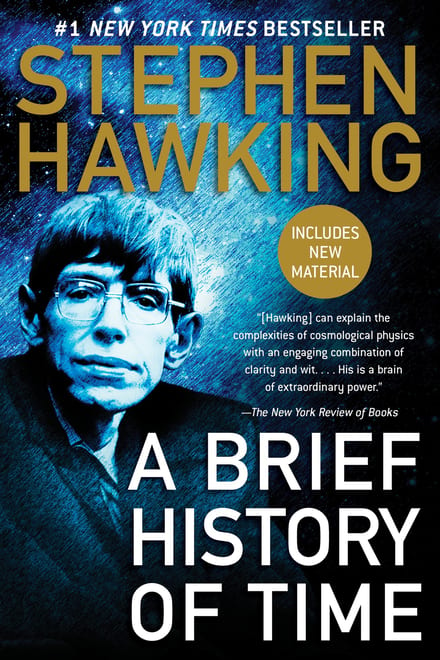
A Brief History of Time: From the Big Bang to Black Holes
The full book runs ~241 pages — roughly 4 hours of reading. You get the key ideas here in 4 minutes.
The key ideas
- Reframe gravity as curved space-time geometry, not mysterious force
- Bend time itself to keep light's speed constant
- Collapse dying stars into black holes that slowly evaporate
- Accept fundamental uncertainty: particles lack definite position and speed
- Unify four forces at the universe's extreme early energies
- Confront the clash: relativity and quantum mechanics won't reconcile
The summary
Space and time once seemed like the fixed stage on which everything happened — an unchanging backdrop, identical for everyone. Stephen Hawking’s tour of modern physics takes that stage apart. Space and time are a physical fabric, and mass bends it. Gravity is not a mysterious force reaching across empty space; it is the shape of that fabric. This single idea reorganizes everything, from the orbits of planets to the death of stars to the first instant of the universe. And it runs headlong into a second theory, just as well tested, that governs the smallest scales and refuses to be merged with it.
Gravity is the shape of space-time
Physics advances by building models that predict what we observe and replacing them when better evidence arrives. Galileo cracked the old belief that everything circles the Earth simply by watching moons orbit Jupiter. In the 1600s Newton went further, showing that objects are not naturally at rest but in constant motion, and packaging that into laws precise enough to predict the movement of the planets.
Newton assumed motion is always relative to something else. Sit still on a moving train and you aren’t moving at all — until someone on the platform clocks you at a hundred miles an hour. That logic held until physicists measured light. Light travels at roughly 186,000 miles per second in a vacuum, and it does so no matter how you move. Race a train toward a beam and the beam still arrives at exactly that speed, not a fraction faster. Something had to give, and what gave was time itself. Einstein’s special theory of relativity holds that the laws of physics are identical for everyone regardless of their motion — so two people moving differently will experience the same event at different moments. Time is not universal; it stretches to keep light’s speed fixed.
General relativity extends the idea. Beyond the three dimensions we see — height, width, depth — time is a fourth, woven together with them into space-time. A massive object like a star curves this fabric the way a heavy weight dents a stretched blanket, and nearby objects roll along the curve. That rolling is what we feel as gravity. It is geometry, not a force.
Black holes push geometry to the breaking point
Push mass far enough and the geometry turns extreme. When a very massive star burns out, it collapses under its own gravity into a singularity — a point of staggering density where space-time curves so sharply that not even light can climb out. That is a black hole, and its point of no return is the event horizon. We can’t see one directly, so we find them indirectly: by the gravitational tug they exert on nearby objects and by the X-rays thrown off as matter spirals in. The evidence points to a supermassive black hole sitting at the center of our own galaxy.
Black holes are not perfectly black, though. The second law of thermodynamics says disorder, or entropy, always increases, and black holes obey it by giving off heat. Near the event horizon, pairs of virtual particles flicker into being; sometimes one falls in while its partner escapes as radiation. That escaping radiation slowly bleeds mass from the hole, so that over immense spans of time it can evaporate entirely, perhaps ending in an explosion.
The very small refuses to hold still
Zoom down to individual particles and certainty evaporates. Measure a particle’s position precisely and its momentum blurs; pin down its momentum and its position goes vague. This is the uncertainty principle, and it isn’t a flaw in our instruments — it’s how matter behaves. Physicists cope by describing a particle’s quantum state, a blend of its likely positions and speeds, and by treating it as a wave whose interference lets them predict where it will probably turn up. Prediction here means odds, not appointments.
Four forces and a hot beginning
Gravity is one of four fundamental forces. The electromagnetic force acts between charged particles, the weak nuclear force drives radioactive decay, and the strong nuclear force binds protons and neutrons inside the nucleus. They differ in strength and reach at everyday energies, but at the enormous energies of the early universe they may merge into a single unified force. That early universe is described by the hot big bang model: about 13.8 billion years ago everything began as an infinitely hot, dense state, then expanded and cooled, giving rise to elements, galaxies, stars, and planets. Our sense that time flows forward is tied to that expansion — we depend on rising entropy to turn food into energy, so as long as we exist we will perceive time moving in one direction.
The bottom line
Physics runs on two triumphant theories — general relativity for the large, quantum mechanics for the small — and their equations collapse into nonsense the moment you try to combine them. Until someone finds a theory of everything that unites them, the universe stays only partly explained. Read this if you want the big questions of cosmology laid out plainly, and you’re comfortable ending on the honest admission that the deepest one is still open.
Fact check
Popular books repeat findings that later research has complicated. Where A Brief History of Time makes a testable claim, here's what the evidence actually shows.
A supermassive black hole sits at the centre of our own galaxy, inferred from its gravitational pull on nearby objects and the X-rays from infalling matter.
Confirmed, and confirmed after the book was written. Decades of tracking stars whipping around the galactic centre established an invisible compact object of about four million solar masses — work that shared the 2020 Nobel Prize in Physics — and in May 2022 the Event Horizon Telescope published a resolved image of the shadow of Sagittarius A*, the first direct visual evidence. Its size matches what general relativity predicts for a black hole of that mass.
- Event Horizon Telescope Collaboration. First Sagittarius A* Event Horizon Telescope results. I. The shadow of the supermassive black hole in the center of the Milky Way. Astrophys J Lett. 2022;930:L12. Source
- European Southern Observatory. Astronomers reveal first image of the black hole at the heart of our galaxy. ESO press release eso2208. May 12, 2022. Source
Black holes give off radiation from particle pairs near the event horizon, slowly bleeding away mass until they evaporate.
The prediction is standard theory and no working physicist doubts the reasoning, but the radiation has never been detected coming from an actual black hole — which is precisely why experimenters build stand-ins. In 2019 a team steered a Bose-Einstein condensate into a sonic analogue of a black hole and measured radiation whose spectrum was thermal at the temperature set by the analogue's surface gravity, the behaviour Hawking's calculation predicts. Evaporation therefore rests on a well-motivated and now partly modelled prediction rather than on an astrophysical observation.
- Munoz de Nova JR, Golubkov K, Kolobov VI, Steinhauer J. Observation of thermal Hawking radiation and its temperature in an analogue black hole. Nature. 2019;569(7758):688-691. PubMed
The universe began about 13.8 billion years ago as an infinitely hot, dense state that then expanded and cooled.
The date is settled: NASA puts the Big Bang around 13.8 billion years ago, a figure that falls out of the Planck satellite's fit to the cosmic microwave background, which also pins the expansion rate to better than one percent at 67.4 plus or minus 0.5 km/s/Mpc. The infinite density at time zero is on weaker ground — it is what general relativity returns when the expansion is extrapolated all the way back, but the theory has no standing at conditions that extreme, which is the same relativity-versus-quantum clash the book closes on. Observational evidence for the hot dense phase reaches back to the nuclear reactions of the first minutes, not to the singularity itself.
Frequently asked questions
What is A Brief History of Time about?
It takes apart the old idea of space and time as a fixed backdrop, showing instead that they form a physical fabric that mass bends, which is what we feel as gravity. From there it tours modern physics, from the orbits of planets to black holes to the first instant of the universe, and the deep problem that our two best theories refuse to be merged.
What are the key takeaways from A Brief History of Time?
Because light's speed stays fixed no matter how you move, time itself stretches, which is the heart of special relativity; general relativity then treats time as a fourth dimension woven into space-time that massive objects curve. Black holes form when a huge star collapses into a singularity behind an event horizon, yet they aren't perfectly black, since they slowly radiate and can evaporate. At tiny scales the uncertainty principle means position and momentum can't both be pinned down, so prediction becomes odds. Gravity is one of four fundamental forces, and the hot big bang model traces the universe back about 13.8 billion years.
Who should read A Brief History of Time?
It's for anyone who wants the big questions of cosmology laid out plainly and is comfortable ending on the honest admission that the deepest one is still open.
Is A Brief History of Time worth reading?
It does a rare job of explaining relativity, black holes, and quantum uncertainty with everyday images like a weight denting a stretched blanket, and it's honest that a theory of everything remains unfound. The concepts still demand patience, so readers hoping for a light, math-free skim may find some stretches genuinely challenging despite the plain language.