Book summary
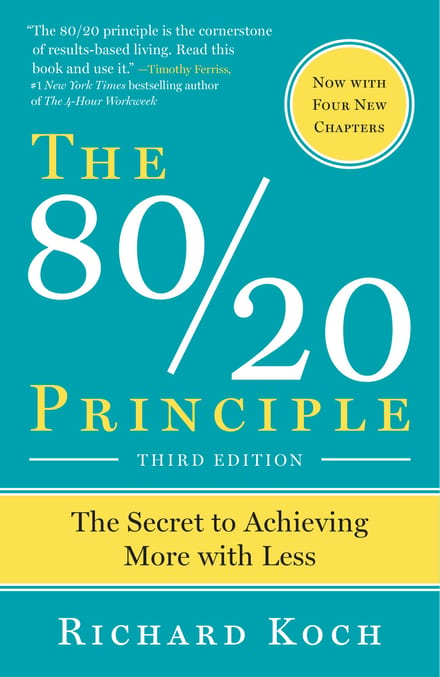
The 80/20 Principle: The Secret to Achieving More with Less
The full book runs ~283 pages — roughly 5 hours of reading. You get the key ideas here in 2 minutes.
The key ideas
- Recognize that inputs and outputs are wildly imbalanced everywhere
- Simplify business ruthlessly—complexity breeds hidden overhead that kills profits
- Serve your most profitable 20% instead of chasing everyone
- Be intelligently lazy: maximize output per unit of effort
- Stop low-value work rather than cramming more tasks in
- Protect the small slice of life that creates real joy
The summary
Look closely at almost any outcome in your life and you’ll find it rests on a thin slice of its causes. Twenty percent of a company’s products bring in 80 percent of its sales. Twenty percent of criminals commit 80 percent of crimes. Twenty percent of motorists cause 80 percent of accidents, and 20 percent of your carpet takes 80 percent of the wear. The exact numbers don’t matter, and they don’t have to add up to 100 — 99/10 or 70/30 would make the same point. What matters is the shape: inputs and outputs are wildly out of balance, and most of your energy is buried in the unproductive majority.
Richard Koch calls this the 80/20 Principle, after the economist Pareto who first spotted the pattern, and he treats it as the most useful idea most people manage to ignore. We ignore it because it offends our sense of fairness. We expect effort and reward to line up: work twice as hard, get twice as much. But balance is the exception. Imbalance is the natural state of things, driven by feedback loops that magnify small early differences. A slightly larger goldfish reaches food more easily and grows disproportionately bigger. Someone who starts with a little more money finds it easier to make more. Tiny head starts compound into enormous gaps.
That is both the problem and the opening. If a fraction of what you do creates most of what you value, then finding that fraction and pouring your energy into it — while cutting the rest — multiplies your results without adding a single hour of work. Most people do the reverse. They spread themselves evenly across everything and end up exhausted and average.
Business grows by subtraction
Complexity is what quietly kills profit. Carry too many products or chase too many kinds of customer, and hidden overhead explodes: more managers, more systems, more meetings to hold it all together. Koch puts it flatly — “the unprofitable business is so unprofitable because it requires the overheads and because having so many different chunks of business makes the organization horrendously complicated.” The genuinely profitable core, usually small, barely needs those overheads at all.
So the move is to find your vital few and let the rest go. One Bible salesman built his success by selling only to previous customers. A real estate agent earned over a million dollars in commissions from repeat clients. Koch credited his own consulting firm’s success to tackling clients’ most important 20 percent of issues instead of trying to fix everything. Doing less, better, beats doing more, worse — and it serves customers too, who get clarity and speed instead of a bewildering menu. The same lens works in negotiation: identify the handful of points that actually decide the outcome and fight for those, rather than scattering effort across every clause.
Be intelligently lazy
General Von Manstein once sorted his officers along two axes, intelligence and effort, and concluded that the intelligent but lazy ones belonged at the top. They instinctively look for the highest-impact move and skip everything else. That’s not shirking. It’s refusing to confuse motion with progress.
Traditional time management pushes the opposite: cram more tasks into the day, squeeze the calendar tighter. It leads straight to burnout, because the problem was never speed. Most of what fills your schedule contributes almost nothing. The 80/20 approach frees time instead of filling it. Take a hard look at the inefficient 80 percent of your work — the meetings no one needs, the reports no one reads, the clients who cost more than they pay — and cut it. Then give the freed hours to the 20 percent that actually moves things.
Most of your life is spent in low-quality ways
The same imbalance runs through your personal life. Roughly a fifth of your friendships supply most of the real connection and joy; a small share of your activities produces most of your happiness, while long stretches — including hours in an unrewarding job — give back almost nothing. “It is not shortage of time that should worry us,” Koch writes, “but the tendency for the majority of time to be spent in low-quality ways.” You can’t fix that by adding one more errand. You fix it by naming the activities that make you happy and clearing space for them.
Koch’s own shortlist of what feeds a good life is telling: exercise, mental stimulation, spiritual or artistic stimulation, doing a kindness for someone, taking a pleasure break with a friend, giving yourself a treat, and congratulating yourself. Notice what isn’t there. Not “answer every email.” Not “work harder.” Most of what crowds your day doesn’t make the list at all.
The bottom line
If you’re working hard and still feel stuck, you’re almost certainly spread thin across low-value activity. Name the vital 20 percent, protect it, and cut the rest — that’s how you achieve more with less. Read this if you’re overworked, overwhelmed, and tired of effort that doesn’t pay off.
Fact check
Popular books repeat findings that later research has complicated. Where The 80/20 Principle makes a testable claim, here's what the evidence actually shows.
A small minority of criminals commits the bulk of crime — roughly 20 percent of offenders accounting for 80 percent of offences.
The concentration is real but consistently milder than 80/20. Tracking 2.4 million Swedes born 1958-1980, researchers found that 1 percent of the population — 24,342 persistent violent offenders, about a quarter of everyone ever convicted of a violent crime — accounted for 63 percent of all violent crime convictions over three decades. So the honest shape is nearer a quarter of offenders producing two-thirds of convictions than a fifth producing four-fifths, and the counts are convictions, not crimes committed.
- Falk O, Wallinius M, Lundstrom S, Frisell T, Anckarsater H, Kerekes N. The 1% of the population accountable for 63% of all violent crime convictions. Soc Psychiatry Psychiatr Epidemiol. 2014;49(4):559-71. PubMed
About 20 percent of motorists cause 80 percent of traffic accidents.
Traffic researchers gave this argument a name — the percentage fallacy — because the split is an artifact of how long you watch. Of roughly 6 million licensed British drivers in 1952, no more than 200,000 were involved in an injury accident that year, so 4 percent of drivers had 100 percent of the accidents; over a single hour it was 0.004 percent of drivers having 100 percent of them. Crash counts for the same people in consecutive periods correlate close to zero, and the mid-century reviews that dismantled "accident proneness" concluded that chance dominates and any stable individual proneness is of small practical importance.
- Haight FA. Accident Proneness: The History of an Idea. Working paper UCI-ITS-WP-01-2. Irvine, CA: Institute of Transportation Studies, University of California, Irvine; 2001. Source
The lopsided 80/20 relationship between inputs and outputs is a near-universal pattern, showing up in essentially any domain you care to examine.
Skewed distributions are genuinely common, but the everywhere-you-look version does not survive testing. Clauset, Shalizi and Newman applied maximum-likelihood fitting and goodness-of-fit tests to 24 datasets previously claimed to follow power laws — the distribution family the 80/20 shape belongs to — and found some consistent with the data while others were ruled out; they also showed that the eyeballed log-log fits behind many such claims give substantially inaccurate estimates. Where a power law does hold, its exponent varies by domain, so the real split ranges from far steeper than 80/20 to nearly even. The book is careful to say the exact numbers do not matter, and that caution is well placed — the shape is a useful prompt to look for concentration, not a constant you can assume.
- Clauset A, Shalizi CR, Newman MEJ. Power-law distributions in empirical data. SIAM Rev. 2009;51:661-703. Source
Frequently asked questions
What is The 80/20 Principle about?
It observes that inputs and outputs are wildly out of balance, so a thin slice of causes, often around 20 percent, produces most of the results, whether that's sales, accidents, or carpet wear. Richard Koch treats this imbalance as the most useful idea most people ignore, because if a fraction of what you do creates most of what you value, you can multiply results by concentrating there and cutting the rest.
What are the key takeaways from The 80/20 Principle?
In business, growth often comes by subtraction, since complexity and its hidden overhead quietly kill profit, so you find your vital few products and customers and let the rest go. Be "intelligently lazy": General Von Manstein put the smart-but-lazy officers at the top because they look for the highest-impact move and skip the busywork. Traditional time management makes things worse by cramming in more; the 80/20 approach frees time instead. The same lens applies to life, where a fifth of your friendships and activities supply most of your joy, so name what makes you happy and clear space for it.
Who should read The 80/20 Principle?
It's for people who are overworked, overwhelmed, and tired of effort that doesn't pay off, and who suspect they're spread thin across low-value activity.
Is The 80/20 Principle worth reading?
Its lasting value is one powerful, repeatable lens applied across business, work, and personal life, with the freeing insight that doing less but better beats doing more. Because it circles that single idea at length, readers who grasp the principle quickly may find the book repetitive and wish for a shorter treatment.