Book summary
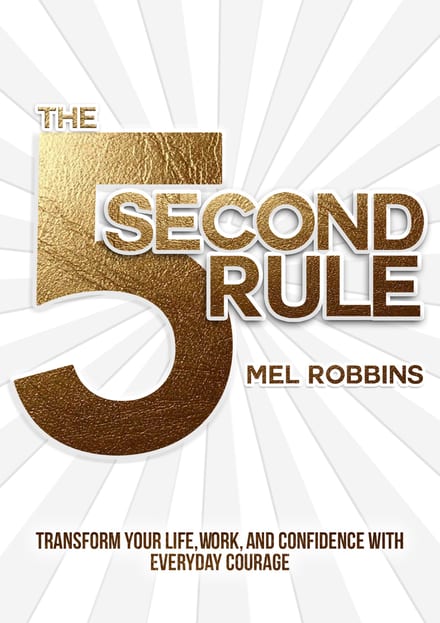
The 5 Second Rule: Transform Your Life, Work, and Confidence with Everyday Courage
Transform Your Life, Work, and Confidence with Everyday Courage
The full book runs ~246 pages — roughly 5 hours of reading. You get the key ideas here in 5 minutes.
The key ideas
- Feel the instinct, count 5-4-3-2-1, then physically move — that's the whole rule.
- Counting up fails: after 'one' there is nowhere left to go but movement.
- Your feelings decide first, and you will never feel like doing the hard thing.
- The countdown is a starting ritual that interrupts hesitation before excuses arrive.
- Procrastination is stress relief, not laziness — forgive yourself, then start small.
- Anxiety and excitement are the same arousal; call it excitement and move.
The summary
In 2009 Mel Robbins was forty-one, out of work, and hitting the snooze button three or four times a morning. Liens were arriving at the house, checks were bouncing, and her husband’s pizza company had expanded into a second restaurant and a wholesale operation, both sinking. She was drinking too much and blaming Chris for the mess. One night a television commercial caught her eye — a rocket on the pad, the countdown, smoke, launch — and she thought she’d throw herself out of bed the same way, moving too fast to talk herself out of it. The next morning the alarm rang, the dread arrived on schedule, she counted 5-4-3-2-1, and stood up. That is the book.
The rule fits on an index card
Here it is, in her words: “The moment you have an instinct to act on a goal you must 5-4-3-2-1 and physically move or your brain will stop you.” Count backwards, silently or out loud, and move on one. Counting forward doesn’t work, she argues, because you can always keep counting; after “one” there is nowhere left to go but movement. Five seconds is roughly the gap between an impulse and your mind killing it, and she’s happy for you to shorten it — a friend training for a Tough Mudder cut his to three: “In 5 seconds I can make up at least 2 excuses in my mind.”
She draws one distinction that’s sharper than anything else in the book. “Just Do It” is a concept: what you need to do. The Rule is a tool: how you make yourself do it. She isn’t offering a reason to act. She’s offering a physical interruption to run at the moment reasons stop working.
You’re losing to your feelings, not your willpower
The premise underneath is that you don’t choose with logic, you choose with feeling and narrate the logic afterward. Robbins leans on neuroscientist Antonio Damasio, who found that people with damage to the emotional regions of the brain could lay out the pros and cons of any choice and then not make it — “what do I want to eat” became paralyzing. Human beings, in his phrase, are “feeling machines that think,” not thinking machines that feel.
So when you ask yourself “should I get up,” what you’re actually asking is “do I feel like getting up,” and at 6 a.m. the answer is permanently no. Robbins is blunt about where that leads: motivation is a myth, you will never feel like it, and waiting to feel ready is how people lose decades. Hesitation is the trigger. A pause before something hard signals to your brain that something must be wrong, and it moves into protection mode. You don’t hesitate before pouring coffee. You hesitate before the sales call — and the longer you think about the call, the less likely you are to make it.
The science came after the countdown, and she says so
Robbins invented the countdown first and went looking for an explanation later. She’s a lawyer, and she describes the research exactly that way: she hunted for “precedent, evidence, and guidance” as if she’d have to prove the Rule to a jury. Three years of that produced a vocabulary. The countdown is a “starting ritual” that interrupts a habit loop and activates the prefrontal cortex. The shove past resistance is Mihaly Csikszentmihalyi’s activation energy — the initial burst that’s always bigger than what it takes to keep going. Acting instead of waiting builds an internal locus of control, Julian Rotter’s 1954 idea that believing you steer your own life predicts how it goes.
None of that research was conducted on the Rule. It’s a set of established findings assembled around a countdown after the fact, and the science chapters read better held that way. What survives the skepticism is modest and real: a starting ritual is a documented way to break a habit loop, and moving before you’ve finished deliberating is a sensible way to run one.
What she says it fixes, and what she says it doesn’t
She sorts the uses into three: change your behavior, act with courage, control your mind. The best chapter is on procrastination, where she reports Timothy Pychyl’s nineteen years of research: it’s not laziness or poor time management but a coping mechanism for stress you’re carrying somewhere else — money, a marriage, life. The fix is three-part. Forgive yourself first (students who forgave themselves procrastinated less on the next test), picture the person you’re trying to become, then use the countdown to start for fifteen minutes. Her anxiety chapter is nearly as good: anxiety and excitement are the same physiological arousal, and telling yourself “I’m excited” beats telling yourself to calm down, because you can’t take a body from sixty to zero. Her eleven-year-old repeated “I’m excited to sleep over” for a six-mile drive, and it worked.
The limits are stated plainly, mostly by her: the Rule doesn’t make anything easy, it makes it happen. It works every time you use it — but only while you use it, and if you stop, fear creeps back in. It gets you started and supplies no plan for what comes next. And on serious mental health she is more careful than the packaging suggests: if you’re in a hole you can’t climb out of, get professional help and possibly medication. She took Zoloft for nearly two decades before coming off it.
The bottom line
The idea is genuinely useful and takes ten seconds to learn: when you catch yourself hesitating, count backwards and move before your brain assembles the case against you. Everything after that is testimonials — social media posts, reader emails, the same arc retold by a hundred strangers — which builds conviction rather than content. Read it if you already know what you should be doing and keep not doing it; if you want an argument rather than a push, this isn’t the book.
Fact check
Popular books repeat findings that later research has complicated. Where The 5 Second Rule makes a testable claim, here's what the evidence actually shows.
You decide with feeling and invent the logic afterward — patients with damage to the emotional regions of the brain can weigh the pros and cons of a choice and still not make it.
The clinical observation holds up. Bechara, Damasio, Damasio and Anderson showed that patients with ventromedial prefrontal damage kept normal intelligence yet were, in the paper's words, "oblivious to the future consequences of their actions," guided by immediate prospects on a gambling task built to imitate real-life choice. The broader theory built on those cases — that bodily emotional signals steer decision-making — is far less settled: a review of the lesion, imaging and drug evidence concluded the causal link from bodily feedback to performance was unproven and that alternative explanations fit the data equally well. The patients are real; "feelings decide first and reason narrates" is a bigger claim than those cases establish.
- Bechara A, Damasio AR, Damasio H, Anderson SW. Insensitivity to future consequences following damage to human prefrontal cortex. Cognition. 1994;50(1-3):7-15. PubMed
- Dunn BD, Dalgleish T, Lawrence AD. The somatic marker hypothesis: a critical evaluation. Neurosci Biobehav Rev. 2006;30(2):239-71. PubMed
Procrastination is a coping response to stress rather than laziness or poor time management.
The half about time management is right. Steel's meta-analysis of 691 correlations found procrastination predicted most strongly by task aversiveness, low self-efficacy, impulsiveness and low conscientiousness — a self-regulation problem rather than a scheduling one, and not laziness. But the drivers that emerged sit in the task itself and in impulse control, with neuroticism only weakly related, so stress carried in from elsewhere is one plausible mechanism among several rather than the established explanation.
- Steel P. The nature of procrastination: a meta-analytic and theoretical review of quintessential self-regulatory failure. Psychol Bull. 2007;133(1):65-94. PubMed
Students who forgave themselves for procrastinating went on to procrastinate less before the next exam.
One study reports this, with real limits. Wohl, Pychyl and Bennett followed students across two consecutive midterms and found that those who forgave themselves for procrastinating before the first exam procrastinated less before the second, an effect they traced to reduced negative feeling about the earlier delay. The design was correlational, not an experiment, and the association held only among students who had procrastinated heavily the first time — so it shows a pattern in one student sample rather than evidence that deliberately forgiving yourself causes the change.
- Wohl MJA, Pychyl TA, Bennett SH. I forgive myself, now I can study: how self-forgiveness for procrastinating can reduce future procrastination. Pers Individ Dif. 2010;48(7):803-808. Source
Anxiety and excitement are the same physiological arousal, so telling yourself "I'm excited" works better than trying to calm down.
The original experiments back it: across singing, public speaking and math tasks, people told to say "I am excited" felt more excited and performed better than those told to relax. Pooled across later randomized trials the gain is small — a meta-analysis of 44 effect sizes found an average performance improvement of d = 0.23, strongest for public performance tasks and not significant for stress-mindset instructions alone. An earlier meta-analysis found reappraisal reliably lowered how stressed people said they felt but produced no measurable change in physiological stress markers such as cortisol and cardiovascular output, so the relabel shifts the experience more than the body it is supposedly renaming.
- Brooks AW. Get excited: reappraising pre-performance anxiety as excitement. J Exp Psychol Gen. 2014;143(3):1144-58. PubMed
- Bosshard M, Gomez P. Effectiveness of stress arousal reappraisal and stress-is-enhancing mindset interventions on task performance outcomes: a meta-analysis of randomized controlled trials. Sci Rep. 2024;14(1):7923. PubMed
- Liu JJW, Ein N, Gervasio J, Vickers K. The efficacy of stress reappraisal interventions on stress responsivity: a meta-analysis and systematic review of existing evidence. PLoS One. 2019;14(2):e0212854. PubMed
Frequently asked questions
What is The 5 Second Rule about?
It's about one habit: the moment you feel an instinct to act, count backwards 5-4-3-2-1 and physically move before your brain talks you out of it. Mel Robbins invented it in 2009, broke and out of work, to stop hitting the snooze button, and built the book around the claim that hesitation — not laziness — is what keeps people stuck. The countdown isn't a reason to act; it's a tool you run at the moment reasons have already failed.
What are the key takeaways from The 5 Second Rule?
Four ideas carry the book. Your feelings decide before logic does, so waiting to feel motivated means waiting forever. The countdown works as a starting ritual — it interrupts the hesitation habit and gets you moving before excuses arrive; counting up doesn't work, because you can always keep counting. Procrastination isn't laziness but a way of coping with stress from elsewhere in your life, and the fix is to forgive yourself, picture who you're trying to become, then start for fifteen minutes. And anxiety and excitement are the same physical arousal, so labeling it excitement beats trying to calm down.
Who should read The 5 Second Rule?
Anyone who already knows exactly what they should be doing — the gym, the phone call, the hard conversation — and keeps not doing it. It's aimed at the gap between knowing and starting, not at people looking for a strategy or a plan.
Is The 5 Second Rule worth reading?
The core idea is genuinely useful and takes about ten seconds to learn, and the chapters on procrastination and anxiety are solid, well-sourced practical advice. But the book is one small idea surrounded by hundreds of reader testimonials and social media posts, and the supporting science was gathered after the countdown was invented rather than tested on it. If you want an argument rather than a push, skip it — you can take the rule itself from the first few chapters and lose nothing.