Book summary
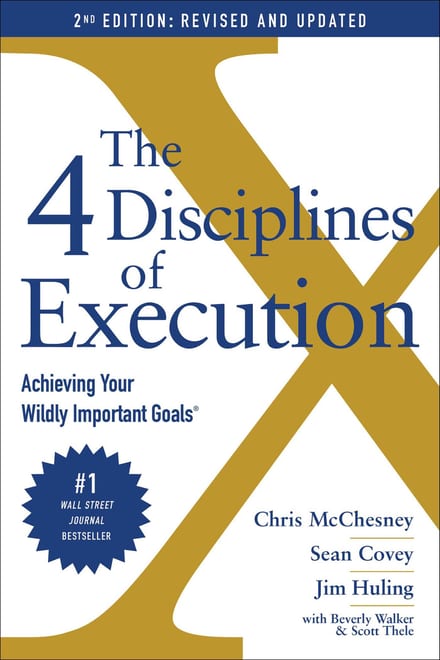
The 4 Disciplines of Execution: Achieving Your Wildly Important Goals
Achieving Your Wildly Important Goals
The full book runs ~352 pages — roughly 6 hours of reading. You get the key ideas here in 5 minutes.
The key ideas
- Pick one wildly important goal your team wouldn't reach on autopilot.
- Act on lead measures — weekly behaviors you control, not lagging results.
- Shape the goal as from X to Y by when.
- Build a players' scoreboard anyone can read in five seconds.
- Meet twenty minutes weekly; commit to the room, not the boss.
- Know the evidence is FranklinCovey's own client data, with no control group.
The summary
Most strategies don’t fail on the whiteboard. They fail because the people who have to carry them out already had a full week before the strategy showed up. Chris McChesney, Sean Covey and Jim Huling gave the culprit a name — the whirlwind, “the massive amount of energy necessary just to keep an operation going on a day-to-day basis” — and their claim is blunt: the whirlwind is “the real enemy of strategic execution.” Not because it’s wasteful — because it’s urgent, and urgency wins out every time. Nobody chooses the day job over the strategy. It simply arrives first, every morning, and the strategy waits.
That premise narrows what the book is for. If your plan can be carried out by signing something — buying a company, changing a price — you don’t need this. 4DX is for the harder case: the strategy that only works if a lot of people behave differently while still doing everything they already did.
The whirlwind wins because nobody argues with it
The evidence they lean on is their own firm’s survey work. FranklinCovey commissioned Harris Interactive to field its Execution Quotient questionnaire to 12,182 U.S. workers in November 2003. Only 44 percent said their organization had clearly communicated its most important goals. A separate FranklinCovey study of 26,500 respondents across more than 150 companies found that just 15 percent could name their organization’s top three goals. Take them for what they are — an online panel, explicitly not a probability sample, run by the firm selling the cure — and the shape will still be familiar to anyone who has worked in a large company.
The response is four disciplines, and the authors insist on the order — each only works standing on the one before it.
- Focus on the wildly important. One goal per team, two at the outside — the one that won’t happen unless it gets special attention.
- Act on the lead measures. Track the few weekly behaviors that predict the goal.
- Keep a compelling scoreboard. Everyone can see whether they’re winning, right now.
- Create a cadence of accountability. A short weekly meeting where people commit in front of each other.
Lead measures are the part that’s actually new
Most goal systems stop at the number you want. 4DX calls that a lag measure — revenue, profit, retention, weight — and the problem is in the name: by the time you can read one, the performance that produced it is already over. You can stare at last quarter’s revenue as long as you like. It will not move.
A lead measure is what you do instead, and it must pass two tests: it predicts the lag measure, and your team can move it this week. The teaching example is domestic. Your weight is the lag measure; diet and exercise are the lead measures. You don’t control the scale. You control what you eat on Tuesday. “Think of a lead measure as a lever that moves your Wildly Important Goal.”
The goal itself gets a fixed shape — from X to Y by when — so it carries a start, a finish and a date. The authors’ own example, from a 2012 interview: increase the percent of annual revenue from new products from 15 percent to 21 percent by December 31. That’s a sentence you can be wrong about, which is the point.
A scoreboard for the players, and a twenty-minute meeting
Discipline three brings the sports metaphor and the book’s most quoted line: people play differently when they’re keeping score. Not the score the coaches keep — the dense dashboard with everything on it — but a players’ scoreboard, a few simple graphs showing where you should be and where you are. The test is five seconds: if nobody can tell that fast whether the team is winning, it’s the wrong scoreboard. “Great teams know at every moment whether or not they are winning,” McChesney says.
Discipline four is a weekly meeting capped at twenty minutes, held no matter what else is on fire. Three moves: report on last week’s commitment, say what it did to the scoreboard, then commit to one or two things for the week ahead. The commitments come from the person doing the work, not the manager, and they’re made to the room. That’s the mechanism. People will work hard to avoid disappointing their boss; they work harder to avoid disappointing the people sitting next to them.
Consulting data, not independent research
Be clear-eyed about the proof. When the first edition shipped in 2012, FranklinCovey said the model came out of more than a decade of work with over 13,000 teams and 200,000 people; by the revised edition in April 2021 that had become “more than 100,000 teams” and nearly twenty years. Those are counts of the firm’s own client engagements, self-reported, with no control group. Clayton Christensen wrote the foreword and called it a book every leader should read; J.W. Marriott Jr. supplied an endorsement, and Marriott was a client, one McChesney implemented personally alongside the State of Georgia. None of that makes the method wrong. It does mean the book is the front door to a consulting practice, an app and a proprietary execution score.
Worth knowing what it isn’t. Doerr’s OKRs give you the architecture of what to aim at; FranklinCovey’s own pitch is that OKRs “don’t provide a structured framework for execution.” 4DX is the rhythm underneath — thinner as goal-setting, more useful on a Monday morning. And unlike Gary Keller’s ONE Thing, this isn’t about defending your calendar. It’s for the leader whose goal depends on twenty other people changing what they do.
The bottom line
Pick one goal your team wouldn’t reach on autopilot, find the weekly behavior that predicts it, put it on a scoreboard anyone can read in five seconds, and meet for twenty minutes every week to commit and report. The disciplines are ordinary; running all four while the whirlwind screams is the hard part, and that’s the book’s real subject. Read it if you’re a manager who already knows the goal and keeps watching the quarter vanish into the day job.
Fact check
Popular books repeat findings that later research has complicated. Where The 4 Disciplines of Execution makes a testable claim, here's what the evidence actually shows.
Most workers can't name their organization's most important goals — only 44 percent say those goals were ever clearly communicated.
The number is reported faithfully. FranklinCovey's own xQ report, fielded online by Harris Interactive to 12,182 full-time U.S. workers between 11 and 20 November 2003, puts it at exactly 44 percent, alongside 58 percent who said their organization had even decided what its top goals were and 14 percent who said their team stayed diligently focused on them. What the figure can't carry is the weight of a national estimate: respondents came from an opt-in internet panel, and FranklinCovey states plainly that the survey is not a probability sample, so weighting nudges it toward census proportions without making it random. The firm publishing the diagnosis also sells the treatment, which is a reason to read the shape rather than the decimal.
4DX is a proven formula, validated by two decades of study across tens of thousands of teams.
What backs the method is a tally of client engagements, not a test of it. FranklinCovey's framing for the 2021 revised edition is nearly twenty years of studying why execution fails and more than 100,000 teams that have used the system across business, government and education. Those are organizations that hired the firm and were measured with the firm's own instruments — no control group, no randomization, and no outcome data anyone outside the company can audit. That absence isn't evidence the disciplines fail; it just means the book's confidence rests on scale of adoption rather than on a result anyone else could check.
One specific goal, weekly tracking of the behaviors that drive it on a scoreboard everyone can see, and a commitment made out loud to your team is what turns a strategy into execution.
The parts have the research base the whole method lacks, and they point the same way. Goal-setting theory, summarized across 35 years of experiments, is one of the most replicated findings in organizational psychology: specific, difficult goals produce higher performance than vague ones or an instruction to do your best. A meta-analysis of 138 randomized experiments (N = 19,951) found that prompting people to monitor progress toward a goal raised attainment by d = 0.40 (95% CI 0.32 to 0.48), and the effect was larger when the information was physically recorded and when results were reported or made public. That is a fair description of a scoreboard on the wall and a Monday meeting where you say what you did — which is the mechanism 4DX is built on, arrived at independently.
- Locke EA, Latham GP. Building a practically useful theory of goal setting and task motivation: a 35-year odyssey. Am Psychol. 2002;57(9):705-17. PubMed
- Harkin B, Webb TL, Chang BP, Prestwich A, Conner M, Kellar I, Benn Y, Sheeran P. Does monitoring goal progress promote goal attainment? A meta-analysis of the experimental evidence. Psychol Bull. 2016;142(2):198-229. PubMed
Frequently asked questions
What is The 4 Disciplines of Execution about?
Most strategies don't fail on the whiteboard — they fail because the people who have to carry them out already had a full week. McChesney, Covey and Huling call that the whirlwind, the energy needed just to keep an operation running day to day, and it wins because it's urgent and arrives first every morning. 4DX is a four-part discipline for the harder case: a strategy that only works if a lot of people behave differently while still doing everything they already did.
What are the key takeaways from The 4 Disciplines of Execution?
The four disciplines have to be run in order, each standing on the one before. Focus on the wildly important: one goal per team, two at the outside, shaped as from X to Y by when. Act on the lead measures: the few weekly behaviors that predict the goal and that your team can actually move this week, as against lag measures like revenue or weight that only report performance already over. Keep a compelling scoreboard — a players' scoreboard, not the coaches' dashboard, passing the five-second test for whether the team is winning. Create a cadence of accountability: a weekly meeting capped at twenty minutes where people report on last week's commitment, its effect on the scoreboard, and commit to one or two things in front of each other.
Who should read The 4 Disciplines of Execution?
A manager who already knows the goal and keeps watching the quarter vanish into the day job. It's aimed at the leader whose goal depends on twenty other people changing what they do, not at someone defending their own calendar.
Is The 4 Disciplines of Execution worth reading?
The mechanics are genuinely useful — lead measures and the twenty-minute weekly meeting are specific enough to run on Monday morning, and the disciplines are ordinary in a way that makes them repeatable. Be clear-eyed about the proof, though: the numbers are FranklinCovey's own client engagements, self-reported with no control group, and the book is the front door to a consulting practice, an app and a proprietary score. Skip it if your plan can be carried out by signing something, or if you want goal-setting architecture rather than the rhythm underneath it.