Book summary
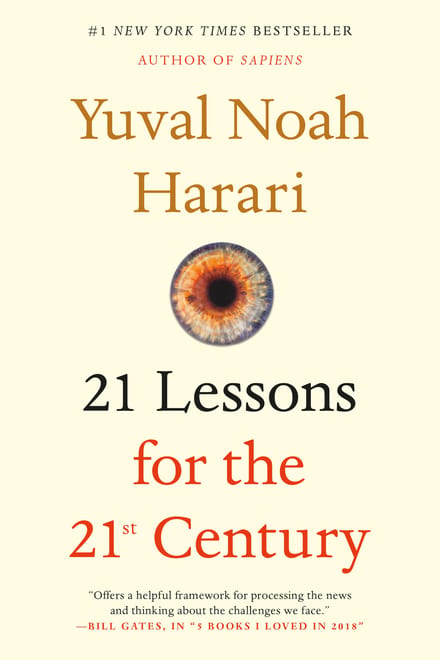
21 Lessons for the 21st Century
The full book runs ~400 pages — roughly 7 hours of reading. You get the key ideas here in 6 minutes.
The key ideas
- Beware a data-owning elite ruling an economically useless class.
- Fear unconscious algorithms concentrating power, not sentient rebel robots.
- Prioritize real killers like pollution over headline-grabbing terrorism.
- Reject nationalist fictions; global problems demand global cooperation.
- Teach adaptability and critical thinking, not soon-obsolete skills.
- Find meaning by observing suffering, not chasing comforting myths.
The summary
The people who own the data and biotech of this century may end up owning everything, including us. That threat runs under all twenty-one of Harari’s essays. Whoever masters the ability to predict and shape human behavior at scale could fracture our species into a genetically and cognitively enhanced elite and a vast underclass with no economic use at all. The old stories that once organized political life—fascism, communism, liberal democracy—all spread through simple emotional narratives rather than data, and any story that wants to matter now has to make sense of artificial intelligence, big data, and bioengineering. That is hard, because humans have always been better at building tools than foreseeing what they do. It is easy to dam a river; it is nearly impossible to predict what the dam does to the whole ecosystem. The same goes for redirecting the flow of our own minds.
When the machines can do your job
Automation is coming for far more than assembly lines. AI will outperform not just drivers but radiologists and lawyers, and it could produce a “useless class”—not people who lack talent, but people the economy no longer needs. New jobs will appear, but maybe not enough, and not fast enough for the displaced, so societies may have to try ideas like universal basic income. The safer bet is to cooperate with AI rather than compete against it. But the deeper question isn’t how people will earn a wage; it’s what they will do with themselves once they are no longer necessary.
Who owns the data owns the future
Globalization was supposed to spread equality. Instead, AI and biotech could build the most unequal societies that have ever existed, because a small group owning the algorithms and enhancement technology could turn itself into a superior caste. So the decisive question is ownership: do the data belong to corporations, governments, individuals, or some shared model nobody has built yet? This isn’t a far-off worry—algorithms already run pieces of finance, policing, and war. In 2017, Israeli forces monitoring the West Bank arrested a Palestinian laborer who had posted a photo beside a bulldozer captioned “Good morning!"—Facebook’s translation software rendered it as “Kill them.” He was released once the mistake surfaced, but the machinery that flagged him stayed in place. We keep handing decisions to systems like this, forgetting that intelligence and consciousness are not the same thing. Intelligence solves problems; consciousness feels pain, joy, love. The algorithms have the first and none of the second, which is why the science-fiction fear of rebel robots misses the real danger: unconscious systems concentrating power in very few hands.
The clash of civilizations that isn’t
Online life can’t replace offline life, because you have a body that needs presence and touch, not a feed. And for all the talk of a clash between the West and Islam, the world has converged into essentially one global civilization—on political systems, economics, even how we see the body and nature. Nationalism papers over this by claiming a nation is superior, where patriotism only claims it is distinctive, and the difference matters because our biggest problems are global: climate change, pandemics, and runaway technology don’t stop at borders. Religion no longer solves technical problems, but it still fuels identity, and identity is what splits us—Eastern Orthodox and Western Christians once divided over the wording of a creed. On terrorism, the panic is more dangerous than the threat: terrorists kill roughly 25,000 people a year while air pollution kills around seven million, yet we reorganize governments around the smaller number.
You know less than you think
No single person understands the modern world. A Stone Age hunter-gatherer could make her own clothes, start a fire, hunt rabbits, and escape a lion. You almost certainly can’t do any of those, yet you rely on strangers’ expertise for nearly everything. Harari calls this the knowledge illusion: our species succeeds by thinking together in large groups, so we individually know far less than we assume. Our sense of justice, evolved for small bands, breaks down in a world where your purchases ripple out to consequences you’ll never see. We have always lived in a kind of post-truth, uniting around useful fictions—but you can still insist on reliable sources and stay wary of a culture that learns about AI from movies about rebel machines. Because change is now the only constant, education has to stop cramming students with facts that expire and start teaching flexibility, critical thinking, and the nerve to keep learning.
Meaning without the story
Life is not a story, which is oddly freeing. Meaning doesn’t arrive from some grand cosmic plot; it comes from facing suffering and impermanence honestly. The Buddha taught three plain realities: everything changes, nothing has an enduring essence, and nothing fully satisfies. Suffering grows when we chase an eternal something—God, nation, soul, true love—and turn bitter when it slips away; the harder we cling, the more we come to hate whatever stands in the way. Morality, in this view, isn’t obeying commands from on high but reducing suffering, and for that you need no myth, only a deep appreciation of pain. Meditation is Harari’s tool for seeing this directly: watch your own sensations and reactions long enough and you notice that suffering springs from the mind’s responses, not from the world itself. Science studies the brain from outside with scanners; this studies the mind from inside, and we could use both.
The bottom line
When no skill and no story stays valid for long, mental flexibility beats any fixed belief. The future belongs to people who can think clearly about who owns their data, refuse nationalist and technological myths, and ground themselves in the reality of change and suffering rather than a fantasy of permanence. Read this if you want a clear-eyed map of the pressures bearing down on the coming decades, and a sober sense of what it will take to stay human through them.
Fact check
Popular books repeat findings that later research has complicated. Where 21 Lessons for the 21st Century makes a testable claim, here's what the evidence actually shows.
Terrorism kills roughly 25,000 people a year worldwide while air pollution kills around seven million, so the political response to terrorism is out of all proportion to the risk.
Both figures check out. Global deaths from terrorism averaged close to 24,000 a year over the decade to 2019, with about 20,000 in 2019 and a peak of nearly 45,000 in 2014 — roughly 1 in 2,000 deaths worldwide, and less than a quarter of the toll from armed conflict. The WHO attributes 6.7 million premature deaths a year to ambient and household air pollution combined, with outdoor air pollution alone responsible for 4.2 million deaths in 2019. The two-orders-of-magnitude gap Harari draws on is real.
AI will outperform skilled professionals such as radiologists, displacing them from their work.
On narrow image-classification tasks the parity is real: a systematic review of 82 studies found pooled sensitivity of 87.0% for deep learning models against 86.4% for health-care professionals on the same samples, and specificity of 92.5% against 90.5%. But only 14 studies made that like-for-like comparison, and the authors reported that few studies presented externally validated results and that poor reporting limits how far the accuracy figures can be trusted. Displacement has not followed — US radiology now faces a workforce shortage driven by rising imaging demand, limited residency places and retirements, with AI discussed in the clinical literature as a way to relieve that shortage rather than replace radiologists.
- Liu X, Faes L, Kale AU, et al. A comparison of deep learning performance against health-care professionals in detecting diseases from medical imaging: a systematic review and meta-analysis. Lancet Digit Health. 2019;1(6):e271-e297. PubMed
- Jing AB, Garg N, Zhang J, Brown JJ. AI solutions to the radiology workforce shortage. NPJ Health Syst. 2025;2(1):20. PubMed
Automation will leave a large share of people economically "useless" — a class the economy no longer has any work for.
Estimates of automation exposure drop sharply once you measure tasks instead of whole occupations. The OECD's task-based analysis of 21 countries put 9% of jobs at high risk of automation, against the 47% of US jobs Frey and Osborne estimated with an occupation-based method — a difference driven by the fact that high-risk occupations still contain many tasks that are hard to automate. Following those same 21 countries over the next decade, the OECD found no support for net job destruction: every country's employment grew, though growth was 6% in high-risk jobs versus 18% in low-risk ones, and the pressure fell hardest on low-educated workers. The squeeze is real, but so far it appears as slower job growth and reallocation rather than a redundant class.
- Arntz M, Gregory T, Zierahn U. The Risk of Automation for Jobs in OECD Countries: A Comparative Analysis. OECD Social, Employment and Migration Working Papers No. 189. Paris: OECD Publishing; 2016. Source
- Georgieff A, Milanez A. What Happened to Jobs at High Risk of Automation? OECD Social, Employment and Migration Working Papers No. 255. Paris: OECD Publishing; 2021. Source
Frequently asked questions
What is 21 Lessons for the 21st Century about?
It warns that whoever masters the data and biotech to predict and shape human behavior at scale could end up owning everything, potentially splitting humanity into an enhanced elite and a vast underclass with no economic use. Across twenty-one essays, Harari asks how we stay human as AI, big data, and bioengineering reshape work, politics, and meaning.
What are the key takeaways from 21 Lessons for the 21st Century?
Automation may create a "useless class" the economy no longer needs, so cooperating with AI beats competing against it. The decisive political question becomes who owns the data, since intelligence and consciousness are not the same and unconscious systems can concentrate power dangerously. The world has largely converged into one global civilization, and our biggest problems, climate change and pandemics, ignore borders, while terrorism triggers panic out of proportion to the harm. Harari also names the "knowledge illusion," our tendency to overrate what we personally understand, and points to meditation and facing impermanence as a way to find meaning without a comforting story.
Who should read 21 Lessons for the 21st Century?
It's for readers who want a clear-eyed map of the pressures bearing down on the coming decades and a sober sense of what it takes to stay human through them.
Is 21 Lessons for the 21st Century worth reading?
It's valuable for connecting big themes, data ownership, AI, nationalism, and meaning, into one accessible argument with sharp examples like the mistranslated "Good morning" arrest. Because it ranges so widely across twenty-one loosely linked essays, readers wanting deep, definitive answers rather than provocative questions may find it more diagnostic than prescriptive.